In the ‘Meet NHK’ session at Sunny Side of the Doc, Shin Yasuda, Head of International Co-productions and Acquisitions at NHK (Japan Broadcasting Corporation), presented a selection of current and future projects and, together with members of his team, highlighted NHK’s acquisition and international co-production opportunities.
This year, NHK is celebrating 100 years in the business. Japan’s sole public service media organization was founded in 1925 after a massive earthquake hit Tokyo and Yokohama. Newspaper publishing houses were decimated as part of the resulting widespread destruction of infrastructure, contributing to the nationwide confusion, chaos and misinformation.
“That’s when the Japanese government realised the need for a nationwide network of radio stations. NHK’s first radio broadcast began in 1925, which then led to the unification of these regional stations to build NHK,” Yasuda explained.
One hundred years on, NHK now has 54 stations across Japan, 29 overseas offices, a domestic audience of 57 million households, a strong track record of documentary co-production and acquisitions, and a keen audience for their doc output in regular weekly and monthly slots across multiple subject strands.
During the ‘Meet NHK’ session Tomoko Okutsu, Commissioning Editor, told the professional audience about NHK’s two main factual content strands dedicated to international acquisition: World Documentary and Dramatic Planet.
Both are prolific strands, with Dramatic Planet acquiring 40 docs per year, and World Documentaries acquiring 80 docs per year, with around 6 international co-pros annually.
Dramatic Planet is science-related, with educational Saturday night programming aimed at families and a particular focus on inspiring stories for children. The company looks to acquire narrative content on the basis that it’s easier for young families to remember. But, documentarians should be aware of a key factor when approaching NHK. “The producer of this channel has been stressing about telling everyone that all content they buy must be dubbed in Japanese, so please have separate audio. This is always a big problem we encounter,” underlined Okutsu.
The NHK World Documentary strand is aimed at audiences interested in world affairs. It’s a diverse slot, Okutsu explained. “We cover a lot of social issues, geopolitics, and so on. However, because it can be so difficult and challenging to watch, we also try to find warm and inspiring stories.”
It’s unlikely though, that a Japanese-themed story will have the chance of being acquired by NHK. “The point is, we want your content to be different from that of our team and our Japanese filmmakers. We might consider a project with exclusive access, a unique story, and perhaps extensive, long research, which would be difficult for a Japanese filmmaker. We would also want it to resonate and offer a new way of seeing the world for our Japanese viewers,” Okutsu added.
That said, the company is more than happy to help with connections. “We’re often approached by filmmakers who are working on projects about Japan. It’s not necessarily for World Documentaries, but… I can connect you to producers on our production team who might be interested in your project.”
Executive Producer Hiroyuki Shirakawa joined the presentation to tell audiences about the NHK co-production approach to their Frontiers doc strand, which covers science, technology, space, medicine, culture, and history.
Frontiers annual output includes 4-6 international co-productions. Similar to acquisitions, the team look to work with co-producers on large-scale projects, or those who have access to projects that are not available to NHK teams and that can be realized through exclusive access. Other key factors for Frontiers would be “new discoveries, historical expertise based on solid science, and mysterious questions that captivate viewers from the very beginning,” Shirakawa tells us.
What submissions tips can the NHK executives give? “We need a synopsis, or if it’s a film that’s already been made, a synopsis and a trailer.” Commissioning Editor Tomoko Okutsu is very clear on this point. “If it’s still in production, send us a rough cut and a treatment. And then, when we go into a budget project, we need a synopsis, a trailer, and a rough cut. That’s what we need to be able to have more detailed discussions,” she explained, before reminding about potential co-pro submissions, that “it really needs to have an urgent story that’s particularly relevant to our Japanese audience. Or stories that are from the inside.”
Shin Yasuda explained the unique technical advantages of co-production with NHK. “Our first international co-production took place in 1980, [using] an in-house science and technology laboratory, which develops various technologies and equipment for production and broadcasting. And it is thanks to this equipment that we were able to find projects to work with our international partners. Often, the projects come from independent filmmakers like yourselves, and our contribution would be our HD equipment. Other times, we provide quirkier equipment that’s suitable for filming underwater or in space. This is how we’ve expanded our co-productions over the years. And of course, in recent years, we’ve increasingly worked with independent filmmakers around the world on more personal and human stories,” he says.
The NHK co-production roster is impressive, one that includes Legends of the Deep – the first film to capture giant squid in its natural habitat – co-produced with ZDF and Arte.
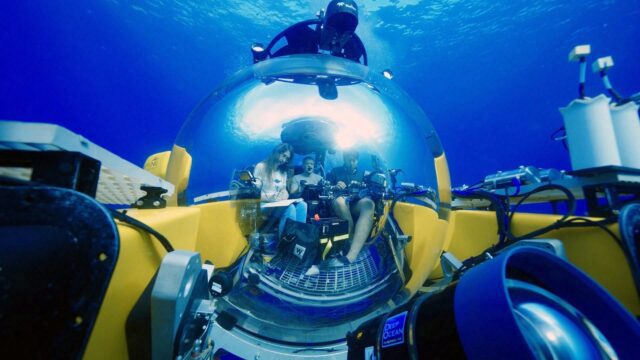
That same team have reassembled to create one of NHK’s most ambitious projects to-date, and the audience were presented with an exclusive preview trailer at the event: Deep Ocean: Kingdom of the Coelacanth, narrated by David Attenborough, co- produced with ZDF/ARTE and OceanX in collaboration with CMMAI. The doc succeeded in a 72-hour non-stop observation filming expedition, and captured, in 8K, the world’s first-ever video images of a group of coelacanths and their behaviour indicative of reproduction.
As a coelacanth is nocturnal in the deep sea, its behaviour has been shrouded in mystery until now. After years of negotiations, the research was conducted aboard the cutting-edge OceanX submersible research vessel.
NHK’s Deep Ocean team has created eight documentaries including this episode, and David Attenborough has narrated all the English versions. The project has already been acquired by the BBC, and PTS – the Taiwanese public broadcaster.
So, what does the next 100 years look like for NHK? Yasuda was unambiguous in explaining the role of public broadcasters such as NHK.
“The role of public service media will always remain important, relevant, and necessary. We don’t know in what form, size, or capacity, but we believe that right now, public service media is still necessary. As I mentioned at the beginning, NHK’s origins began with a natural disaster that resulted in the spread of rumours, and disinformation. [That] happened 100 years ago, and it’s happening now, so for sure we believe that public service media must survive for the next few hundred years.” Yasuda concluded.
Stop press: Run Against Time: The Snowman Race in Bhutan, an NHK/BBS/GEDEON Programmes co-production, has been acquired at Sunny Side French broadcaster Ushuaia TV.