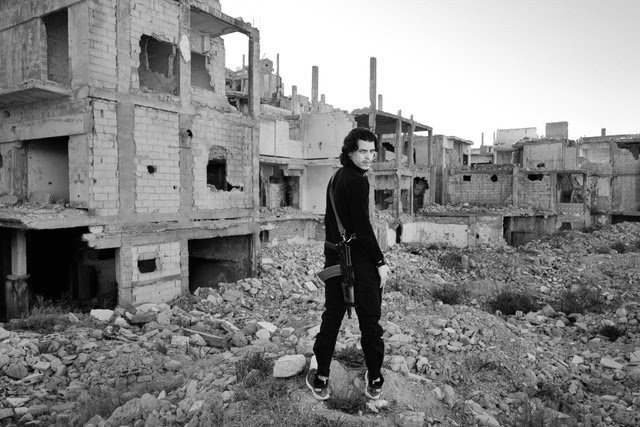
As we see in the NLWave project Idlib by Palestinian director Sakir Khader, life goes on. But it is not a life most will have ever experienced, or could ever begin to imagine.
The film opens in 2018, following three men fighting on the front lines against Assad’s soldiers during the occupation of Syria. These are the famous revolutionary Abdul Basset al-Sarout, his teenage nephew Mohamed, and sniper Abu Dhar. When Sarout dies, it is not only a momentous passing, it is also marks the moment when Mohamed, his successor, is propelled into adulthood.
When the Assad regime falls in 2024/25, Mohamed, now 25, addresses the crowds in Homs, just as his uncle used to do. Later, in 2026, during a period of uneasy peace, with the scent of war still hanging in the air, sniper Abu Dhar, now a farmer, visits the graves of his sons. Mohamed, meanwhile, is getting married this summer, but thinks he was happier during the war…
“This film could have been my life,” says director Khader.
The film is produced by mint film office, who respond to questions posed by BDE. “Many viewers already know Abdul Basset al-Sarout from [Talal Derki’s] Return to Homs, and Idlib continues his story, and that of his nephew Mohamed. The final chapter opens up to the women in Abu Dhar’s family and to the domestic side of the war,” the company explains the film’s appeal to loyal audiences.
What’s more, Idlib offers access that is unique, and which “cannot be repeated,” mint film office adds. “The 2018 footage was filmed by one person, embedded with the fighters for four months, without institutional backing. The black-and-white visual concept makes the film distinctive in a festival programme. It speaks to several audiences at once: observational cinema lovers, the Syrian diaspora, the Return to Homs audience, and a broader public interested in the aftermath of war. [And] the subject is urgent, with renewed Israeli strikes on Syria.”
Idlib is at an advanced stage of finance, with over 80% of the budget in place. The film is in post-production, with a “strong rough cut, Netherlands Film Fund support, a Dutch distributor (Cinema Delicatessen) attached, and completion planned for early 2027.”
“There is a clear open position for a world premiere and a sales agent,” mint film office underlines.
Khader is a filmmaker of much integrity, the company suggests. “As a Palestinian-Dutch filmmaker, he approaches this story with a personal connection to struggles across the Middle East rather than as an outsider reporting on ‘others.’ His way of working comes from photography: he stays, spends time with people and puts them at ease, which creates intimacy that commissioned crews rarely achieve. He films, records sound and photographs himself, so he can work alone in places others cannot reach.”
Khader’s artistic profile is growing internationally, as an associate at Magnum Photos, winner of the Amsterdam Prize for the Arts 2025, two Silver Camera Awards and two Tegel nominations, and his Obada was selected for Golden Calf competition. He works with editor Fatih Tura, winner of the 2023 Golden Calf for Best Editing, who has cut his material since 2018.
“Sakir intends to keep filming in black and white as long as his homeland lives under occupation,” mint film office tells BDE. “The choice gives the images stillness and timelessness, and moves the focus away from war reporting towards the people in it. The camera is observational and patient: wide, steady frames, filmed without a tripod, so there is always a slight movement that keeps the image human. Sakir looks consciously at faces, hands and small gestures, because in war these ordinary images can become the last one you have of someone. His presence is felt throughout: his voice is heard, and the characters speak to him directly.”
Khadir describes his directorial approach. “Many war films focus on the moment of battle, placing the viewer at the heart of the fighting. Few films show the everyday reality of life on the front lines or the ruins that remain after liberation, as mine does,” he says. “What distinguishes my work is its persistence. I do not leave when the news cycle moves on. I stay and return, maintaining an ongoing commitment as a chronicler of life in the Middle East, bringing to light injustice as well as the humanity and dignity of my people. My camera is my weapon in that struggle.”
The company further articulates its strategy for Utrecht. “Through NLWave we want to find the right partners to bring Idlib to an international audience. Our main goal is a world premiere at a major festival that fits observational cinema, and a sales agent who can take the film into international distribution. We also want to meet broadcasters and co-financiers who could close the small remaining gap in our finishing budget.”
“Beyond that, NLWave is a chance to introduce Sakir, as a first-time feature director, to international decision-makers, and to get feedback on how the film and its story land with an international industry audience, so we can sharpen our festival and distribution strategy before completion in early 2027.”