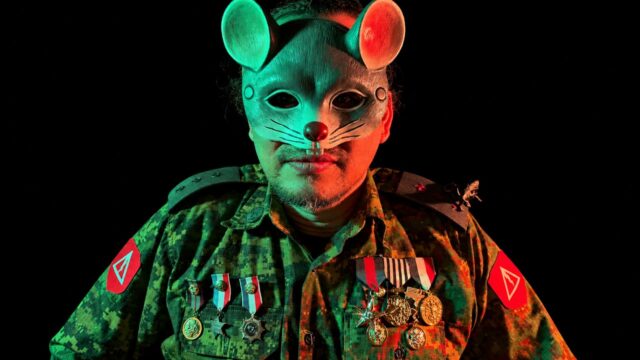
Dutch producer Corinne van Egeraat (ZINDOC) and DOP/Editor Petr Lom are at pains to point out that their NLWave project, What Happened to My Country, What Happened to Me? is a hybrid film, not a hybrid documentary.
Most of the Myanmar Film Collective, whose Myanmar Diaries won the Berlinale Documentary Award in 2022, as well as 15 other international prizes, are no longer in Myanmar, but living in exile in Germany, Thailand and Sweden (although some remain at home, living under pseudonyms). Their new testimonies are told as much in fictional form as documentary, hence van Egeraat and Lom’s unwillingness to pigeon-hole the film as a piece of non-fiction.
It is a film that moves fluidly between dreams and reality, memory and the present, all the time exploring grief, displacement, identity, and resilience. Together, these fragments create a collective portrait of a generation torn apart, but a generation that is still deeply connected to the country it calls home.
Yet it remains a film “from a country that is a brutal dictatorship terrorizing its own people, still almost entirely ignored by the international media, and from which very few voices are heard,” Lom tells Business Doc Europe. It is both a testimony to Myanmar’s continuing tragedy and an imaginative reflection on loss, displacement and the enduring search for home.
There are (at least) four qualities that make their project unique, producer van Egeraat claims. What Happened to My Country, What Happened to Me? builds on the success of Myanmar Diaries, a film from a country with a brutal dictatorship that still terrorizes its own people, a fact that is almost entirely ignored by the international media.
Secondly, the film expresses the emotional and psychological feeling/effects of displacement and exile.
Thirdly, its hybridity. Lom describes one chapter, set in the German Alps, about a Burmese refugee who falls asleep, barefoot in the snow and dies. Woken up by a magical Astral-Transition Specialist, he is informed that his path to either heaven or hell is not straightforward, as he still is lacking the correct immigration papers even in the afterlife.
Fourthly, the film is reinforced by a highly collective work method among the group who can operate with considerably more freedom than on Myanmar Diaries, when each member was forced to work in their individual ‘cell.’ “The strength of the collective is its high level of collaboration – based upon a deep trust – that is a result of a more than 15-year-long relation […] and with us,” van Egeraat tells BDE.
Furthermore, the project is fully financed via the Caleidescoop scheme of the Dutch Film Fund that supports low budget feature films, and further supported by a highly-experienced professional team in the Netherlands to help the Burmese directors reach their highest potential. These include the internationally recognised Dutch/Swiss composer Ella van der Woude – a winner of two Golden Calves and whose filmmaker collaborators include Charlie Kaufman – and the veteran Dutch sound designer Michel Schöpping.
“We hope this will be a film like you have never seen before – not just for its hybrid form/creativity, and often black humour – but especially for giving creative expression to the subjective experience of exile and not belonging here or there,” Lom stresses of the story’s strengths. “Despite the world being tired and saturated with refugee stories, we don’t know of many examples where this subjective psychological experience is creatively explored.”
The 70-80 minute film will be ready for Autumn 2027. In Utrecht the team is looking for a world premiere, international festivals, sales representation and distribution opportunities. “We have high ambitions with this film, and hope to premiere at an A-festival. So it is wonderful to be able to signal to the programmers that our film is coming.”
“This is cinematic storytelling. Patiently and carefully framed cinema. Much more polished, and different than the lo-fi look of Myanmar Diaries,” van Egeraat adds. “The fiction stories are intertwined with documentary testimonies from those participating in the film – not just the Burmese directors – but also Myanmar crew and actors in the film. We use these testimonies while we explore surfaces and vast wide landscape shots. Both because some of the participants still need to remain anonymous, and to emphasize this psychological state of limbo – of being in-between – the landscape as witness, where all voices of the collective become one.”
In their statement, the Myanmar Film Collective underline how safety must remain of paramount importance. “Myanmar Diaries was completely anonymous. Now some filmmakers can appear openly, while others must remain anonymous because visibility would endanger them and their families.
“Working collectively across borders requires trust, flexibility and care. Together, we bear witness to what has happened to our country – and to ourselves.”