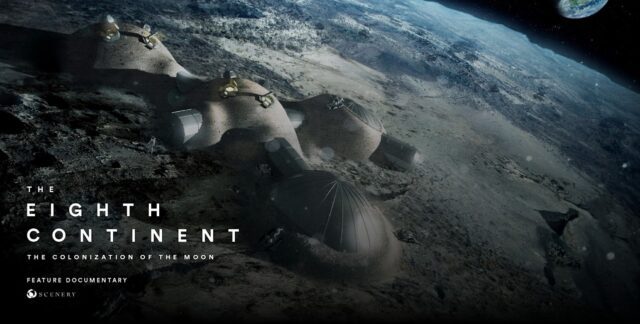
Until recently, only the US and Russia had succeeded in landing on the Moon, directors Luuk Bouwman and Tomas Kaan remind us in their notes for their project The Eighth Continent, produced by Scenery and pitched at NLWave25.
Five years ago, a Chinese robot planted a flag on the lunar surface, and since then, newcomers like Japan, India, the UAE, Israel and Europe have launched their own Moon missions. Why? Because “the Moon might become the launchpad to the rest of the universe,” co-director Bouwman points to Business Doc Europe, and that could yield everyvast riches.
“In 2020 there was the still the dream of an international Moon village where nations would collaborate on missions for all humankind,” he continues. “[But] the war in Ukraine tore apart many long-standing space collaborations with Russia. A new wave of nationalism and commercial enterprise with many players involved is setting up for a new Moon race. The film asks the question: who owns the Moon?”
“Our film…turned out to be a mirror for what is happening on Earth,” he adds. “It digs into bigger themes like power and ownership, trust and distrust, distribution of resources, the commons and the private. That makes it a universal story relevant for international audiences.”
The Eighth Continent therefore raises ethical questions about decision-making around the ownership of natural resources and territories. “To what extent is the process democratic? Or will it be land-grabbing, as in the Wild West? Will tech billionaires, like modern-day robber barons, start mining the resources and become even richer – while the have-nots are left to watch?”
Appropriately, the film draws inspiration from the Western genre. “Thematically, this is a story of pioneers, settlers, barons and valuable resources,” Bouwman underlines. “The deserted lunar landscapes are a new frontier. We don’t intend this Western genre reference to be a pastiche or gimmick, but it is informing our cinematography – the way we look at humans in a larger, panoramic, picture. We are shooting in widescreen cinemascope.”
“Light and dark is an important visual theme in the cinematography,” he continues. “The ‘holy grail’ in the story is a place on the moon called the Peak of Eternal Light. This is the place that many missions are targeting as it would be the best place to settle. There is always sunlight and a crater with ice – which means energy for a sustainable base.”
So far, the pair have filmed in many locations across the world, such as Russia, Japan, the Emirates, France, Germany – and closer to home in the Netherlands where the biggest branch of the European Space Agency is located.
“But the story is grounded in the people we are portraying.” Bouwman underlines. “We get to see how Moon bases are being dreamed up and engineered, from mock-ups held together by scotch tape to large modules in halls. Many involved in the space missions are driven by curiosity and questions on our existence, thinking about the future of humankind, forging international collaborations. And we get a look behind the curtains of who are deciding on the future of the Moon.”
The filmmakers pitched the film at IDFA Forum 2024. So far, partners include the Netherlands Film Fund, Dutch broadcaster HUMAN, German-French broadcaster ZDF-ARTE, Belgian broadcaster VRT and SVT (Sweden). During NLWave, Bouwman is keen to spread the word to as wide an international audience as possible. Sales are handled by Autlook.
Given the vastness of the subject, the filmmakers are also keen to follow the story into the future. “Dreaming ahead, right from the start I had the idea this could become a series of films, of doing a follow-up film in ten years, then 20 years,” says Bouwman. “Like with Michael Apted’s 7UP documentary series – to really follow developments over a long period of time.”