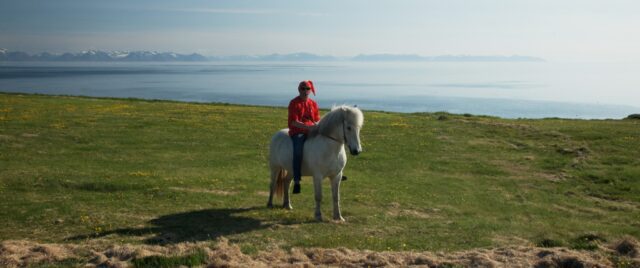
The island of Grímsey, 60km north of Iceland, was once home to a remote but thriving community. Now, as we see in Nikolai Galitzine’s project Islanders, a work in progress at Nordisk Panorama 2025, the island has only 20 permanent residents, two of whom are children, Konni (8) and Bjorn (9).
Climate change has severely affected the remote habitat. It rarely snows there, and sea ice is beyond the memory of most. Fish numbers have diminished over the years and, little by little, the mainland withdrew its support for this tiny community. As folk began to leave, cruise-ship tourism invaded the peace of the last remaining residents. Then the island’s church burned down, taking with it, relics from hundreds of years of their history.
But the remaining community were steadfast and nevertheless rebuilt the church, demonstrating how, despite such fundamental change within their lives, they intended to stay just where they were.
Shot over three years, Galitzine’s film charts daily life on Grímsey, telling of the residents’ rich past and the reality of their lives now, as well as their reflections on the future of such remote communities.
For producer Dögg Mósesdóttir of Northern Wave Productions (Iceland), the feature documentary is “an elegy to a remote community going through upheaval, depopulation and change, as the last two children enjoy this fading life.”
“[Nikolai] is extremely experienced and knowledgeable when it comes to film and film history, and he’s also an exceptional cinematographer,” Mósesdóttir further stresses of director Galitzine. “Another great quality is his humanity, the way he’s approached the community with love and respect. Last but not least is his point of view as a foreigner, and a nomad who has found a sense of belonging on the island of Grímsey.”
She emphasises the amount of time he has dedicated not only to the project but to the island itself. “He became part of the community for years – still is – and even helped them rebuild the church when it burned down.”
In his film notes, Galitzine describes his urge to make the film: “Without the facility to feel the wind, or to smell the ocean, we are left with only sounds and images. And with these tools I aim to take the viewer into a dream state that I have lived for the past year while on Grímsey.”
“At the beginning, I was by chance at a friend’s house when they mentioned they had won the contract to rebuild the church on the island. Having carpentry skills and a curiosity, I allowed myself to be led by instinct. I raised my hand and volunteered to be part of the reconstruction crew, as long as I could also make a film,” he adds of his immersion into island life. “I placed myself as an outsider into the heart of this community who, on the whole, have been incredibly welcoming and generous beyond my expectations.”
“The film is beautifully shot,” producer Mósesdóttir stresses. “Even though it’s a documentary, Nikolai has approached it almost as a fictional film, which gives it an other-worldly and dreamy tone, which is very fitting as the island is, in many ways, other-worldly.”
At Nordisk Panorama, she is looking to pique the interest of distribution and sales outfits, as well as secure a premiere at an A-festival. “Nordisk Panorama has been very supportive towards the film since the beginning. and we have previously been selected to pitch the film at the Forum. We are very grateful for their support.”
“I feel that by observing such epic themes as generational change, isolation and resilience, we can only create something beautiful which will be appreciated universally, as well as by the Grímseyingar themselves,” director Galitzine signs off.