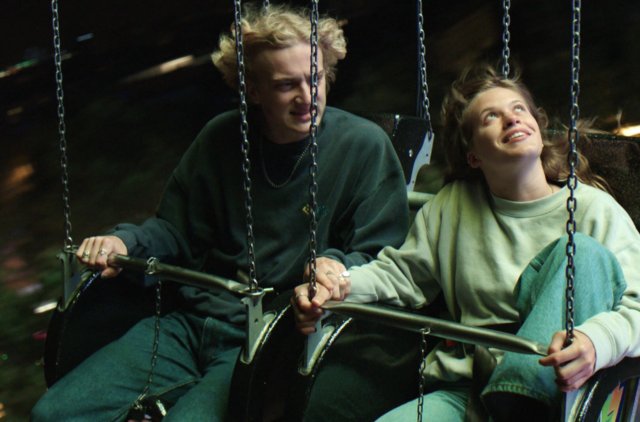
The roots of Kind Hearts, screening in RE>CONNEXT, are found in the feature doc Grands travaux which Olivia Rochette and Gerard-Jan Claes directed in 2016, a film about students within a secondary vocational school in Brussels.
“In that film, which is mostly focused on school life and youngsters growing up, we also had a couple of scenes where they [the male subjects] would talk to their girlfriends,” says co-director Claes. “We thought the ‘going-together’ of these love stories and the way that we set up the mise-en-scène between the writing and improvisation [was] working so beautifully…that we wanted to make a film that was focused entirely on love and more specifically on how youngsters deal with love and the first love experience.”
So the directing pair went in search of two young characters, eventually settling on Billie and Lucas, a young Brussels couple, who are both set to leave for university, where they will face a year of momentous change, replete with existential growing pains, doubts about life and relationships and what the world expects of them.
“We did not set out to make a documentary ‘about’ love, but instead wanted to take a concrete look at a love affair, showing meeting points between the two lovers,” Claes underlines in his notes for the film. “Using their story, we deploy their semi-clichéd but also disarming vocabulary, the language young people use to voice their feelings today, thereby ‘filming’ love in a documentary. The experience of love is closely linked to the experience of narrative; in our minds, we recreate love as an adventure. This notion of love as a construction is also reflected in the form of the film, characterised by its ambivalent place between staging and documentary.”
What also fascinated the directors was “to make a film that had a certain narration [whereby] you could follow a certain love story that portrayed these fragile moments in the life of the youngsters where they are looking at adult life, but not really knowing entirely how to cope with it,” Claes adds. “It’s that moment of transition that really interested us.”
As in most documentaries or closely-observed narrative, a high degree of trust must be built on both sides given “the material that we’re working from, which is their life.”
“We film a lot. So there are in the beginning a lot of things that just don’t work. But at a certain moment, it just clicks,” Claes continues. “We found a collective way of working, them being the characters in the film – or the actors’ characters – and we as filmmakers.”
The film presents such an intimate and authoritative chronicle of young love that one is tempted to assume that there is an academic [I suggest anthropological or sociological] undertow to the exercise. Claes disagrees.
“I think we’re not so much interested in the anthropological element in such that it’s not, I think, a film that wants to say something about the youngsters in absolute terms,” he says, further emphasising how such intimate study of the film’s two youthful subjects enables audiences to wider reflect their our own lives. “I think it’s more related to our love for observation…The face of someone is almost like a landscape that you can discover in itself or that you can dissect as a spectator also.”
Which is why Claes welcomes a broad demographic for the film which is currently in post-production ahead of a Spring 2022 delivery. The RE>CONNEXT pitch notes stress a target audience of teenagers, twenty-somethings… and their parents. “I think it’s a film for everyone in that sense,” Claes underlines. “I think it’s really a film that you should just look at and watch and experience. I know that sounds general, but I think it’s also part of our filmmaking [philosophy] that film should be seen by any group.”