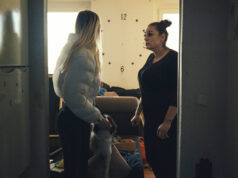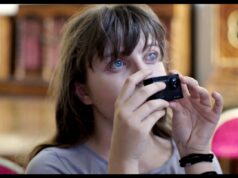
Croatian Silvestar Kolbas may be a successful, award-winning film director, but to his kids he is just a dad, with all the annoying characteristics and idiosyncracies that all kids invariably see in their dads. Kolbas records a lot on camera – in fact he has recorded their whole childhood and more, and he allows the device to keep recording long after most people would have pressed the ‘off’ button.
But, then again, he is a filmmaker, and that’s what curious and dedicated filmmakers do; they observe and they let the camera roll, shooting happy scenes, sad scenes and angry scenes right through to their conclusion.
Silvestar is married to Natasa and is father to the artistic Eva and the adopted Ante, who has wild tendencies. He was previously married to Irina, with whom he fathered Jakov, now in his thirties and who seems, at least within this film, introspective, although he has a passion for music and sound which has propelled him towards both DJ-ing and the film industry. He has even worked on some of his father’s films.
In many ways, Silvestar’s is a totally normal family, with all its emotional undulations, worries and concerns, its (two-way) expressions of exasperation. Embedded within the film is a deep sense of affection, but there is also doubt and regret, especially from Silvestar who questions whether he was ever a good father, whether he paid enough attention to his kids, whether he showed them enough warmth. It is, in good measure, an attempt to explain to his kids how the business of parenting can actually be very difficult, despite his best efforts. It is also an apology and an olive branch. And, yes, it is also a love letter, Kolbas tells Business Doc Europe.
“With this film I also explain things to myself, what preceded what, and what is the cause of what. In a way, working on the film also had a therapeutic effect on me,” he says. “But my family saw it as my project and as a bit violent towards them, so apologies. For the most part, it was a walk on the edge. Someone I know said that even though my approach is ethically dubious, she is glad the film exists.”
“Working on this film was very exhausting, and I’m not sure I would do it again,” he further acknowledges. “I wasn’t sure how the family would accept the film [but] now I feel a lot of relief.”
Kolbas may have shot hundreds of hours of footage, but he never, at least initially, intended to make a movie out of it. “Then at some point the film’s producer Nenad Puhovski noticed the interesting fact that I have three children, each of whom entered my life with their own story. He suggested I make a film,“ he says. “I’ve noticed the same thing before, but I wasn’t determined to make a film about it. It was clear that there would be many obstacles on the way. But I thought a little and accepted Nenad’s idea. At that time, I believed that it could be a charming, fun and fluffy film, and not that it would turn into a drama. At that time, it did not seem that family relations would become so complicated.”
It was over a little over a decade ago in 2014, when Jakov was 29, Ante was 13, and Eva was 12, that Kolbas determined to make the movie. A year later, in the summer of 2015, he started filming intensively, after which there was a lot of new material. “I probably exaggerated with the shooting, because that’s when the resistance to the camera started,” the director concedes.
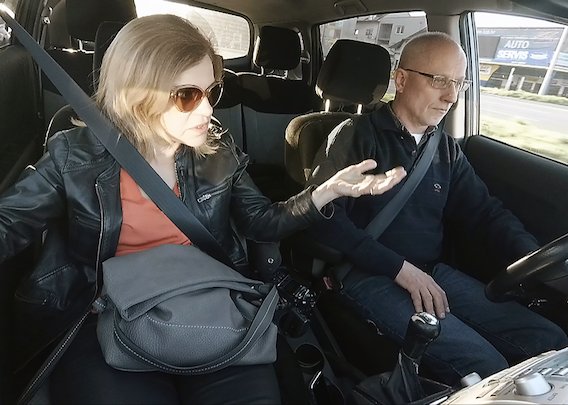
“Of course I had certain aspirations and I filmed expecting emotional reactions,” he continues. “This sometimes happened, but sometimes it also caused resistance, which can be seen in the film itself. Sometimes I had to stop shooting because of the protagonist’s reluctance. In some cases, the recording continued regardless of the events, for example in the car while driving, the camera was fixed, and it was not even possible to interrupt the recording.”
“However, I was always aware that only in editing are final decisions made about what goes into the film. All the time I was balancing between the attitude that it is better to have everything recorded, even if in the end it was not used in the film and, on the other hand, looking for a [balance] so as not to hurt the protagonists, my family members,” he adds.
Our Children is brave in that it shows many very personal actions, reactions and emotions by all family members, not least Silvestar himself. What reservations did he have (if any) about making these public?
“First of all, this film helped me to put some things in order in my head. The process of my personal opening [up] was very gradual and took a very long time. I consider myself a shy person and overcoming my introversion took a lot of time,” he responds. “And yes, I had a lot of dilemmas about what to show the public and what not. My wife warned me several times that in one of my earlier films I exposed more or less only myself, [but] here also others, which not everyone was happy with. Finally, even though there doesn’t seem to be any filter, some things didn’t even make it into the movie.”
“In the film, we deal with the inner world, emotions and self-questioning. That’s why I see this project closer to literature than to film. And that was somehow my [justification] that more things were allowed,” Kolbas adds.
The film can also also be testing for the protagonists from an existential perspective, seeing at first hand how you operate, or are perceived, within the initimate setting of the home. Does (or can) ongoing recording and observation of oneself determine behavioural change?
“There are similarities but also differences in watching yourself on the screen or focusing on your behavior in the past,” Kolbas replies. “On the screen, you may see that you are fat, that you look stupid or that you talk nonsense. The younger son saw some stupid things he was doing on the screen. Looking at the screen reminds my wife and daughter of the less happy aspects of our lives, and they don’t like to see it. I myself was ashamed more than once as well, seeing from a distance of time some of my actions. But whatever we do, no matter how many stories are told from one point of view, it shows fragments of the truth that exists. And sometimes you have to face the truth.”