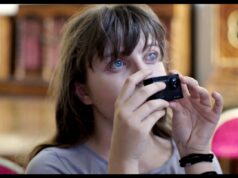
Cuba and Alaska are not their real names of course, rather codenames applied in the field of combat, to be used alongside soubriquets ascribed to other Ukrainian military personnel, such as Artist, Javelin or, for obvious reasons, Baldhead.
Yulia is called Cuba because of her tanned skin and dark hair, while Olexandra is named Alaska because she is “distant and cold,” she laughs in response to the question.
The pair are volunteer paramedics operating on the front line in the war against Russia, and as such are in continuous danger while on duty. As is evidenced when Alaska is wounded by a fragment from a drone attack and thrown ten metres through the air. Her leg is severely damaged and for much of the film we see her in hospital in Kyiv or undergoing physiotherapy, pain and frustration continually written across her face.
Meanwhile Cuba remains in action saving lives and limbs, all the time teaching fellow military personnel the rudiments of essential first-aid on the battle field, such as the correct application of a tourniquet.
When director Yegor Troyanovsky was working for PBS NewsHour he thought he had had enough of covering the war, having extensively filmed in Donbas even before the full-scale invasion of 2022. Nevertheless when he came across film of an interview with Cuba and Alaska which was filmed by a colleague he immediately saw the women’s potential as subjects for a feature.
“That film team stopped after just the interview, they couldn’t see there was a
movie there,” Troyanovsky says in his film notes. “But I could. I knew they were the right ones to follow. Then, Alaska was wounded not long after we started filming, and suddenly we couldn’t film the two of them together. You know, war is not something we switch on or off. War is everywhere. We would have to find another way to tell this story.”
When Cuba and Alaska are together they laugh and dance all the time, like Thelma and Louise, albeit set against a wartime backdrop, but when apart they are each forced to endure pain without their best friend. Such as when Cuba falls in love and gets engaged to sniper Dmytro (aka Shepa). But very soon, he is killed in action and we, the audience, are accorded the privilege of witnessing his desperately sad funeral.
We also see intense scenes of Cuba treating wounded soldiers, including one highly dramatic sequence in the back of an ambulance. “We provided her with GoPros and also had to push her, because at times she forgot to film,” says Troyanovsky, such was her concentration on her paramedic work. “She was not even thinking about it [filming], but later it was better. We were lucky that we got at least something because she saved probably, I think she said, 700 people. So it was not about the filming, it was about her [real] job. I mean, both their jobs because Alaska also did a lot of stuff.”
Away from the war, Cuba is a fashion designer who, when on leave from frontline duties, puts on a show in Paris, one that features traditional Ukrainian embroidery on futuristic designs. After the show she visits her mum in Spain before returning to the war. Alaska in the meantime returns to drawing, all the time struggling on her crutches and craving a return to Kharkiv, where she was posted and where the war was particularly intense. In Kyiv she feels vulnerable because she has no weapons and there are too many idiots around, she says. Only a return to duty, and to her best buddy, will, one feels, restore Alaska’s zest for life…
“I hope audiences see Cuba and Alaska the women, not just the soldiers,” Troyanovsky says. “We worked hard to be accurate, to show their lives and perspectives without
judgement. And I hope [people] can see the importance of the things our two participants do – that there is still joy of life in Ukraine. Cuba and Alaska are just two girls on
Instagram asking themselves, “do we die now or later? And what’s the playlist?”
In interview with BDE last year, producer Olha Bregman (2Brave Productions) underlined the women’s equal status with their male counterparts. They have the same contract as the male soldiers and paramedics, but there is one difference. Women are not obliged to serve in the army. So for them it’s their own choice. They could resign if they want, but men cannot resign. But they [Cuba and Alaska] are staying all this time and saving lives. So that’s why it’s for us really important to tell their story, because they’re choosing this job every day.”
As of November 2024, Troyanovsky has been a full-time soldier himself, setting aside his camera. He does not foresee a speedy return to the business of regular film production.
“You have to understand that film production, in the way that all the people in the world understand it, is dead in Ukraine,” he tells Business Doc Europe. “And it’ll be dead maybe for next 10 or 15 years.”
“I’m happy that we could find partners from Europe [for Cuba & Alaska], happy that Arte France supported us and many other partners, and we almost finished the movie without Ukrainian financing,” he adds. “[But] it’s not about making movies right now in Ukraine, and the next day it’s even less and less about making movies. So people, I think they’re just lucky to get something. I know they feel like there are a lot of Ukrainian movies now probably, but they have to understand that it is not so easy as it seems.”
“If I made something, it would be just [a] love story without any war, without any Russians,” he adds in his film notes. “We are all part of history…and you cannot stop history. I can’t plan for any future. I can’t plan for next week. I can only live in this moment right now.”
Meanwhile, Cuba & Alaska will be released in Ukraine in late August, he confirms to BDE. “People are interested and they also trying to find some other perspective because they’re also tired of everyday news,” he anticipates the public reaction. “I think the girls give small hope about existence. Like, okay, it’s bad now, but it’s not that bad. If there are such people, I think we can continue. I mean, we continue to fight, so I think everyone needs this small hope.”
Cuba & Alaska is produced by 2Brave Productions (Ukraine). Clin d’oeil Films (Belgium) and Tag Film (France). Sale are handled by Java Films.