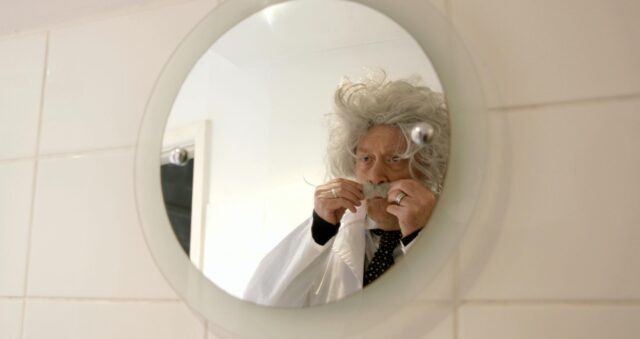
After being diagnosed with an incurable brain tumour, filmmaker Kit Vincent sets about enlisting his family on an intimate and darkly humorous journey that he hopes will help them come to terms with his illness.
Unsurprisingly, this cinematic journey is more complex, emotional and engagingly offbeat than Kit might have first intended. His plan to point the camera anywhere but at himself proves temporary before realising that only he, himself, can be the centre of the film’s story.
The curious title presumably refers to this very fact. While the film is, on the surface, about how his parents and girlfriend deal with the news of his terminal illness, this turns out to be a ‘red herring’ as things take a subtle shift and he finally understands that the film is really about his way of dealing with matters and how he must find ways to express the emotions he feels.
Right at the start of the film while filming his father Lawrence there is reference to Kit’s reluctance to open up about matters. Lawrence says: “I’ve struggled these last few months if I’m honest Kit – I’ve had high levels of anxiety…and they were pretty high before,” before asking Kit why he won’t talk about things. “I’m making a film about it,” replies Kit, before adding that he can really only talk about things in an abstract way.
Kit’s family had already experienced its fair share of tumult when the 24-year-old was diagnosed with terminal cancer. Kit’s mum Julie is a community nurse who spends much of her time caring for dying patients, and was traumatised at the thought that her son will be one of them. Meanwhile his dad, Lawrence, throws himself into a series of increasingly eclectic diversion tactics – from growing cannabis in his spare room, taking up painting and relinquishing his lifelong atheism to attend a local synagogue.
Girlfriend Isabel largely refuses to play along with his film/therapy sessions – “will you get a new boyfriend when I die?” Kit films himself asking her before she gets annoyed with him – and tends to remain away from the core of the film, which is Kit talking with his parents.
The film often delightfully treads that fine line between grief and humour, and works best when celebrating how family and relationships can offer so much support and solace in life’s darker moments.
Father Lawrence especially is an engaging and intriguing character. As Kit recalls: “I was
24 when I had my first seizure as I was coming back from the beach. My parents were both with me at hospital and when they told me (about the terminal brain tumour) I looked at my dad and he had passed out on floor and had a heart-attack.” He adds: “I wish I had filmed that.” Lawrence says: “My heart stopped for 30 seconds – just when you needed me the most I flaked out in you,” adding that he still feels the guilt.
While his father searches for ways to deal with what is happening, Kit finds it initially harder to talk about things with his mother, telling her how he started making a film about his dad coming to terms with death and maybe she should be in it as well, adding that they haven’t really spoken about things in depth.
She replies: “What about, the film or illness? Death is something I deal with a lot – I understand death as a process. But to incorporate you in that is really difficult. I don’t want to have to think I will live through your journey of death.”
But Red Herring takes a subtle, perceptive and revelatory turn. As his father is embracing Judaism (even dressing up as Einstein for a Purim party) his mother opens up to Kit about the fact she had been adopted, revealing that her birth mother had died of brain tumour. After further brain scans Kit finally comes to admit that “apparently I have to be the centre of attention in this film.”
He says: “Obviously I’m scared of dying…but worse than that I just feel so alone – no one can ever know what it feels like to be this scared. Everyone around me keeps pushing me to open up but if I say this stuff out loud it is just going to swallow me up. I don’t want it to be a sad film. I want to give them something to watch when I’m not here…something to remember me by, and to know I was happy.”
Despite its subject matter the film never becomes maudlin or even over-emotional, and Kit keeps things moving at a steady pace, tending to favour scenes of smiles and partying over tears and angst. Film as therapy is clearly important for Kit Vincent, and Red Herring offers a fascinating and often very engaging insight into his challenging and very personal journey.
UK, 2023, 94mins
Dir: Kit Vincent
Production: Good Kid Films, Bright West Entertainment, Postcode Films
International sales: Cinephil
Producer: Edward Owles
Cinematography: Rik Burnell, Kit Vincent
Editors: Hattie Brooks-Ward, David Higgs
Music: Xav Clarke