

Carpets and weaving are a prime staple of mythology and story-telling, whether it be the story of Aladdin in the Arabian Nights, Penelope from the Odyssey or Arachne as depicted within Ovid’s Metamorphoses.
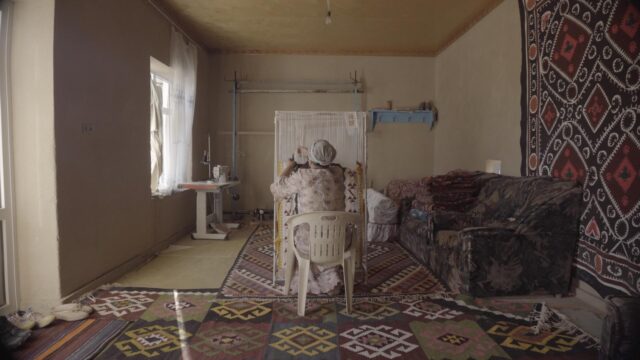
In her short film Do You Know That I’m With You, Netherlands-based Uyghur filmmaker Darya Andijan, from Xinjiang, in the western region of China, which borders Kazakhstan, invokes the myth of Gülem, a forgotten goddess of carpet weaving. The film is highly poetic and personal as it weaves female narratives across borders, all the time set against a background of oppression, and China’s erasure both of the Uyghur language and its sense of identity.
In Xinjiang, Andijan could learn barely anything of her culture, as books and records had been summarily destroyed. It was only when she came to Amsterdam that she could embark upon research to try and learn about what had always been denied her. But even this proved to be frustrating, as the second-hand stories of Uyghur history were coloured by too many external influences.
It was when Darya’s mother told her about the carpet that was woven to celebrate her birth that the filmmaker determined to reclaim her language and culture through storytelling and myth…and by returning to Central Asia to witness the art of weaving.
A devotee of Sufism, Andijan duly traversed Uzbekistan in search of the goddess Gülem, and to embrace her essence. In her intricate, multi-layered film, Andijan further invites recital of desperately sad verses by the imprisoned Uyghur poet Gulnisa Imin, while weaving in archival and family footage from Xinjiang.
“Uyghur people have a long tradition of remembering history through fiction,” says Andijan. “This is a way also to get away from censorship, but also try to retain the ownership of our own history that is written by ourselves. I felt that that this was one of the ways, by passing on the knowledge of this goddess.”
“She [Gülem] is a way to free the imprisoned language of my region,” Andijan underlines. “Through her I could connect my people, my culture to other cultures in Central Asia. Also, the language of weaving is a very universal language itself.”
The women we see weaving in the short documentary were filmed in Uzbekistan. These were folk with whom Darya had no problems communicating. “It was fascinating for me, because we could speak with basically zero difficulty. I can just speak Uyghur to them, they would understand perfectly. Because we used to be the same nation, we used to be the same country.”
One older woman tells how her whole existence consisted of weaving and raising 11 children, and that she had never even visited the local bazaar.
Andijan tells of another mythological association which further inspired the film; the local discovery of an ancient 2,000-year old carpet which had retained its colour and vibrancy. “The pattern on it is actually a Sumerian myth. It’s about Gilgamesh who went to rescue his brother from Hell, and was helped in this by the goddess Inanna. So I was really amazed by how this story travelled so far and stayed there. The colours and the patterns are still so vivid.”
In the film, glowing lights are placed over the faces of family members, so as to protect their identity. The name Darya Andijan is, itself, a pseudonym.
As thrilled as she is by the Sheffield selection of her short film, Andijan is determined to make a feature documentary on the subject, as she believes that the distribution and impact potential of long-form is greater.
“Globalisation is failing us, and people need a different hold on where their home is and what their identity is. This is what I want to further research,” Andijan says. She quotes an old Uyghur proverb from the days of the Silk Road, that ‘it doesn’t matter where you’re born, it only matters where you die.’
“I think this is such a beautiful idea, and so important to be acknowledged, especially nowadays,” she signs off.
This article was first published for SEE NL, a collaboration between EYE Filmmuseum and the Netherlands Film Fund.





