Pic: courtesy of HBO
Twice in a lifetime. 36 years on from the release of Stop Making Sense, Jonathan Demme’s iconic Talking Heads’ concert movie, comes David Byrne’s American Utopia in which Spike Lee documents Byrne’s wildly popular 2019/20 Broadway show, performed with a troupe of 11 international musicians.
Spike Lee’s visually audacious film opens with David Byrne sitting centre stage under a spotlight, his shock of white hair radiating against the black backdrop. On the table before him is a brain which he proceeds to pick up, singing about its various regions. Meanwhile a glistening curtain of silver chain is slowly revealed behind, forming the border of the stage. Two ghostly figures appear from behind the chainmail to join Byrne, singing and circling within their respective halves of the stage.
Five minutes in and we are hooked, struck by the immediacy of Byrne’s unmistakeable sound and presence. The effect is mesmerising, the stage set for the weird and spectacular extravaganza to come.
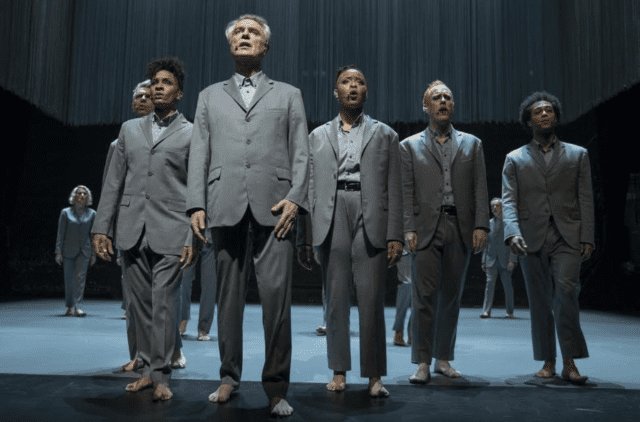
Throughout the film there are continual nods to the ‘Stop Making Sense’ tour more than three decades prior. Yes, we are treated to a handful of classic Talking Heads songs, but the references are more often visual rather than sonic, such as the suits that all 12 performers wear which bear close resemblance to that worn by Byrne on screen in 1984. The inventive staging and dramatic lighting are also similar. For true fans of the Heads, the visual creative for the song ‘Bullet’ serves as endearing homage to the iconic lamp dance performed by Byrne over 30 years ago for ‘This Must Be The Place.’
At various points in the film the band line up along the front of the stage, although this time around there is no clunky equipment on view, nothing extraneous, neither wires nor amps, only humans and their instruments. The reason for this, Byrne tells the audience, is that people are mainly interested in looking at other people – as opposed to a ‘bicycle’, a ‘beautiful sunset’ or a ‘bag of potato chips’ – hence why he thought to ‘eliminate everything from the stage, except the stuff we care about the most’.
He also talks of the importance of diversity within his band. They come from around the world; from Canada to Brazil, France to North America. Byrne himself moved to the US from Scotland as a child. His message: ‘most of us are immigrants, and we couldn’t do it without them’.
The show is punctuated with instrumental cameos, which is testament to Byrne’s recognition of the skill and importance of each fellow musician, and many of his songs leave space for the band members to improvise and demonstrate their musical voices. In ‘Born Under the Punches’ he introduces the instrumentalists one at a time, starting with a simple bass drum, adding muso after muso before eventually achieving full band sound.
In true Byrne fashion, surreal humour is integral to the choreography of the show. The whole thing is interlaced with tongue-in-cheek dance sequences which are entirely synchronised and rehearsed to a T. A recurring example is when one of the performers mimes the chopping of a vegetable along their arm before pushing it aside. At another point Byrne stands alone on the stage as disembodied arms poke through the chain wall whilst playing their respective instruments.
The most obvious demonstration of comic choreography is during ‘I Dance Like This’. It is a song of two halves; a ballad section which alternates with a heavy rock chant section rife with dad-dancing. Towards the end of the song the performers continue their hilarious moves over a long period of silence before a sudden cut to an epic strobe finale. All completely over the top but highly entertaining, and a satisfying nod to Dada.
Towards the end of the show the tone becomes more reflective, as Byrne performs a cover of Janelle Monae’s ‘Hell You Talmbout’ – a song listing the names of African-Americans who have died as a result of racial violence. Earlier in the show he implores his US audience to engage in the political process, acknowledge their hard-earned right to vote and take to the polls. ‘We’re a work in progress, we’re not [yet] fixed,’ states Byrne before the final number.
But his message remains one of hope. Our peers have utmost importance in our lives, because who we are is ‘established through the connections between all of us’. All of w
hich underlines how Spike Lee’s film is not only funny, entertaining and so beautifully oddball, but also poignant and somewhat timely.
Production: An HBO Films release of a Participant Media, River Road Entertainment, Warner Music Entertainment, 40 Acres and a Mule Filmworks, RadicalMedia production.
Producers: David Byrne, Spike Lee. Executive producers: Meredith Bennett, David Bither, Len Blavatnik, David Byrne, Kristin Caskey, Patrick Catullo, Charlie Cohen, Kurt Deutsch, Mike Isaacson, Jon Kamen, David Linde, Bill Pohlad, Dave Sirulnick, Jeff Skoll, Diane Weyerman, Christa Zofcin Workman.
Crew: Director: Spike Lee. Screenplay: David Byrne. Camera: Ellen Kuras. Editor: Adam Gough. Music: David Byrne.
With: David Byrne, Chris Giarmo, Tendayi Kuumba, Bobby Wooten III, Karl Mansfield, Gustavo Di Dalva, Jacquelene Acevedo, Angie Swan, Maura Refosco, Daniel Freedman, Stephane San Juan.