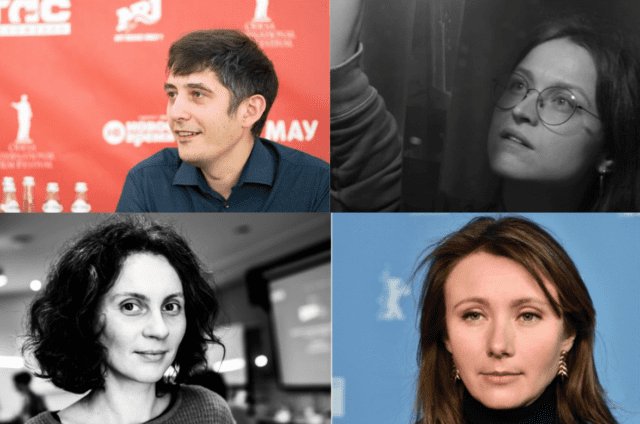
Clockwise from top left: Roman Bondarchuk, Alina Gorlova, Maryna Er Gorbach, Darya Bassel (pics courtesy of Arthouse Traffic)
Ukrainian filmmakers, who remain in a country under bombardment from Russian artillery, continue to articulate their desire for a boycott of Russian cinema. “Do you want to stop Russian aggression? You should stop its culture from influencing your minds,” says Darya Bassel, head of Industry at Docudays.
The following statements were co-ordinated and forwarded by Ukrainian Denis Ivanov, who produced Sergei Loznitsa’s Donbass and Oleg Sentsov’s Rhino.
Darya Bassel: producer, Head of DOCU/PRO Industry Platform and Festival Programmer at Docudays UA International Human Rights Documentary Film Festival (Ukraine).
What scares me the most in the current situation is that I see that Ukrainian voices are still ignored on the international cultural scene. Many international film festivals are organizing special programs dedicated to Russia’s war against Ukraine, and what do we see in these programs or panel discussions? We see films made by Russian filmmakers or by foreign filmmakers. The same is with broadcasters. They air Russian films instead of giving the floor to Ukrainian filmmakers. Even these films are produced by filmmakers who do not support Putin and his bloody regime still – why the international community doesn’t want to listen to Ukrainians? Even now? It is the same if you invite a man to be a spokesperson for a #MeToo movement.
I say it’s time to listen to Ukrainian voices! Culture is politics. It’s a dangerous illusion that culture is beyond politics, that culture doesn’t influence you and your opinions and that it can’t be used as a weapon. Ukrainian theaters right now turned into hospitals or hostels for refugees. Ukrainian filmmakers turned into soldiers. Ukrainian museums are being bombed. It is culture and it is part of the war as every other part of the social life. Do you want to stop Russian aggression? You should stop its culture from influencing your minds.
Alina Gorlova: Ukrainian director of documentaries No Obvious Signs, This Rain Will Never Stop
Russia has committed a crime. Against Ukraine, against Europe, against the whole world. This crime is the collective responsibility of all citizens of the Russian Federation. Collective responsibility means collective. I call on all film festivals, all foundations, all international institutions to block the cinema from the Russian Federation.
We currently have a large number of films in production, including co-productions. This war has called into question our ability to fulfil our obligations to our partners. All of our films that are due out this year are unlikely to be released.
Instead, Russian cinema will be presented to the world. This cannot be allowed. All Russian cinema must be blocked. I insist on the following movie lock markers:
- country of manufacture Russia,
- a Russian director who has lived in Russia for the last two years,
- a Russian director who has not publicly condemned the actions of the Russian authorities for the last 8 years regarding the aggression against Ukraine,
- Russian director who opposed the blockade of Russian cinema.
I urge you to block Russian cinema until the aggressor takes the following steps:
- complete withdrawal of Russian troops from the territory of Ukraine outside the state corridor, including the liberation of Crimea and Donbas,
- payment of reparations to Ukraine for losses due to the Russian military aggression against Ukraine since 2014
- completion of the investigation into Russia’s crimes against Ukraine in Hague.
Until Russia publicly acknowledges the fallacy of its actions or is convicted under all the laws of international law, I consider inadmissible any representation and support of Russian cinema.
Nariman Aliev: Ukrainian film director (Homeward)
Ukraine is fighting for its freedom and its right to exist. Ukraine is fighting against the Russian Federation, which has no limits to its insane imperialist appetites. They are no longer ashamed to attack a sovereign country in front of the eyes of the world, having no right or reason to do so. Russian culture has always been an instrument for legalizing all crimes committed and committed by their authorities. Russian soldiers and bombs are no different from their propaganda weapons, which may not kill people directly, but justify these atrocities or divert attention and shift the focus from the main thing.
With the tacit consent of its compatriots, Russia is killing innocent people in Ukraine. The boycott of Russian cinema and culture is an attempt to cleanse the world of the propaganda of a terrorist state.
Maryna Er Gorbach: Ukrainian film director (Klondike)
During a war with no rules, applying the rules of the civilized world to the aggressor is the same as asking an anemic patient to become a donor.
I protest against the madness of the Russian Federation, against murderous imperialism, against military aggression as a world disease. I urge you to do everything in your power to stop the bloodshed. The public position against Russian Federation in all areas is a loud cure for despotism.
Roman Bondarchuk: Ukrainian film director (Ukrainian Sheriffs, Volcano), Art Director at Docudays UA International Human Rights Documentary Film Festival (Ukraine), member of the board of the Ukrainian Film Academy.
A news feed is now open:
Clockwise from top left: Roman Bondarchuk, Alina Gorlova, Maryna Er Gorbach, Darya Bassel (pics courtesy of Arthouse Traffic)
“Mariupol is under blockade: the occupiers disrupted the evacuation of the population and captured the entire city.” This is the east of Ukraine, my aunt and family live there. They have not been contacted for several days. In the photos coming from the city – completely burning ruins.
“Russia drops powerful unguided bombs on Chernihiv” – a large family of my wife lives in Chernihiv. The city in the north, until the last day of peace – a sincere belief in the friendship of “brotherly peoples,” many families mixed with Russians and Belarusians.
“Russian troops still control the perimeter of Energodar. At night they fired at the nuclear power plant ” in the south, closer to Kherson, where I was born and where my dearest people live. The city is running out of food, the occupiers are robbing and shooting passers-by just on the streets.”
Among this news is a director from Russia who is against the war, against Putin, who writes that she has finished a new documentary. But she is sorry that this film is unlikely to be seen now, except for her friends. The film is about another, now deceased Russian director Balabanov, the author of the chauvinistic film “Brother”, which infected a whole generation of Russians with hatred for Ukraine. A film that formulated their need to “answer for Sevastopol” – that is, to annex Crimea. The 1997 film “Brother” is currently being released in Russian cinemas. For my friend director, Balabanov is a genius of his time. But she is against the war. And does not feel any contradiction in this.
The popular Russian writer Zakhar Prilepin, a veteran of the war in Chechnya, still travels around the Ukrainian East in tanks and writes in his books how he squeezed Ukrainians’ eyes with his fingers. Renowned Russian opera singer Netrebko has decided that it is better to end her career in Austria than to condemn Putin’s actions. The entire Russian Institute of Cinematography, VDIK, hastened to recognize the independence of the LDNR republics artificially created by Russia.
Those artists who are critical of Putin have shown extreme passivity. They did nothing to stop this war or to speak out against it before it began. And now their attempts to sign collective letters and resent the sanctions look hypocritical.
These days, Ukrainians are defending their freedom and right to exist. We need help. It is necessary to limit the influence of Russian culture in the world. Culture prepared the ideological basis for this war. A culture that can veiledly justify Russia’s aggression. The culture that Russia knows how to use for its purposes is no worse than weapons.
After the war, when Ukraine’s existence will not be threatened by tanks and missiles, it will be possible to return to it, study it, research it and structure it. Just like nowadays, we study Riefenstahl’s films or Wagner’s works.
The only relevant manifestation of Russian culture now is the broadcast of ‘Swan Lake,’ which traditionally marks a change of government in Russia. There are so many other future-oriented cultures in the world. In particular, those who were oppressed by Russia. Let’s turn our attention to them. Do not stand aside. Sign the petition. Help Ukraine survive this war.
As of March 6 Streaming giant Netflix decided to its suspend service in Russia, citing the country’s invasion of Ukraine and joining numerous entertainment companies that have suspended their business there.
As previously reported in BDE, international response to the call for a boycott is so far mixed. Venice FF stressed that while it would ban Russian delegations from the 2022 edition, it will not stop independent Russian filmmakers from attending. “The Venice Biennale will not close the door to those who defend freedom of expression and demonstrate against the ignoble and unacceptable decision to attack a sovereign state and its defenseless population,” the festival said in a statement.
Likewise Cannes said it would “not welcome official Russian delegations nor accept the presence of anyone linked to the Russian government” at the 2022 edition, but that “we would like to salute the courage of all those in Russia who have taken risks to protest against the assault and invasion of Ukraine. Among them are artists and film professionals who have never ceased to fight against the contemporary regime, who cannot be associated with these unbearable actions, and those who are bombing Ukraine.”
In a statement Locarno FF stated how it “stands for freedom of expression and for the cinematographic art in all of its forms,” adding that it “does not intend to boycott Russian films, since cinema is a voice for supporting diversity and creativity in all countries.”
November’s Stockholm FF meanwhile says it will not program any films that have benefited from Russian state funding, and Glasgow FF, which opened March 2, has withdrawn two films from its line-up – Kirill Sokolov’s No Looking Back and Lado Kvataniya’s The Execution.
On March 1 the European Film Academy added its voice to the call for sanctions against Russia by excluding Russian films from this year’s European Film Awards.
“The European Film Academy remains a place to support and unite all filmmakers who share our belief in human dignity, freedom, democracy, equality, rule of law, and human rights,” the statement read. “We acknowledge and appreciate those brave filmmakers in Russia who stand up against this war. But in view of a brutal and unjustified attack, we have to stand with our sisters and brothers in Ukraine whose lives are at risk.