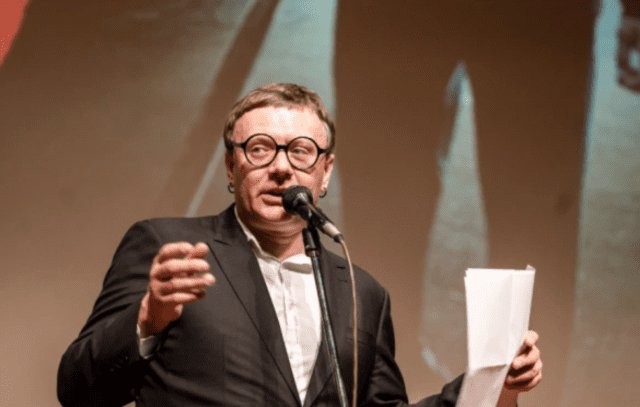
Denis Ivanov (pic: courtesy of European Film Academy)
Denis Ivanov, the Ukrainian producer of Sergei Loznitsa’s Donbass and Oleg Sentsov’s Rhino, has made an impassioned call to the international film community to boycott Russian cinema and culture.
“I think some festival selectors, film professionals and cultural managers just do not get what is happening in Ukraine,” he writes in an open letter. “This war of aggression by the Russians has turned into a war on independence and a war for values and rights. It is, first of all, the genocide of Ukrainians.”
He questions the stance of tolerance adopted by commentators. “I sincerely wonder about the position that I endlessly read about in the press and online that: ‘culture is out of politics’, ‘we have to hear opposition voices’, ‘[the] boycott will put limits to artistic expression,’” Ivanov writes.
He argues that, “Russian cinema is funded by the Russian State and most of the films are supported by the Russian Ministry of Culture or state-backed Cinema Fund,” adding how, “that means that at the beginning of each film there will be their logos. Logos of the State, responsible for the genocide of Ukrainians.”
“Films that are made out of the state financing system are financed by funds of oligarchs, like Roman Abramovich’s fund KINOPRIME,” he further states. “These oligarchs became rich because they were and mainly are close to power. They helped Mr. Putin to get his influence and agreed with the actions of his regime. They are using their funds for cinema support to clean their reputation in the West.”
In terms of the response to the war on the part of Russian filmmakers, Ivanov writes that, “the best [they] can do now is to refuse to represent their country in international events and make a statement about it. This act of solidarity would be the most clear and eloquent anti-war message to the world and Ukrainians than their statements in social media that they are ‘against war’. It’s not the right time for red carpets for our dear Russian colleagues.”
He compares their situation with that of filmmakers in his home country. “Ukrainian film professionals have now gone to the army, or are helping as volunteers, or taking cover from Russian missiles in shelters, or evacuating their families from the war zone.”
“Their ‘artistic expression’ is limited by these circumstances. On behalf of them, I’m asking for support of our boycott of Russian cinema at all international film events and all international organizations until [the] Russian government will end up in [the] Hague…No more ‘business as usual’ with Putin’s Russia,” Ivanov ends his open letter.
International response to the call for a boycott is so far mixed. Venice FF stressed that while it would ban Russian delegations from the 2022 edition, it will not stop independent Russian filmmakers from attending. “The Venice Biennale will not close the door to those who defend freedom of expression and demonstrate against the ignoble and unacceptable decision to attack a sovereign state and its defenseless population,” the festival said in a statement.
Likewise Cannes said it would “not welcome official Russian delegations nor accept the presence of anyone linked to the Russian government” at the 2022 edition, but that “we would like to salute the courage of all those in Russia who have taken risks to protest against the assault and invasion of Ukraine. Among them are artists and film professionals who have never ceased to fight against the contemporary regime, who cannot be associated with these unbearable actions, and those who are bombing Ukraine.”
In a statement Locarno FF stated how it “stands for freedom of expression and for the cinematographic art in all of its forms,” adding that it “does not intend to boycott Russian films, since cinema is a voice for supporting diversity and creativity in all countries.”
November’s Stockholm FF meanwhile says it will not program any films that have benefited from Russian state funding, and Glasgow FF, which opened March 2, has withdrawn two films from its line-up – Kirill Sokolov’s No Looking Back and Lado Kvataniya’s The Execution.
As previously reported, on March 1 the European Film Academy added its voice to the call for sanctions against Russia by excluding Russian films from this year’s European Film Awards.
“The European Film Academy remains a place to support and unite all filmmakers who share our belief in human dignity, freedom, democracy, equality, rule of law, and human rights,” the statement read. “We acknowledge and appreciate those brave filmmakers in Russia who stand up against this war. But in view of a brutal and unjustified attack, we have to stand with our sisters and brothers in Ukraine whose lives are at risk.”