

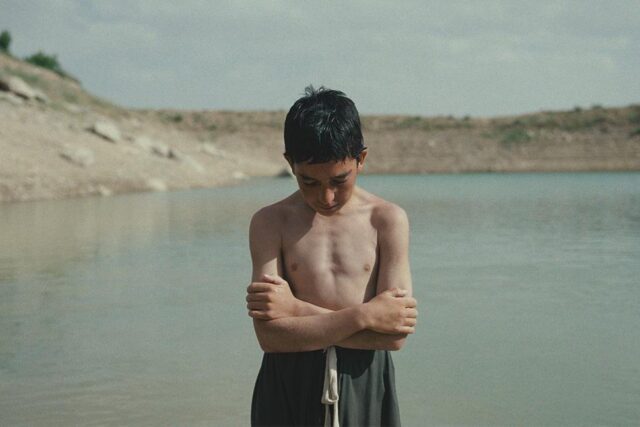
In Kabul, Between Prayers, sold by Mediawan and world-premiering Out of Competition at Venice 2025, Samim may be a Taliban soldier who talks openly with colleagues about martyrdom, but he is nevertheless given a human face by director Aboozar Amini.
Samim is devoutly religious, but his marriage is in trouble. In a fascinating opening scene, he prays to God for forgiveness, for faith and for his dead friends. He is handsome, grooms his hair and wears kohl around his eyes, and goes about the business of keeping order on the streets of Kabul, both during the day and on night patrols.
His younger brothers Elias and Rafi idolise him, especially Rafi, who is just 14. The youngster dutifully talks the language of war and of “burning infidels,” but he is also a sweet lad who goes shy and giggly when asked if he has a crush on anyone.
“As an artist, my foremost inclination is to transcend the impulse to condemn,” says Dutch/Afghan director Amini, “creating, instead, a space where observation can delve deeper than what populist politicians dictate.”
As in his acclaimed debut feature documentary film Kabul, City in the Wind (2018), Amini depicts his subjects without judgment, but for this film he had to do so remotely from The Netherlands. as he cannot return to Afghanistan for reasons of safety. Every day he would lay out each scene with precision, and view the rushes sent to him from his cinematographer in Kabul, and then react/direct accordingly.
“My film depicts the effect of war on people,” Amini underlines. “Not only the war in Afghanistan, it’s the war everywhere. War is not only destructive for cities, buildings, houses, hospitals and roads. It also destroys the souls of people generation after generation after generation.”
“And I, as a filmmaker, need to face this new chapter of my country which has a Taliban government. Either I turn my head around and look in the other direction, or press the button and record with all the limitations. I went for the latter one.”
Amini explains the process of remote direction, pointing out that it took 18 months to find a “tune” that worked together with his cinematographer and protagonists, the whole thing set against the backdrop of Kabul’s new reality. “It was really tough, intense. It was like walking in the darkness in the beginning, especially the first one and a half years. It was like finding ourselves in a dark room. We didn’t know any direction, because cinema is a strange medium to the Taliban. Once they see a man with a camera, it’s a potential danger to them.”
But the constraints within which the filmmakers were working eventually proved to be a boon. “Usually, I see it like this, that limitations for an artist bring more creativity. When you have too many options, you can get lost. But when it’s limited, your creativity starts – from camera movement to the placement of the camera, to organically following the protagonist, to understanding the protagonist, to giving them enough space to move, to insisting on freedom when shooting, to not giving up easily, to be daring, to crossing borders. Everything that, in my opinion, is necessary for a good film, for good storytelling, developed over this period.”
Amini argues that Kabul, Between Prayers, a key theme of which is the transition from boyhood to manhood, is as appropriate for viewing by teen audiences as by adults.
“Especially as kids these days are way smarter, and they can digest way more things than we think,” he says. “This is a trilogy, and the second film on Kabul, and a third one is also in the making process and also dealing with kids this age. To me, that is a golden age, because between 12 and 14, and up to 16, your identity takes shape. How the world deals with you, and how you reflect on the world, is so decisive for your inner soul and character.”
The director also maintains that the extreme radicalisation that Afghanistan has witnessed is the result of military intervention over the past half-century and more. “Go back to your country, save your mosques from the communists in the name of God,” Amini cites as the ‘advice’ offered to Afghanistan by America in 1979 during the Soviet invasion. “However, once the war with the Soviet Union began, ideology itself became a weapon—shaped and fuelled with support from the United States, specifically targeting the beliefs of the people.”
“This greed between the Eagle and the Bear, it’s never-ending. The world is suffering between them. The world is paying the price,” he adds. “My generation in Afghanistan, in particular, has lived through the consequences – most recently with the US withdrawal in August 2021, which felt like a deep betrayal. In that moment, it became clear to us that democracy, human rights, and women’s rights are often spoken of loudly in international forums, but when political interests are at stake, their value diminishes.”
Despite the geographical distance between Amini and his protagonist Samim, a sense of mutual accord developed between them. “It doesn’t mean that I agree with him on his choices. And he also understood that there are differences between him and me. He once told me, ‘I know that you think differently about this subject. I do respect that. I’ve learned this from you during this process, that there is a different way of living as well in this world.’ That’s a good sign. Because of this film, there was a common understanding between us.”
Amini doesn’t like the term ‘exile,’ as he has now lived more than half his life in Amsterdam. What’s more, he doesn’t profess to be an Afghan filmmaker, just a filmmaker, period, he says. That said, he dearly misses his former homeland and resents how he is denied access to it. “You deal with storytelling, and of course, access to a geographical place is a unique, valuable thing. Unfortunately, I don’t have that now at the moment. And with a pain in my heart, I cannot return. The risk is too high. And this is not my choice.”
Jia Zhao, Amini’s long-time collaborator adds: “My collaboration and friendship with Aboozar has lasted nearly 18 years. Over that time, we have learned that in a world mostly controlled by ideology and politics, telling a truthful story through cinema from another perspective often requires the courage to walk almost alone — yet it may be the only way for all of us to remain connected.”
“What I am especially grateful for this time is the many kindred spirits who joined us on this road, supporting and resonating with the work, and helping to give form to this deeply human film, a murmur of warning and a chant of humanity, asking viewers to look into the blurred space where fanaticism and tenderness co-exist.”
This is a longer version of an article first published in SEE NL, a collaboration between EYE Filmmuseum and The Netherlands Film Fund.





