Comme un château fort is a small film, about a huge subject, which is also, in itself mundane: mourning a loved one. It happens to all of us, and it happens to those we love. How to cope, and how to help others cope? What is possible, what is reasonable, what is out of our hands? What is too much, and what isn’t enough?
It took me a while to get into the rhythm of Lou Colpé’s Comme un château fort, but once I did, that initial difficulty became part of the film’s meaning. Because it is hard to get into synch with someone who is mourning a lost love. Especially when, as in this case, death was unexpected. An accident, thirty years old, and Colpé returns to the Walloon house they had been living in together. Grandma, who owned the house, had passed away some time earlier, leaving Colpé alone with Granny’s cat – which she and Bertrand never really liked. As Colpi approaches with her camera, the cat growls.
Bertrand. The name pops up now and then. A photo from a photo booth, of them embracing, is stuck to the fridge.
But now we get to what Colpé doesn’t do. She is a filmmaker, so I’m pretty sure the material’s there, but she doesn’t show us any video material of her and Bertrand in happier times. No flashbacks at all. We are here, with her, in the moment, with all that Bertrand now is: a name that crops up in conversation, a photo on the fridge.
There aren’t many conversations in Comme un château fort. Most of the time, the house is silent. In a clever move, Colpé has replaced the traditional voice-over with text, handwritten over the image (in English, in the version I saw). Contrary to what one might expect, these written words are less distancing than a voice-over usually is, because this way, the essential silence and interiority of her mood are preserved. Also, it feels almost like reading over her shoulder as she’s writing in a journal – even more intimate than listening to someone speak.
Interestingly, we also don’t hear the voice messages she apparently leaves a friend, only those friend’s return messages. It’s not even a close friend, Colpé’s written words inform us, but somehow the way she talks feels right for her.
This way, Colpé again preserves her own silence, and uses her friend’s responses as an indirect reflection of her own very slowly developing grief. Messages which return with such regularity that I, as a viewer, also come to await and expect them. Just as Colpé does.
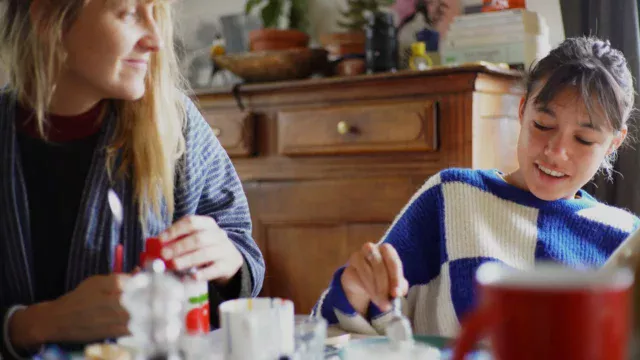
After a while, her 16-year-old friend Lily starts visiting twice a week. Just sitting there, doing her homework, smiling when she catches the camera lens, completely at ease when Lou asks her something while she is being filmed. She knew Bertrand, too. She is a comfort. Gradually, there is more conversation in the film. More life.
There are other ways Colpé structures her film. She starts the documentary with a party at the house with her friends – a smart way to avoid too gloomy an atmosphere from the outset – which she returns to more than once. She also shows written lists on the screen. Like a ‘List of weird things other people do’ (including ‘write messages to me telling me to “bounce back”’) or a ‘List of difficult things’ (e.g. ‘cleaning our bedroom’).
I like lists. And I have also recently lost loved ones – both expected and unexpected. I mention this because I don’t believe I can separate my experience of Colpé’s film from those personal feelings of recognition and loss. I’m not sure the many silences, accompanied by everyday images around the house, would have worked as well otherwise. Which is why I think the film might be especially worthwhile for those who are themselves mourning or have friends or loved ones who are.
Ok, There is a comparison with the Space Shuttle Challenger exploding just when it seemed to be heading for the stars, which feels a little dubious – using those dead to symbolise her own – and unnecessary, not adding anything to the film’s narrative or emotional impact.
But in the end, it is the silence, the absence, which in Comme un château fort speaks so much louder than any image ever could.
Belgium, 2026, 83 minutes
Director Lou Colpé
Production Dérives
Producer Julie Frères
International sales Emma Gratton
Script Lou Colpé
Cinematography Ramón Giger
Editing Nicolas Rumpl
Sound design Rémi Gérard
Sound Lou Colpé