Though conventional in tone and structure, Steven Vit’s My Old Man also manages to be gently profound as it dwells on a childhood spent in a conventional family (not unlike countless ones encountered in Switzerland and elsewhere) and the director’s realisation that he doesn’t really know the often-absent father who would call from the other side of the world to say goodnight when he was a child.
Vit’s warm and devoted mother Kathi was the one who was always there, while his father Rudi returned for extended periods from travels overseas for warm and nurturing family time before heading back to Asia for another stint within a series of hotel rooms.
But for Rudi, it is time to take his leave, retire and plan for a new life, in which work – and being defined by work – will no longer be the central focus. It is during this moment of worry and fragility that his son chooses to discover his father and, camera in hand, he accompanies him to Asia on his last business trip.
As he says: “Every time I visit my parents something has changed since my last visit…furniture, the garden, the colour of the neighbour’s cat…and my parents’ faces.
But if I think about it, I actually don’t know him [Rudi] that well – never asked myself how he is doing or what he’s thinking or what his life looks like beyond our own four walls.”
Steven and Rudi head first to Shanghai where dad slips back into his uniform of business suit and tie, wanders a factory floor and a trade fair and explains when Steven is filming him during a meeting that “my kids have no idea what I do.”
He reveals himself to be an expert at packing travel bags, and as they head on to Japan Steven is surprised that there is no fancy living while on the business jaunts. “Since the trade fair we spent most of our time in transit and in some random sterile hotels or stale meeting rooms smelling of carpet glue,” observes Steven. “I imagined it much more glamorous his business life here.”
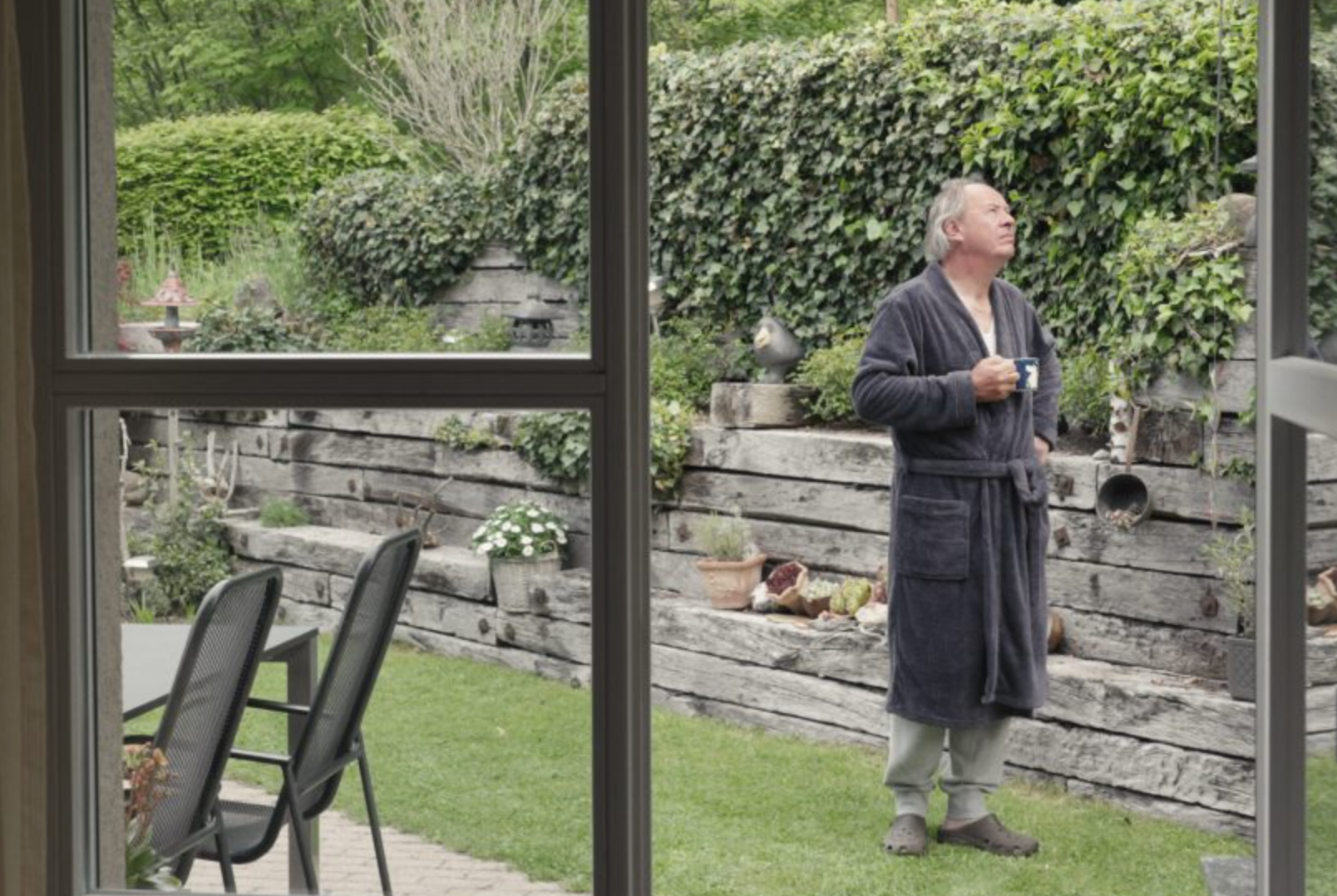
Back in his office in Switzerland (replete with Swiss flag and a map of the world) Rudi clears the detritus of a working life into a rubbish bin. On his wall is a photograph of Jack Nicholson in dressing gown, playing golf with a cigarette in mouth…Rudi looks a little like Nicholson and certainly likes a game of golf. At the obligatory company leaving party his boss’s speech recounts that Rudi joined the Schleuniger company in May 1973 (“Some 43 years,” he says, “that is like 2236 weeks and weekends and 15,695 days.”) Just over 20 minutes into the film and Rudi is retired – and having to try and adjust to a new way of life.
As he questions his desires and his place within his new life and marriage, the film goes beyond the typical structure of a family film and paints a clinical, open and often sensitive portrait of a 20th-century “boomer”, an archetypal figure of an endangered species. He and Kathi bicker about how best to load the dishwasher (she admits that when he was working she had a freedom that she grew to like); argue about cooking recipes and play scrabble for two. When they debate (with Steven there as a moderator of sorts) about how Rudi wants to cancel her favourite newspaper and control how much television news they watch she counters, “you are confronting me with your negative energy,” Rudi admits he was probably the “bad buy who started the bad vibes”.
But as the whole family celebrate a milestone birthday for Kathi he reads out a tender speech where he says he regrets not being kinder and that he needs to work on his critical nature (“though I’ve been saying that for years” he adds). For Steven he feels that “behind his behaviour there is a lot of fear,” largely of getting old. For Rudi retirement (and life) is a work in progress, but at least one he admits he has to keep on working on.
Switzerland, 2022, 85mins
Dir: Steven Vit
Production: Lomotion AG
Producers: Louis Mataré, David Fonjallaz
Cinematography: Steven Vit
Editor: Katharina Bhend
Music: Philipp Moll
With: Rudi Vit, Kathi Vit