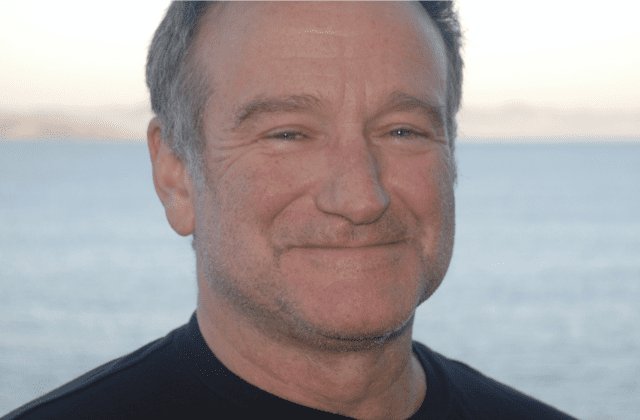
Picture courtesy of Vertical Entertainment
In the hours after the much loved comedian and movie star Robin Williams’ suicide in the summer of 2014, news reports around the world all covered the event as yet another example of a Hollywood legend falling from grace.
It was assumed that alcohol or drugs or financial problems were behind the tragedy. In fact, as Tylor Norwood’s new documentary Robin’s Wish, reveals, Williams had been destroyed by a neurodegenerative disorder, Lewy Body Dementia (LBD), for which there was no cure. He had shown considerable heroism in the face of a condition that had attacked his brain.
The film [distributed by Vertical Entertainment] was one of the best performing feature docs in the US last autumn albeit in a marketplace distorted by the pandemic and in which the release had to be handled online. Now, it is in contention for awards.
Norwood had first been approached to make the documentary by the comedian’s widow, Susan Schneider Williams, who had seen Naples Yellow, one of his earlier films.
“She called and I assumed we were immediately going to talk about Robin Williams but instead she started talking about this disease I had never heard of, Lewis Body Dementia,” Norwood remembers.
Schneider Williams had strong ideas about how the film should be made. She wanted it to “go deep” into the science and to use complex 3D animation to illustrate how LBD worked. Initially, Norwood was taken aback. He didn’t know anything about the condition but then, she started talking about what she and Williams had gone through in the last year and a half of the comedian’s life.
“That gave me a real human sense of what had happened to this person I cared about. I am a Robin Williams fan like millions and millions of others. Just at the end of that phone call, I had a real sense of a human story that this guy experienced – something that could have happened to anyone of us; that was harrowing and terrifying but also deeply fascinating…”
Norwood told Schneider Williams that he wasn’t “the guy for a hardcore science documentary,’ but that if she wanted the film to deal with the human side of the story, he’d be keen to take it on, at which point the director was given creative autonomy. Schneider Williams trusted him, stepped back and let him do his work.
Norwood talks of the media myths surrounding Williams’ death – the notion that the comic genius “burned too brightly, got too close to the sun” and then was brought down by human weakness. He quickly discovered none of this was true. “No,” he declares emphatically. “This was a beautiful human being who led a rich and full life and then had a terrible thing happen to him – a thing that could have happened to anyone.”
If Williams had died of a disease like cancer, the director continues, everybody would have understood it. However, no-one knew about the undiagnosed condition which had killed him. Only after his death did the doctors realise how badly he had been ravaged by LBD.
“There is a really difficult and delicate thing that happens when a story gets out to the world and it’s incorrect,” Norwood observers of how the false narrative about Williams’ death had taken root. His film challenges that narrative. He has the coroner’s report and the medical reports to prove his account was accurate.
Many of Williams’ friends (as well as his multitude of fans) were unaware of the true circumstances of his suicide. Norwood talks of the “catharsis” they felt when they learned what had really happened. Those, like director Shawn Levy [Night In The Museum] and writer-producer David E. Kelley [The Crazy Ones], who had worked with Williams late in his career, realised that something wasn’t right with their colleague. Everyone had liked and respected the comedian so much that they had deliberately kept secret those moments when Williams had forgotten lines or was stumbling around or hadn’t seemed himself. Now, they knew why his behaviour had been erratic. They were hugely relieved finally to have this information.
Norwood’s film stands as a tribute to one of the best loved screen comedians and actors of his era. From Mrs Doubtfireto Mork & Mindy, from Good Morning Vietnam to Dead Poets Society, from Good Will Hunting to The Fisher King, everyone has their favourite Williams’ performances. Norwood wanted to acknowledge Williams’ brilliance while also dealing accurately with the tragic situation the comedian faced at the end of his life. By a cruel irony, this master of improvisation, renowned for his wit and ingenuity, ended up betrayed by his own faculties.
“That balance was really difficult to strike because, in the beginning, I was completely obsessed with what the hell happened to Robin Williams!” the director remembers. He was obsessed with getting the story right but eventually realised that the film could deal with Williams’ condition while also giving viewers “a remembrance of who this beautiful human being was who shined for all of us and would take us into these other worlds.”
All the interviewees featured in the film would invariably have an affectionate story about Williams. Even at the end of his life, the comedian was still capable of acts of grace and kindness. “What would always happen in the interviews is that someone would tell us a beautiful story about how Robin would come over, hang out and be this beautiful human who was so curious and so lively. You’d have us cataloguing what happened and what they saw…and then you’d have 40 other minutes in which they’d just say he was the best – the most fun, the most lively, the fastest, most genius-like performer.”
Robin’s Wish was originally due to be released on 600 screens in the US in the summer. That was delayed because of Covid. Some were advising Norwood to wait until the pandemic was over but his instinct was to get the movie out.
Scientists have welcomed the documentary. The Lewy Body Society in the UK is among the organisations to have embraced it. That, Norwood is convinced, would have delighted its subject. After all, Williams was deeply interested in neuroscience. One of his best known dramatic roles was as the neurologist (based on Oliver Sacks) in Penny Marshall’s film Awakenings (1990).
“Everything I’ve learned about his life points to that he [Williams] would have loved that some pain he had experienced in this way could have been transformed into the positivity of one person getting diagnosed who wouldn’t have been diagnosed otherwise or one treatment being a little closer to development because his story allowed a donation to be made” the director concludes.
Available on https://www.robinswishfilm.com/