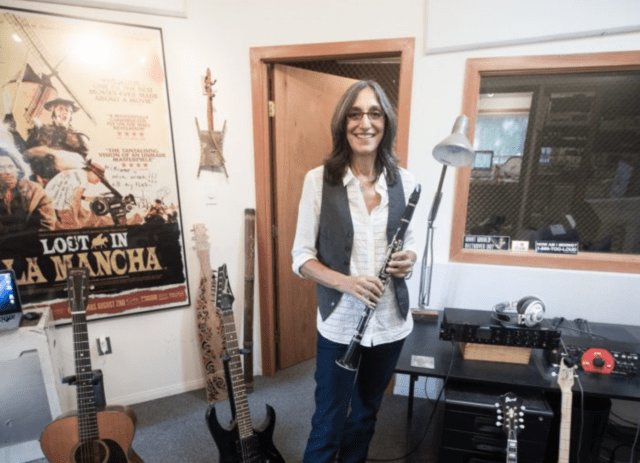
During a February 10 Industry session organised by the Institute of Documentary Film (IDF), three-time Emmy-nominated composer Miriam Cutler gave an online masterclass to analyse the marriage of music and doc. The session was moderated by George Cremaschi, professor of sound art/production at Prague College and FAMU tutor.
At the beginning of her IDF masterclass Miriam Cutler described the first time she ever applied music to visuals. She was playing in bands in the late 1970s, at the same time mulling over a career in public law, when one night somebody suggested that she might want to score a short film.
The idea seemed, she said, slightly ludicrous. Writing for film was something that the likes of Bernard Hermann (Psycho) did. “Not me, I’m a person in a band,” she recalled thinking. “But what happened when I put my hands on the keyboard with pictures – and in those days they had no home studio synchronization, there were no computers, you just wrote music and then you cut it into a film – was so magical.”
For a decade this is what she did, placing her hands to the keyboard, and engaging other instruments, to score low budget flicks. She managed to keep her head above water financially and it was initially invigorating, but little by little she began to feel “empty and without purpose.”
Until she met gay activist documentarian Arthur Dong who was working on License to Kill, a film that set out to understand the psychological reasons for the attack and murder of gay men in the US. This time, for Cutler, the working experience was transformative.
“I didn’t know at the time that he [Dong] was this very well respected documentary filmmaker, and he brought me to Sundance and the film won two awards (Best Directing, Filmmakers Trophy),” says Cutler. But as importantly, she was “exposed” to a global community of highly skilled and very smart documentary filmmakers, an experienced that “blew my mind.”
“I had been searching for so long. I love music but it’s not enough. I am an activist but it’s not enough. And all of a sudden I realised I could actually apply my music skills to something I really could be passionate about. It was 1997 and from that moment on I just made that my goal, to become part of the documentary film community.”
“What an artist is someone who is passionate about what they do,” she adds, “looking for purpose and some kind of way to express their values or what is important to them through their work. It’s important to at least meet yourself and present your own values and work on things that matter to you.”
Over subsequent decades Cutler has scored more than 50 doc features and shorts, gaining three Emmy nominations. She wrote the scores for RBG (CNN) and Dark Money (PBS) which both premiered at Sundance 2017 and Love, Gilda (CNN) which premiered at Tribeca 2018. All three films had theatrical releases with RBG posting extraordinarily one of high box-office returns for a doc. Other highlights include BAFTA nominated Lost In La Mancha, Emmy winners One Last Hug, Vito, Ghosts of Abu Ghraib, Desert of Forbidden Art (for which her score was also nominated); Oscar-nominated shorts Poster Girl and Kings Point; Emmy-nominated Ethel, Thin, and Pandemic: Facing Aids, as well as Sundance Special Doc Jury Prize winner American Promise.
Cutler co-produced and scored Dark Money (PBS) and One Lucky Elephant (OWN). She has served as Lab Advisor for the Sundance Institute Documentary Composers Lab since it began in 2003, and has sat on documentary juries for the Sundance Film Festival, Independent Spirit Awards, International Documentary Association Awards, and American Film Institute’s Film Festival Awards. She is a co-founder of The Alliance For Women Film Composers.
Modus operandi
“I love the process of being involved early,” Cutler told moderator Cremaschi of her initial film-by-film approach to composing for film. “It doesn’t mean I’m working on it full time. But I want to see footage, I want to see where they [the makers] are going….My goal is to have enough time to write good compositions.” Yes, she concedes, the score for Gone With the Wind may have been written in three weeks, “but I want time to do my best work and to be able to [develop] themes and variations. I love composition, but the funnest part for me is writing the music, having a theme and then working it through the film.”
Cutler may be highly adept on a range of instruments, but new technology was the game changer, she pointed out, in terms of the greater efficiency it enabled. “When the computers came in it really levelled the playing field, because I have fast ideas. I orchestrate really fast in my head, and the computer allows me to manifest that and to demonstrate my ideas. I have a huge sample library that I use to mock things up and to get ideas. Sometimes a really cool loop will give you a great idea.”
She is also a strong advocate for what she terms the ‘musical story arc’ that complements the visual onscreen story structure. “The musical story arc, you can actually graph it out,” she said. “I have a document where you can look at your whole movie, act one, two and three, and you can map out what is happening with the score.”
That said, the graph isn’t so regimented as to preclude adaptation to whatever the film can evolve into. “Themes and variations, you can start with a structure in your mind but what ends up happening is it all starts to blend together – but it makes sense in the universe of that film,” she underlines. “So I don’t adhere to a specific strict structure. I let the film tell me what it is going to be, because…there’s a way that the music and the editing can really be married. Music is another layer. It’s an emotional telling of the narrative.”
She further outlined how adaptability is of key importance in her approach to a given project, moreso in documentary than in fiction. “Documentary has a whole other area of unknowns. You’re just dealing constantly with change. [The film] is locked but it’s not really locked.” All of which calls for a particular type of professional approach. “Not everybody is meant to be a lead composer because you need to be so many things, not just an endless source of creative ideas and [and ability] to change quickly. You have to be able to be a producer, a psychologist and you have to be a storyteller. And you also have to be an entrepreneur. You have to be a business person. You need a business model. Otherwise you cannot monetise and keep doing it.”
Another axiomatic principle, she pointed out, is the clear communication between the director and the composer, and that filmmaker needs, wishes and preferences are expressed clearly and without ambiguity. The director must be honest and not feel intimidated into ok’ing something at an early stage that they may insist on unravelling later in the production, she said.
Cutler’s advice to the director: “You don’t need to feel like you need to learn musical language. You just need to know what works for you when you feel it.”
“I need to find something that I love and they love and that’s my whole goal,” she added. “No humming and hawing. No ‘you’re Miriam Cutler, I don’t want to say something bad’. No, I need to know. If you don’t like it, it’s ok, because I can do something else that’s just as good and better for the film. So filmmakers need to be able to be open and free about what they say, but they need to be respectful and understand that every time we sit down and present a cue, it could represent a week’s worth of work….Everything is about getting the information I need, and I want to have clear communication that isn’t cluttered with [anxiety].”
Cutler ended by describing the reasons why she co-founded the international Alliance for Woman Film Composers https://theawfc.com. “There was a study that showed that one per cent of industry films are scored by women,” she said. “It [was] like ‘wow look at these numbers, this is really astonishing’. So with that wind at our back we started the Alliance.” She articulates her satisfaction at the growing number of young composers within the organisation, and how half the graduates from film composition programmes and courses are women, she claims. “They are super interested in this career but so few of them get past the gatekeepers when they get to town, and are trying to get jobs.”
To address this the Alliance has drawn up a programme of education and advocacy to counter “all those fake reasons why they don’t use women.” What’s more, the website includes an exhaustive directory of female composers across the world who are writing for audiovisual. “We started it, we got the ball rolling,” ends Cutler. “But in the meantime, the young women, their interest in this organisation has exploded. They have really taken over.”