Montrose-based Anthony Baxter has spent a large part of his recent filmmaking career in pursuit of a certain Donald J Trump. His Trump Trilogy, You’ve Been Trumped (2011), A Dangerous Game (2014) and You’ve Been Trumped Too(2016), explores such matters as the former US President’s battles with feisty Scottish landowners and the immense damage his golf courses have been doing to the environment.
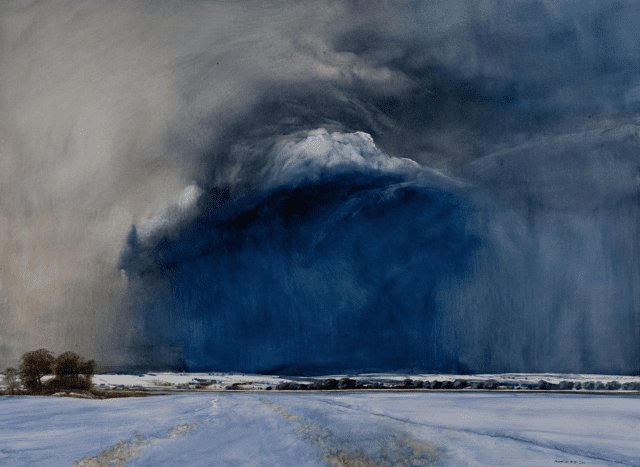
After all the storm and fury involved in the trilogy, and his more recent campaigning doc Flint, about the water poisoning scandal in Flint, Michigan, Baxter has made a new film in a very different groove. Eye Of The Storm (which world premieres at the Glasgow Film Festival February 28) offers a lovingly crafted portrait of James Morrison, one of Scotland’s greatest – and most unsung – landscape artists.
The documentary (made through Baxter’s company Montrose Pictures and backed by BBC Scotland) will be released in the UK March 5 by Cosmic Cat. International sales are handled by Journeyman Pictures.
Eye Of The Storm has an extra poignance because it was shot right at the end of its subject’s life. Morrison died at the end of August 2020.
The artist had been a near neighbour of Baxter’s. He had seen You’ve Been Trumped and had written Baxter “a very nice letter” about it. Morrison had been horrified by the way Trump’s golf courses were disfiguring the Aberdeenshire landscapes he so loved.
Baxter’s uncle knew Morrison well and arranged for the director to meet him for a coffee. At the time, three or four years ago, Morrison had stopped painting because of his deteriorating eyesight. “He was talking about going back to it. My uncle Dennis was encouraging him to do so.”
In the end, Morrison did pick up his brushes again and Baxter was there to record the process.
The director regarded Morrison not just as an artist but as someone who, on his trips to the Arctic to paint the ice caps, had turned into an unlikely eco-warrior. He was “unwittingly documenting a diminishing landscape. He didn’t go out to record the effects of global warming or anything like that but he did so by being there. He was capturing these incredible landscapes in a way that no-one has done ever.”
Baxter asked Morrison if he would agree to be filmed, to which the artist said yes. Then, in September 2018, Baxter started “doing a little bit of filming, as a trial.”
Morrison was in his late 80s but remained a virtuoso. Baxter was fascinated by the way he adapted his technique now his eyesight was no longer as sharp as it had been. He found it difficult to judge distances. His work had a certain blurriness. As an arch perfectionist, he was frustrated that he couldn’t achieve precise effects which once came easily to him. Nonetheless, the filmmaker regards the paintings Morrison completed in the last years of his life as being among his very finest.
These final works were displayed in an exhibition, ‘From Angus to the Arctic’, at the Scottish Gallery in Edinburgh in early 2020. Baxter was there to record the event. Shortly afterwards, Morrison went into a care home in Montrose. The director went to see him there when that was still possible, before such visits were stopped by Covid regulations.
“It was strange seeing him in that setting because he seemed so at home in his home, with his paints and his studio, which was so light and airy,” Baxter remembers. “His studio felt like a very special place. You feel that with artists and sculptors, people who’ve worked in a setting for a long time. It [the studio] becomes a part of them. It can become a character in his own right.”
Morrison was “a joy to be with, a very selfless man.” He may have been a renowned artist but he was always curious about others. Baxter approached him in the same way as the subjects of many of his other films.
“You have to spend a bit of time without the camera going to establish that relationship and that trust,” Baxter explains.
Eventually, Morrison was so comfortable with him being there that Baxter was able to capture him at the canvas and to film the brushwork as it happened. “I do find it really helpful when there is just one of you in there with the subject.” Extra crew members, he suggests, might have destroyed the intimacy. Baxter only filmed in short stretches. He knew that his subject was an elderly man and didn’t want to tire him out.
It helped that the artist had fronted a BBC arts programme several years before and so had experience of cameras. “He was just a real natural I think,” Baxter says of his screen presence.
Although Morrison is most celebrated for his landscapes, he grew up in Glasgow where his father worked in the Clydeside shipyards. As the documentary reveals, the young Morrison was a natural artist, doing precocious drawings of Mickey Mouse as a kid, and eventually landing a place at Glasgow School of Art. Long before he began his seascapes and skies, he was painting grimy Glaswegian tenements and slums with the same poetic but forensic eye.
This was a perfect project to edit during the lockdown. If he needed extra shots of the landscapes around Montrose, Baxter could just go out and film them.
“After all that holding people to account [in the Trump films and Flint], it did feel a breath of fresh air really. There is something about James’s work that makes you appreciate the landscape so much more,” Baxter reflects on the quiet pleasures of making a documentary about someone like Morrison…as opposed to someone like Trump.
There may still be battles with Trump ahead. As Baxter notes, “the story here in Scotland is still very much alive after Trump left the White House – although a recent attempt by Green MSP Patrick Harvie to pursue Unexplained Wealth Orders was rejected by the Scottish Parliament. Trump’s plans for a second golf course in Aberdeenshire were green lit by Aberdeenshire Council in autumn of last year meaning another stretch of unique coastline could be destroyed.”
Baxter isn’t currently planning another Trump documentary but won’t rule one out. He is executive producer on a TV dramatisation of You’ve Been Trumped which is being developed by Vertigo Films. At the moment, though, his focus is firmly on Eye Of The Storm and honouring the memory of its subject.
“He (Morrison) is not that well known but his work to me stands up with some of the great artists,” Baxter says of the painter whose reputation looks certain now to grow.
Eye Of The Storm had its World Premiere at the Glasgow Film Festival on Sunday 28 February and is now available in virtual cinemas.