

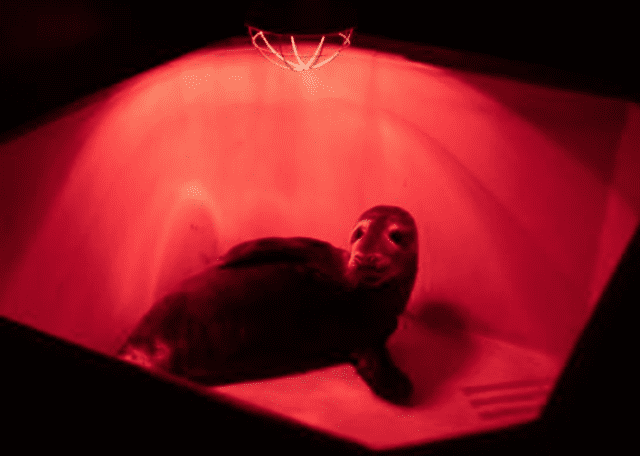
© Tanya Haurylchyk
Danish filmmaker Robin Petré carefully considered the title of her debut feature, From The Wild Sea. “It’s not so much a film about the sea, it’s almost a film from the sea. It’s as if the sea is speaking to us. I really like that idea.”
The poetic feature documentary, which premieres in Berlinale Generation 14plus, looks at humankind’s troubled co-existence with nature by following marine rescue groups in the UK, Ireland and the Netherlands. The seals, whales and swans they work with have seen the detrimental impact of man on their environments via oil spills, plastic pollution or climate change fueling violent storms.
The journey of From The Wild Sea started more than four and a half years ago, when Petré was researching cross-species empathy. That led her to marine creatures. “I was also very attracted to do something about the sea, because it’s so hidden and the last remaining wilderness. I was interested to frame the film around water, and also the whole shoreline that is the borderland between our world and their world.”
The result is not your typical nature documentary. “This film is looking partly at the rescue and rehabilitation processes from the perspective of the animals that are actually getting rescued,” she explains. “So it’s a quite different take on the subject.”
She continues: “Just as the animals are also protagonists of the film I also feel that the sea is a protagonist, and the weather. The sea does have a personality in this film.”
Petré is no stranger to the animal kingdom. She had close ties to nature growing up in rural Denmark. Her 2016 award-winning short Pulse was about a deer farm in Hungary.
From The Wild Sea may inspire audience soul-searching about which animals we rescue, and why. Why, for example, does it make humans feel good to save an adorable seal? “It’s a really, really complex topic, it was really important for me to not be a judge. I didn’t want to create this black-and-white idea of what is right and what is wrong; but to take a step back and leave a space around the film for people to bring their own conclusions and their own values into it.”
The doc doesn’t just show successful rescues, of course, there are also disturbing scenes of dying or dead animals. During the editing process, she and editor Charlotte Munch Bengtsen (The Truffle Hunters) “had a lot of discussions about like how much death we could have in the film. The truth is that a lot of these animals don’t make it. I wanted to show the reality but it was about finding the balance, we didn’t want to overdramatize it either.”
Petré managed to shoot 95% of the footage she needed before the pandemic lockdowns, and was able to land the final scene — of a rescue group training new volunteers — in September 2020. She finds it relevant that the film is premiering as the global crisis continues. “This pandemic is also linked to the interaction [between humans and animals]. How are we going to maintain this balance of nature?”
From The Wild Sea will certainly impress adult audiences and cinephiles (including many who loved Gunda at the Berlinale last year), but the director is also happy that the Generation section of Berlinale wants to show it to teenagers and young adults. “I think my film can be very powerful for young people,” she says. “There are many young people that we see volunteering in the film and they’re not naive, they’re part of this generation who brought the world climate awareness.”
Capturing climate change in action meant that timing was of key concern in this production. Of course Petré had to be ready to immediately spring into action when an oil spill occurred in the Netherlands, or when a large whale came ashore in the UK, or when a big storm was looming in Ireland.
But she also had to be very patient. “The most obvious challenge filming animals is that it’s not a person who you can direct, you really have to wait for the moment. That requires you to spend so much time with them and just wait and wait and observe them.” She found that each seal “has different personalities. They react completely differently to the rescue situation. Some of them are not so bothered in this human construction they are placed in, and yet there was one seal who was just yelling and yelling and he was really upset.”
The director’s wife María Grazia Goya (they met on the Doc Nomads Masters degree course seven years ago, and have since collaborated on other projects) served as the primary DoP, with Petré also shooting some footage herself, especially in the research stage. She says Grazia Goya’s eye was crucial in the “developing of the animal perspective.”
The careful pacing of the film includes some shots that are up to five minutes long. “This is the moment that you actually get this connection with the animals. It takes patience,” Petré adds. The film also includes a human perspective, from rescuers such as Dan Jarvis and veterinarian James Barnett.
Moving from shorts to her first feature-length documentary meant “more patience required and more efforts required,” Petré says. “It was a big step.” She is also currently working on a completely different kind of project, collaborating with a painter and writer on a multimedia art project associated with a Danish national park.
And Petré’s fascination with the natural world will continue in her next feature, a “big international project” that tells another story about humanity’s coexistence with nature.
From The Wild Sea has its world premiere in Berlinale Generation 14plus on March 3. DR International Sales handles the international rights. Malene Flindt Pedersen produces for Hansen & Pedersen, and the film is backed by the Danish Film Institute’s New Danish Screen initiative.





