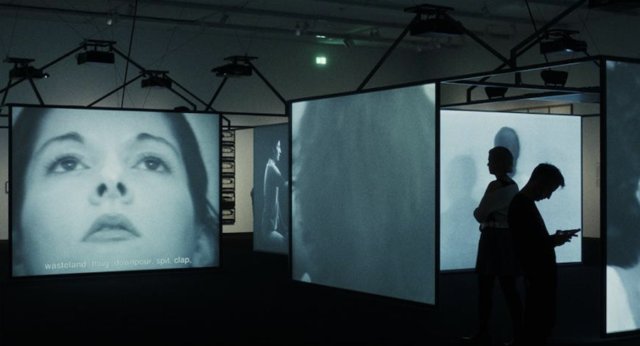
In 1975, Dutch filmmaker Joeri Pruys’s father, Simon Mari Pruys, directed a highly provocative TV documentary called Body Art which contained excerpts of the then-young and little-known Serbian artist, Marina Abramović, performing ‘Thomas Lips’ at De Appel cultural centre in Amsterdam. This is an art piece where a naked Abramović drinks a litre of red wine, eats a kilo of honey with a silver spoon, carves a pentagram in her stomach with a razor and then flays herself with a whip until she no longer feels the pain.
Body Art was supposed to be shown over two consecutive Sundays on Dutch TV in January 1976. “The idea was that this would introduce the idea of body art to general audiences,” says Joeri. “The programme itself features performances by body artists so it is, in some respects, quite shocking, especially the performance by Abramović at the end. That was very…in your face, very confrontational.”
Now, Pruys has directed his own documentary, Final Cut, a world premiere this month at the Netherlands Film Festival, which looks at how his father’s TV show turned into one of the most notorious cases in the history of Dutch censorship.
Broadcaster NOS lost its nerve about showing Body Art. Trying to curry favour with the conservative politicians, who (they feared) might cut their budget or cancel their license, they pulled the programme. Pruys believes it was “sacrificed” so NOS could keep its funding. Ironically, this gesture didn’t stop the politicians from interfering with the running of NOS.
The programme itself, though, was seemingly consigned to oblivion. “You could say it was self-censorship by the broadcaster,” the director reflects. “What NOS did was put a permanent embargo on this material which meant it could never be shown to anybody or used in any other kind of TV programme.”
The intrepid Pruys managed 15 years ago to get hold of a low-res copy of the banned programme – but discovered that Abramović’s performance of ‘Thomas Lips’ had been erased. “At that point, I thought, OK, that is probably lost to history. We will never be able to find it again.”
However, as his documentary reveals, the footage was re-discovered, and Pruys received special permission to screen it at the Eye in Amsterdam.
For Abramović, this is a deeply personal affair. It was in Amsterdam that she met her lover and artistic partner, Ulay. The scandal around ‘Thomas Lips’ marked an important point in her career. Although the TV programme wasn’t shown, she became an instant media celebrity in the Dutch and international media.
Broadcaster NTR (who took over the arts and culture shows made by NOS) now claims rights to the programme, but Pruys, who was only two when his father died in 1980, believes that he should be entitled to use the material as he sees fit.
“The rules around who is actually the owner of this material are very vague. That is why in the film I am also saying it is my heritage so I should be able to do with it whatever I want, because my father created this. It’s Marina’s work as well, so she should be free to use it.”
In 1976, Abramović’s work was considered deeply subversive. However, she is now one of the most revered figures in the international art world – and was the subject of a major exhibition at the Stedelijk Museum in Amsterdam in 2024. Even that hasn’t helped to get Body Art back into circulation.
The documentary isn’t just about the suppression of body art. The writer-director draws parallels with censorship that continues today within the Dutch cultural world. It has one section dealing with the 2023 edition of International Documentary Festival Amsterdam (IDFA) when pro-Palestinian activists interrupted the opening night ceremony holding a banner with the slogan From The River To The Sea, and the festival then issued a statement apologising for allowing the activists on stage. Palestinian artist Basma al-Sharif talks about her experiences in the middle of the controversy, and why she withdrew from the festival.
Several interviewees in the documentary linked to De Appel argue that media and cultural institutions today are still being threatened financially by right-wing governments – and are still failing to stand up for artists and their freedom of expression .
Pruys made Final Cut through Rainproof Media, the company he runs with Ewoud Bon and Sytske van der Ster. Early on, when he was developing the project, he felt “this story should stand on its own,” and didn’t emphasise the personal connection through his father to the banned film.
“But the more entangled I became with the subjects in this film, the more I felt that if I am not putting my own perspective in this film, it would be hard to connect all of the dots.” In the end, he decided to introduce himself as a character in the documentary. He is also the narrator.
Pruys approached Abramović around seven years ago. “It’s like sending an email to Madonna,” he jokes about first making contact with the celebrated performance artist. “It feels like you are never going to get a response, it is never going to have any urgency for that person on the other end of the line – but I felt like I needed to have her story, otherwise I don’t have a film basically. Strangely enough, I got an almost immediate response and she was immediately very enthusiastic.”
Abramović called him by WhatsApp, saying ‘let’s set this up, let’s make it happen.’ Performing ‘Thomas Lips’ at the Appel and meeting Ulay was “one of the key moments in her life and it was documented – and that document had been taken away from her. For somebody like Marina, this has a very strong and symbolic force.”
Pruys visited her “place in upstate New York” and couldn’t help but notice her house is constructed in the shape of the star that she carved into her stomach when performing ‘Thomas Lips.’ She also has two hangars stuffed full of her art works, archives, books and magazines.
“This was also when I realised that was why she wants to hold on to these pieces of material, because they tell her life story and she wants to make sure people understand where she is coming from and where performance art comes from.”
The project was equally personal for Pruys too. Making it, he realised just how radical his father had been. “Once I started to delve into what he had made and what it said about his perspective on the world, I started to figure out there was much more of an ideological slant to his work.”
His father, the director realised, had always taken a firm position against the establishment. “That was part of who he was – and that is one of the discoveries I made, that I am so much more like him than I thought.” Pruys reflects. “I started to realise the radical nature of him and his work.”
Pruys is in talks with Dutch distributors and international sales agents about the release of Final Cut. The film has also been selected for the Brussels Art Film Festival (10-15 November).
The writer/director/producer is now developing a fiction film, Real Blood, which he describes as a horror film about the art world. “It’s not necessarily about censorship but about marginalised voices in the art world trying to have their voices heard but who are manipulated to make work where they cannot be true to themselves.” He is also “tentatively developing” another documentary “related to the colonial history of the Dutch in Indonesia.”
During the premiere on Sunday, 27 September, a live performance by Palestinian-Syrian artist Ahmad Mallah will take place on stage following the screening.