Larry Krasner is one of the most divisive and charismatic figures in US local politics. As a criminal defence lawyer, he was relentless in his attacks on the Philadelphia police and legal establishments, highlighting their racism and incompetence.
He campaigned against gun violence, police corruption and the absurdity of a penal system which locks up so many of its impoverished and disenfranchised citizens at such vast expense. Then, in late 2017, he was elected District Attorney of the City.
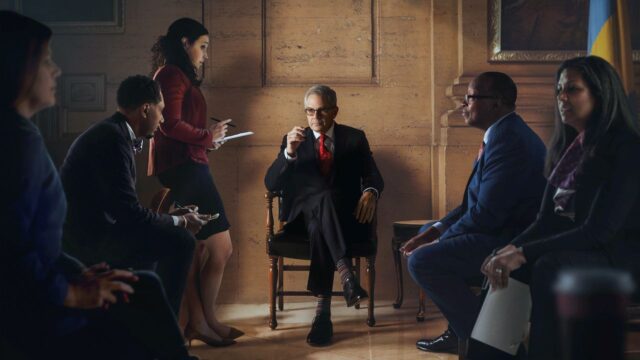
New PBS docu-series Philly DA (screening in Berlinale series and sold at the EFM by Dogwoof) follows Krasner as he tries “to upend the justice system from the inside out.” Made by Ted Passon, Yoni Brook, and Nicole Salazar, this is classic cinema verité in the tradition of Fred Wiseman and DA Pennebaker, in which the filmmakers embed themselves in the heart of the institution that they are documenting.
“I first became aware of Larry Krasner in 2017. I started seeing [election] signs go up in our neighbourhood,” Philadelphia resident and co-director Brook recalls of the main subject of the epic series. Brook’s friends were talking about Krasner being “the real deal,” a populist progressive who might get hold of the reins of power.
The documentary was proposed to Krasner when he was still campaigning. “We were also filming his opponent, Republican Beth Grossman. We weren’t necessarily putting all our eggs in Larry’s basket. We didn’t know until he became the District Attorney what our level of access would be,” Brook notes.
Krasner was comfortable with cameras around him. His communications staff were far less encouraging. They told him and the filmmakers that the documentary was a “terrible idea.” Others in the tight-knit world of Philly politics were wary that the documentary would be used to “prop up” Krasner and that it would be biased in his favour. With his abrasive personality, habit of firing people at whim and crusading zeal, the new DA had plenty of enemies. In order to succeed, he was going to have to work with the police department and the City Council but he wasn’t the type to ingratiate himself with people he didn’t respect. Instead of quiet diplomacy, he preferred the bull in a china shop approach.
The filmmakers were adamant from the outset that they needed complete editorial independence. Their intention was to show what worked in local government and what didn’t – to make a documentary that might help other cities faced with similar problems to those confronting Philadelphia. They were trying to encourage civic engagement and to help audiences understand how “the levers of power” (as Brook puts it) operated in their own communities.
Producer Salazar recently won the Sundance Producers Award for Nonfiction for her work on the series. As she points out, the main investment the filmmakers needed to make was of time. The politicians all became so accustomed to the documentary makers being there that they carried on their business without any self-consciousness.
“We had to be following and tracking many, many stories at the same time,” she notes of the huge logistical challenges behind the series. “With verité, you just have to be there. You don’t know when the meeting is going to happen or where the critical thing will be said. You have to over-invest your time into being in those places…it was a lot of improvisation, a lot of running around frankly.” She calculates that they shot around 800 hours of material. There were assistant editors assembling footage right from the beginning.
The film delves deep into the minutiae of local Philly politics. There are lots of scenes of politicians sitting around conference tables, earnestly discussing strategy and budgets. A Michael Bay movie this wasn’t. Nonetheless, the filmmakers were determined to make it as entertaining as possible without simplifying or trivialising the subject matter.
Like co-maker Brook, Ted Passon is based in Philadelphia. Ask him what he learned about his home city by making the documentary and he suggests that he now sees the criminal justice system in a very different way. “It’s like any small town…everybody knows everybody’s dirt,” he says. “So much of these very fragile, flawed inter-personal relationships are responsible for a lot of people’s lives. It’s interesting to see that human element up close.”
On one level, it was uplifting to be get such intimate access to the local politicians. They may have their weaknesses and blind spots but, Passon suggests, most are motivated more by idealism than cynicism.
“It [making the documentary] gave me a respect for how hard it is when you have to answer to so many different groups and constituencies who all have a different agenda,” he reflects. “Everybody we filmed, even if I couldn’t disagree with them more on their philosophy, I always got the sense that the person we were talking to genuinely cared about the issue and genuinely believed they were doing the right thing. The Philly DA’s office has a history of corruption. People have done horrible things but you get the sense that even those people thought they were doing the right thing.”
Now, the filmmakers are contemplating a further serious of documentaries looking at the inner workings of the DA’s office in other American cities. “It would be interesting to use this series as a keyhole to keep looking at these,” Brook suggests. “There are thousands of DAs around the country…most people don’t know who their DA is, they don’t know who makes these decisions.”