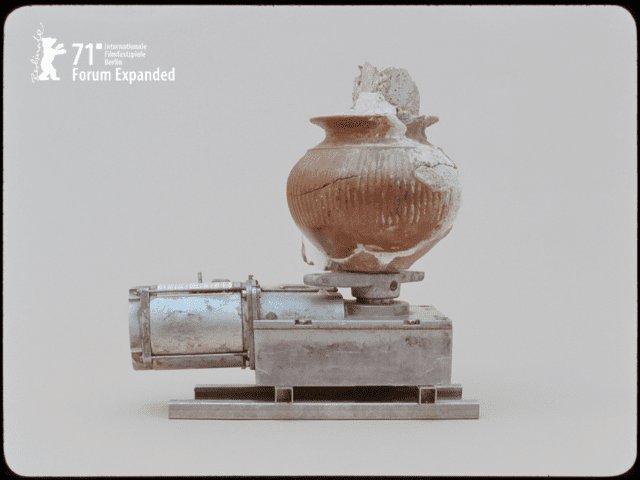
Finnish artist Jonna Kina is back at Berlinale Forum Expanded with her short diptych film After Life followed by Red Impasto Jar, inspired by her discovery of an ancient burial object, looted from a tomb and cemented into a wall before ending up in an Italian museum.
The short film is, as is the wont of all diptychs, an artwork of two halves. In this case, very distinct halves. After Life is slow and lyrical, a series of shots of 10-seconds or so duration that establishes a natural world of trees, leaves, reflections and leaves, brooks and ripples on water, shot in part in delicious green crepuscular light. Midway through we see the ancient stone tombs, almost biblical, which preface the second part of the triptych.
Red Impasto Jar comprises a piece of pottery on a mechanised turning platform which undergoes a 360-degree revolution. The cement used to attach it to a wall some time in its past still clings to, and even partly fills, the jar’s round belly.
The visuals are accompanied by a careful and judicious soundtrack, which is governed by the sound of water and birdsong in the first segment, and by a gentle motor in the second.
“I was staying in Mazzano Romano, Italy in late 2017,” explains director Jonna Kina of the work’s inception. “At the town’s small archaeological museum (Museo Archeologico Virtuale di Narce – MAVNA ) I became interested in an ancient looted tomb object that was presumably originally intended for use in the afterlife. This ancient Faliscan tomb item dating back to the 6th century BC had undergone a radical transformation after its removal from the tomb: it was cast to a wall as a decorative element.”
“I wanted to address the essence of this metamorphic artefact and its story as part of a new work,” she continues. “The object seemed to tell a multidimensional story about the afterlife, about the aura of the object, scientific valuing, past and present, our relationship to other cultures etc.”
The work comprises two very distinct elements which at first viewing may seem fundamentally at odds (albeit making for a contrast both stark and satisfying). Is this how Kina sees it?
“The work is a diptych film with two quite different methods of filmmaking. Both films deal with transcendental themes through archaeological and illegal excavations of tombs. First I thought I have two separate films, but as a diptych they tell a more complete and complex story. First a context and then a detailed documentation of an artefact,” she answers.
“Nevertheless there is no clear evidence that this object originates from these tombs because they were looted. The looting of ancient tombs is not only problematic from a moral point of view. Even if some artefacts are later found, the context of the discovery, which is of great importance in archeology, is lost.”
The framing of the work’s second part is redolent of Kina’s Akiya, selected for Berlinale Forum Expanded in 2020. In that film we see an analogue reel-to-reel tape recorder playing what may be a song (or a prelude to a song) until the tape eventually rotates its way to liberation form the mechanism. Both films are hyper clear and unambiguous both in their presentation and framing.
“These kinds of images are like a laboratory or an empty stage for the observer. All the elements play important role – also the observer. I am interested about the viewer’s relation to the artwork and the whole situation. I wanted to create choreography for the jar, kind of similar method that I had in my earlier film Akiya,” comments Kina. “The film portrays the state of the pottery focusing on the detailed choreography and documentation of the object with a slow 360° rotation on a robust industrial motor. The motor being visible was essential: to reveal the mechanism but also creating a dialogue with this 2500-year-old object.”
When asked about the film’s aural component, Kina’s answer could easily be that of a proud sound designer. “In my works – also other than film works – sound is an essential factor. Sound in films is at least equal in importance with the picture. It should be treated with same care as the image. Listening is an important part when creating sound in works or dealing with the idea of sound. Even silence usually consists of sounds or noises. The flow and composition of time is well adjusted with the design of sound in films. This is a powerful tool in cinema.”
After Life followed by Red Impasto Jar was made in collaboration with the Museo Archeologico Virtuale di Narce – MAVNA (Mazzano Romano), and is distributed by
ArtArsenal – Institut für Film und Videokunst e.V., and AV-arkki – Centre for Finnish Media.