

Aliaksei Paluyan tells Business Doc Europe about his extraordinary feature doc debut Courage, which follows three members of the Belarus Free Theatre (two of whom have been recently jailed) during a summer of riots following the country’s rigged 2020 election.
As director Aliaksei Paluyan points out, it all seemed so civilised at first. A troupe of actors, looking for all intents and purposes like “Berlin hipsters” are rehearsing in a cool loft. But they are being directed via Skype, and the scenes they rehearse have a harsh, sardonic polemical edge. (Director Nikolai Khalezin is in London, a political refugee.)
When Paluyan started making his film back in 2018, his goal was “to understand what it is to be a free, independent artist in such countries as Belarus.” But things changed radically in 2020, firstly after President Lukashenko denied that the country had a Covid problem. “Coronavirus? No, I don’t see coronavirus,” Paluyan mimics the country’s leader.
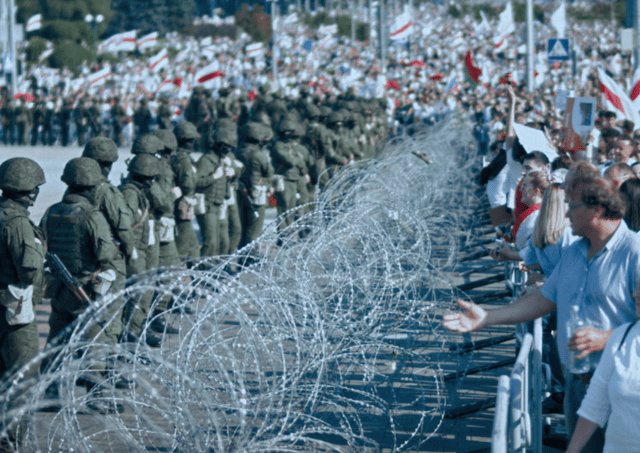
And then there was the country’s election in August and the “three days of hell” as the people took to the streets, protested and rioted, following the announcement of Lukashenko’s victory, whose legitimacy the EU rejected. The protests still continue.
All the time we follow actors Maryna, Pavel and Denis, as they witness and take part in the demonstrations, and then take to the stage (Maryna and Pavel) to make their own contribution in the powerful revival of a protest play.
In shooting the demonstrations, Paluyan describes how he “makes the invisible visible,” articulating the seething discontent of a population. “You see this demonstration, you see these grenades, you see this gas. You see these protagonists inside this situation and it will be much more clear for you as an audience to understand now their existential conflict.”
The footage of the riots is amazing, shot at dusk or at night in wide frame, with flares, explosions, advancing lines of black-clad military and vast crowds ready to turn and scatter in an instant.
Then he shoots the increasingly desperate relatives and friends of jailed protesters as they await news of their imprisoned loved ones. And then he records the continuing stand-off, the “stalemate” as thousands of citizens stand outside a parliament building that is continually protected by a long line of militia.
All the time we see and understand the aesthetics of conflict, as they happen in real time, unstaged. A protester climbs to the top of a statue and drapes the red and white free flag of Belarus, to the cheers of protesters. And yes, a flower of peace is attached to the shield of a soldier, who is happy to let it remain there.
“My intention was to bring the whole emotion of the protest that my protagonists are going through in this film, from hope to angst, from euphoria to depression.” says Paluyan. “It was a structure that should not be linear. But up and down, as in life when you go through this process.”
The director articulates an acute dilemma. He fears for the recently arrested Denis and Pavel (as do their families) just as the film’s profile is likely to go stratospheric after its Berlin world premiere. Nevertheless Paluyan is fully aware that the genie is out of the bottle, and acknowledges the numerous messages he received from Belarus after the film’s trailer was uploaded to YouTube. He further acknowledges his colleagues in the Belarussian filmmaking community who were not “as lucky as me… they were arrested and they lost their material.”
The play that the Belarus Free Theatre performs at the end of the film is genuinely heart-breaking, a reminiscence of a romance that we discover is told by both a woman and her murdered lover.
If the performers’ story within Paluyan’s marvellous documentary is one that charts their journey from acting to activism, how does the director himself describe his own contribution to the struggle?
“I ask myself, ‘Aliaksei, are you an activist or are you a filmmaker?’ And my answer is: ‘I am a filmmaker.’ My active role in this process right now is to bring this unique material – this reality – to audiences. And I do this better as a filmmaker. I catch these moments. I catch this process and I make a film.”





