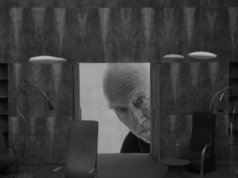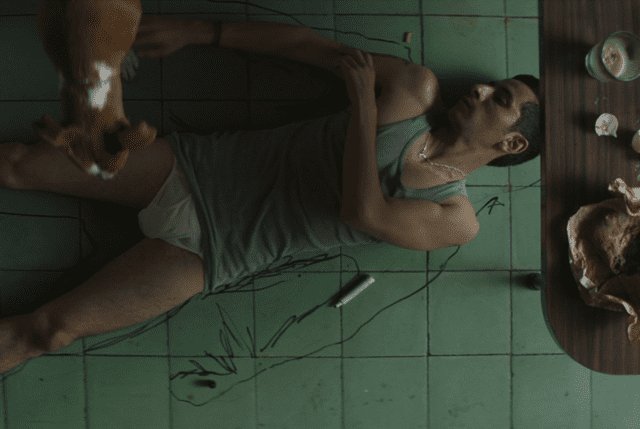
In recent years, lines between documentary and dramatic features have become increasingly blurred. One new feature which straddles the two forms in bravura fashion is Mexican director Alonso Ruizpalacios’ A Cop Movie (which world-premiered in Berlin competition). BDE interrogates the director.
Like fellow Mexican director Alfonso Cuaron’s Roma, Ruizpalacios’ film is being distributed by Netflix. A Cop Movie offers a nuanced, detailed but ferociously intense insight into the inner workings of the Mexican police. Its two lead actors Monica Del Carmen and Raul Briones Carmona undertook extensive training at a police academy in order to play their roles. Midway through the film, the director lays bare the device and reveals that they are indeed actors. They talk on camera about their preparations.
“This was a very genuine thing and a very natural and organic path because of how it started,” the director says of the way he intertwines the drama and doc elements.
Daniela Alatorre and Elena Fortes, two leading documentary producers, had approached him, wanting to work with him. He was from the fiction world. They pooled resources…and storytelling styles.
“We started off just trying to do a conventional documentary about corruption and impunity in Mexico. Then, that led us down the path of the figure of the policeman and police woman as the frontier between the state and the citizenship. [But] when we started interviewing policemen, we came to the problem of how are we going to show visually all that they are talking about, all these little acts of corruption.”
The idea wasn’t just to bring in actors to play policemen but to encourage those actors to…become police officers for real. “They became our avatars, as spectators, to delve deeper into the police world.”
The film has an astonishing early sequence in which the inexperienced, badly trained cop Teresa (Monica Del Carmen) is confronted with a woman in labour in a poor and violent part of Mexico City, with no doctor or nurse in sight. She delivers the baby. If the scene seems extraordinarily realistic, that is because a real baby was indeed being born.
Like every part of the film, the scene is based on an actual incident. “When Teresa told us that story, I knew instinctively that was a great way to start. It’s a story which has so many layers and says so much about the unpreparedness and the precariousness of Mexican society; about inequality and also about the lack of access to ambulances that people have,” the director notes. He was determined to make the scene real. The filmmakers shot it over two nights. Then, they got in contact with a woman who was about to give birth at home and was willing to allow them to film the process.
“We said, in exchange we will give you a really nicely shot video of your birth for you to have for posterity,” Ruizpalacios remembers. This real-life birth was then edited into the fictional sequence. “We accompanied her through the birth…we were in there for 12 hours. I am really proud of those little inserts of the baby actually coming out of the womb.”
At the start of the project, Ruizpalacios and most of the other cast and crew members had a low opinion about the Mexican police. By the end of the process, though, their perspective had changed entirely. “I think that is one of the beautiful things about filmmaking and about documentary filmmaking. It really immerses you in somebody else’s world,” he reflects. “I don’t see them [police officers] as I used to see them, which is as a common, faceless force. I see them as these very vulnerable human beings. I hope the film is not apologetic. It does not separate them [the officers] from their role in the chains of corruption but it just makes us aware of why it happens and where it comes from.”
Ruizpalacios has directed episodes of hit Netflix series Narcos. No, he says, that experience was nothing like that of working on A Cop Movie. “It’s the opposite…this is stories of real people,” he states. In A Cop Story, he was looking at “what it really means” to be a policeman in Mexico.
The hope now is that the film will be given “some sort of theatrical life” before arriving on the Netflix platform. “It is obviously a different world with what we are going through now [with the pandemic] but I will always be a defender of watching films in the cinema.”