

Pic: courtesy of Magnolia Pictures
Alexander Nanau discusses his shocking documentary Collective, nominated for two Academy Awards, which lifts the lid both on ministerial-level corruption and abuse of power in his home country of Romania.
The red line of Alexander Nanau’s Collective may lead us from a newsroom, populated by a small team of dedicated investigative journalists, into the heart of power within Romania’s Ministry of Health, but the viewer is made continually aware of the terrible tragedy that sets the whole narrative in motion, and which gives the film its title.
On October 30 2015 a fire at the Collectiv night club in Bucharest killed 62 people. Twenty-six of those died at the venue, while 38 died later in hospital. But what soon became very clear was that none of the Bucharest hospitals were ever equipped to treat burn victims, despite Health Ministry assurances that standards of burns care could rival that of Germany.
In reality it was quite the opposite, as the capital’s hospitals were rife with bacteria, most prominently the deadly pyocyanin bacteria which fed voraciously on the patients’ injuries.
What’s more, journalists (led by Cătălin Tolontan, of sports paper Gazeta Sporturilor) discovered that the disinfectants habitually used in the hospitals, including operating theatres, were diluted to a tenth of their strength, rendering them useless. The disinfectant’s corrupt supplier Hexi Pharma had supply deals with 350 hospitals across Romania.
So far, so appalling. But then the journalists further discovered that the authorities had known since 2008 about the increased rates of bacteria-related deaths in Romanian hospitals, but had failed to act.
After the Health Minister resigns, salvation seems to present itself in the form of successor Vlad Voiculescu, a former patients’ rights campaigner who at first seems gentle and awkward, but who, in essence, has a core of steel. Little by little, as director Nanau’s cameras are trained on him and his colleagues within the ministry, he begins to understand the depth of corruption within his department which he must find a way of rooting out.
Collective is unusual in accommodating this major shift of emphasis halfway through, from the newspaper offices into the state ministry to chronicle the activities of the new health boss. It was a decision that had to be taken quickly by Nanau after he was granted official permission to record, and in spite of the complications he knew he would have to later deal with in post-production.
“It was, for sure, a decision that had to be taken fast, a decision where I knew I’d face a lot of problems in the editing room,” says Nanau. “Changing a main character in the middle of a story is hard, but at the same time it connected to my first instinct of really wanting to understand power. I wanted to make a film in which I, as a filmmaker, learn something about power.”
As importantly, the decision felt right given how the man taking over the ministry was obviously better disposed to discharging his duties with integrity. “I thought that if it feels organic in real life, there must be a way to translate it also for the viewers into something organic within the storytelling.”
Voiculescu subsequently unpeels layers of Mafia-like nepotism and corruption involving the political appointments of hospital “managers” who control and regularly mismanage budgets reaching hundreds of millions of euros. Little of this money, it seems, would ever find its way into the local hospitals in direst need of financial support.
For Nanau, the process of recording all of this may have served “as a shield” but he admits to being deeply affected by the process. “Emotionally it was the project that made me develop most until now,” he says of the lack of humanity that he was observing and recording on a daily basis. “I really thought this is Hannah Arendt’s ‘banality of evil’ in real life. That’s what it is. I suddenly understood what she meant…how people for money and for profit really kill people, and that was hard to grasp. The company diluting for ten years these disinfectants and the whole state being complicit in that…It’s very hard to wrap your head and heart around it.”
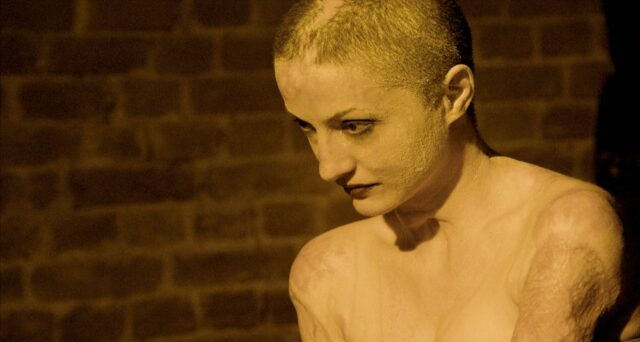
A very important character in the documentary is Tedy, one of the Collectiv victims, a woman who confronts the new reality of her life both with astonishing braveness and without rancour. Her fingers may be mere stubs and her skin might be scarred and lacerated but she poses for artistic photographs that reveal, without even a scintilla of compromise, the extent of her injuries.
“Tedy for me was really an enigma in the way that her reaction and strength to stay herself goes against our impulse of revenge and of hating those who had done those things to us,” says Nanau. “[She had] the strength to say, ‘I won’t let them poison my whole life, and I am still who I am, just with a different body now and I will show it to the world, so that you cannot cover it up’, [which] made me choose her as the symbol of resilience and the power that people have at any moment in their lives about their life attitude.”
The film may end on a downbeat note as paltry numbers come out to vote in the country’s general election and the Social Democrats are returned to power, but in the late 2020 Romanian election a Coalition government was formed which includes the new USR-PLUS party, of which Voiculescu is a member. He was duly asked to resume duties as Health Minister.
In the meantime, Collective has picked up a slew of international prizes, including a European Film Award. It is nominated in the Best Documentary and Best International Film categories for the upcoming Academy Awards.
“For sure it is a tribute to the victims of this incident, but more than that I think it is also a document that will always stay as a reminder in Romanian society of the point of no return when society said enough is enough,” comments Nanau, adding how the film also addresses a profound existential question among the country’s youth. “It was seen by a lot of people in the generation between 16 and 30/35 and they really are the generation that needs answers. They need to see if it is possible to change their society, because they need the answer to a very simple question – do I stay or do I go?”
Running time: 109 mins. Original title: Collectiv. Romania/Luxembourg
Production: A Bad Unicorn release (Romania) of an Alexander Nanau Prod., Samsa Film Luxembourg, HBO Europe production, with the participation of Mitteldeutscher Rundfunk (MDR), Radio Télévision Suisse (RTS), RSI Radiotelevisione svizzera, YES Docu.
Producers: Alexander Nanau, Bianca Oana, Bernard Michaux, Hanka Kastelicová.
Executive producers: Antony Root, Philippa Kowarsky.
Int’l sales: Cinephil
Director: Alexander Nanau
Writers: Alexander Nanau, Antoaneta Opriş.
Camera: Alexander Nanau.
Editors: Alexander Nanau, George Cragg, Dana Bunescu.
With: Cătălin Tolontan, Mirela Neag, Răzvan Luţac , Camelia Roiu, Tedy Ursuleanu, Vlad Voiculescu, Narcis Hogea. (Romanian dialogue)





