

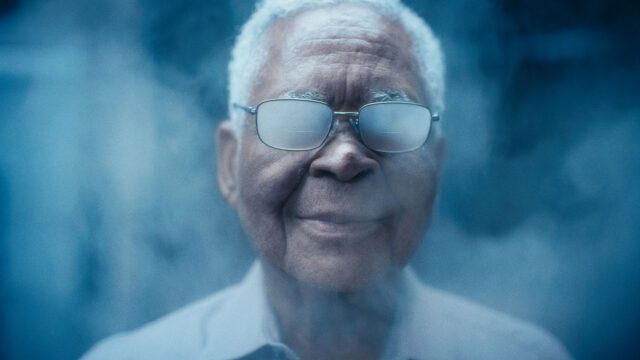
A simple question – what is a concerto? – sets in motion a dialogue, a conversation, between virtuoso pianist/composer Kris Bowers and his astonishing grandad Horace, encompassing over ninety years of lived experience and all distilled into a 13-minute film. Co-director Ben Proudfoot tunes in with BDE.
The development and production of A Concerto is a Conversation may have pre-dated the key events of 2020, most notably the pandemic and the resurgence of the Black Lives Matter movement, but the film serves as well as any other to document, explain and illuminate the contemporary and turbulent times in which we live.
In the doc the conversation between the two men takes place before the world premiere of Kris’ musical work “For A Younger Self’, a concerto for violin and orchestra. A concerto, Kris answers his grandfather, has “two elements, a soloist and orchestra, having a conversation.” At which point Horace takes his cue and tells the fascinating story of his life.
He tells of the indignities his father had to suffer in the 1930s in continually being called ‘boy’ by the adolescent white kid of a neighbouring family. Horace further tells how he was compelled to leave, prepared to head to wherever he could hitch a ride (although he was never going to stick around in Detroit as he hated the snow). When he set off to LA (a place he had hitherto never heard of) he had “27 or 28 dollars” in his pocket.
But Horace was wily. He got a job at a dry cleaning service by calling up in advance, pretending to be a recruitment agent and then sending along the perfect candidate, himself, to fill the position. Later, when he bought the company, he realised that bank loans were never agreed face to face with people of colour. So he conducted all subsequent finances by mail.
Kris tells his own story. Yes, he attended and thrived at the prestigious Colburn and Juilliard schools, but nevertheless the world of classical music, orchestras and film composition was, and remains, one ostensibly dominated by white professionals. “I’m very aware that I’m a black composer, and sometimes I get the feeling I’m not supposed to be in the spaces I’m in, or not supposed to have gotten to the places I’ve gotten to,” he says, despite having scored for such high profile audiovisual works as Bridgerton and Green Book.
“Never think that you’re not supposed to be there, because you wouldn’t be there if you weren’t supposed to be there,” is the sage advice his grandad gives him.
Their conversation is conducted face-to-face-to-camera. To accompany the narration, there is judicious use of archive, and musical motifs and signifiers serve to elevate the story, such as the foot pedals of the steam irons that are pressed with the same sensitivity as the pedals of Kris’ piano.
The high tension within the film derives not from the relationship between the two protagonists, points out co-director Ben Proudfoot – that is one of deep familial love and mutual respect. Rather it is in their relationship with the wider world.
“[There is] internal conflict within them,” asserts Proudfoot, “between Mister Bowers and society and the bigotry that he faced in his life; within Kris and the film industry in terms of his perception… And I think that it is the beauty of it, that a lot of the conversation from Horace’s side is finished in Kris, and a lot of the conversation happening in Kris’ mind is actually finished in knowing Horace’s story, and it’s this bridge that is created when you pull the two stories together.”
When asked how he describes the demarcation of responsibilities between him and co-director Bowers, Proudfoot answers at length and with touching generosity.
“Anybody who has ever made a documentary, you kind of know the key moments that are essential for authorship,” he says. “Kris and I came up with the idea together. Kris conducted the interview…I did a lot of the heavy lifting in the edit. We collaborated on the finishing and of course the film is scored by Kris.” Given the importance of music in the story, Bowers collaborated closely with the sound department, Proudfoot points out.
“So, at the end of the day, when looking at the project, that’s kind of what’s beautiful about it, [how] but for either of us it would have been just a totally different thing,” he continues. “The idea was born together. No-one could have interviewed his grandfather like Kris did and no-one could have written the music for the story like Kris did, or have the ability to give the insight into how to make this conversation feel authentic while obviously dealing with the need to compress a six-hour conversation into 13 minutes.”
“It just became a personal art project for the both of us,” Proudfoot adds. “We set out to make a dedication to Kris’ grandfather and it required both of our effort and both of our input and both of our authorship. And so the co-director credit is how we shared that authorship and that responsibility. And it’s an honour.”





