

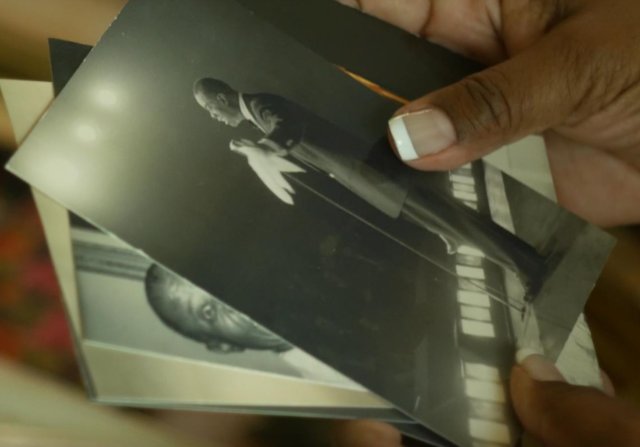
As Sharon Preston-Folta says early on in John Alexander’s doc Little Satchmo, based on her memoir of the same name: “On June 24 1955, Louis Armstrong became a father. Lucille Preston became a single mom. And I, Sharon Louise Preston, became invisible. That’s the way it was. That’s the way it had to be.”
Sharon’s mother Lucille, or Sweets, was a dance performer and part of the popular duo Slim and Sweets, together with her husband Luther Preston. After Slim’s untimely death in 1950, the first person to offer his condolences and support was the already legendary Louis Armstrong, the “ambassador of jazz” with the “1000-watt smile.” Soon afterwards Lucille and Armstrong started an affair, into which both “fell hard.”
But Armstrong was married, and so the relationship, which continued for the next two decades until Satchmo’s death in 1971, had to be conducted in the most clandestine of terms.
All this time both mother and daughter were loved very deeply by him, as evidenced by the messages that Armstrong would record on tape and the numerous letters from which Sharon reads, and they were extremely well supported financially, but marriage was never going to be an option despite Armstrong’s dangling “the carrot of divorce talk.” He had fame, there were societal pressures and the film suggests that his wife’s Catholicism determined that she would never agree to a divorce.
But despite the lavish lifestyle that Lucille and Sharon maintained, all they wanted was Louis. Sharon quotes for a letter from her father to her mother: ‘As long as Satchmo lives, her happiness is assured’. “And he was good on his promised,” she adds, “but I wanted – I needed – him.”
It was some time after Armstrong’s death that Sharon decided that the “stealth” had to stop, when the money dried up due to an amendment made to his will, referred to in the film as “a stroke of the pen by his wife.” And so Sharon determined to go public with her story of her life with her famous dad, a man with “perfect imperfections.”
“I felt so honoured to be able to be the one to bring Sharon’s story to light,” director John Alexander explains to BDE of how he came to make a film which is of potentially huge US and international interest. “First of all, I think really it comes down to my brilliant producers (Lea Umberger and JC Guest) and Sharon herself. Quite a few filmmakers had approached Sharon about adopting her memoir ‘Little Satchmo’ when it came out, about adapting it into something for film or television. And I believe, I don’t want to speak too much for Sharon, but I believe nothing was really quite the right fit.”
But after their meeting, Sharon was satisfied that Alexander was that “right fit.” The director suggests why. On reading the memoir, “my initial instinct was, I don’t want to interfere with this. I want to adapt it as purely and as genuinely as I can without mediating, without inserting my perspective, without deleting things from Sharon’s perspective, but to do as much of a ‘lossless’ translation as possible from the memoir, because I think what’s so strong about the memoir is Sharon’s singular personal voice. That drives the whole thing. So my first instinct was basically like, let’s preserve this voice, this strong voice, that’s a first person perspective of a life that she lived.”
“It’s my film in that I tried to keep myself out of it as much as possible,” he adds with a laugh. “It was a real conscious choice on my part, because it’s very easy for my imagination to run wild and say, ‘oh, we should add this and we should do this. And what if we put a scene like this.’ But no, it really was a collaboration. And it was really an exercise for me in listening rather than asserting my ideas. I was trying to be an open receptacle to Sharon’s voice, to Sharon’s feelings, to Sharon’s thoughts. We really had a lot of intimate conversations where I really tried to just absorb her and her perspective. And to kind of translate that into film as seamlessly as I could without interfering.”
Given that Louis Armstrong has been accorded national (and international) treasure status, is Alexander concerned that this portrayal will tarnish his reputation? Quite the contrary, he argues.
“The irony is if people really care about and love Louis Armstrong, as they claim they do, then you’d think that they would be interested in really knowing more about him and humanizing him and not reducing him to a stereotype or a caricature, when in reality there was so much more,” says the director. “My kind of counter argument to those concerns is, and has been since the development of the film, is that no, this is actually a very compassionate, empathetic portrayal of Louis Armstrong. Does it depict him as a perfect human being? Of course not, none of us are perfect human beings, but this actually brings another level of depth to our understanding of this person that we all claim we love.”
‘This was obviously a burden on Sharon to have a sort of intermittent father presence in her life, which she wished was much more constant, but it was also, I think it’s important to point out, a loss for him as well,” Alexander continues. “He had to bear this burden. He loved Sharon. He absolutely loved her with all his heart. He always dreamed of being a father and he was never able to publicly claim her, which was a secret he had to harbour… due to racism, societal pressures that he was forced to uphold his whole life”
“I think if he had had his druthers, he would have claimed her publicly and taken her everywhere with him and, you know, opened up their relationship for the world to see. But that was something that he had to suppress and he had to hide and that was a loss for him as well… And in realizing that I do have a greater appreciation for not only of course his work and his incredible presence but the struggles that he went through as a human being and as a father.”
The film will do the European festival circuit before returning to the US and domestic screening/broadcast (Alexander wouldn’t go in to specifics). What’s more, the director maintains that, at 60 minutes, it is adaptable for feature or shorter formats “if the deal is worth it.”
“It was sort of a strategic choice on all of our part to premiere the film internationally before bringing it home to the States,” Alexander underlines. “I had some success doing that before with my previous documentary (This is Love, 2018). And what I found is that with a subject like this, which is so iconically American, sometimes it’s nice to sort of save that homecoming for after we’ve had a little bit more success and exposure worldwide, just from a film release strategy standpoint. And also Louis Armstrong was very actively touring in Eastern Europe and Europe in general, and there’s footage of him [in Europe] all over the film.”
And why the Greek docfest for the first showing of the film? “I’ve always dreamed of showing a film at Thessaloniki. It’s a very reputed documentary festival. And the festival has just been lovely to work with, offered us great hospitality and, and made it worth our while. So I have absolutely no regrets about that. It was a great, great choice for a world premiere.”





