

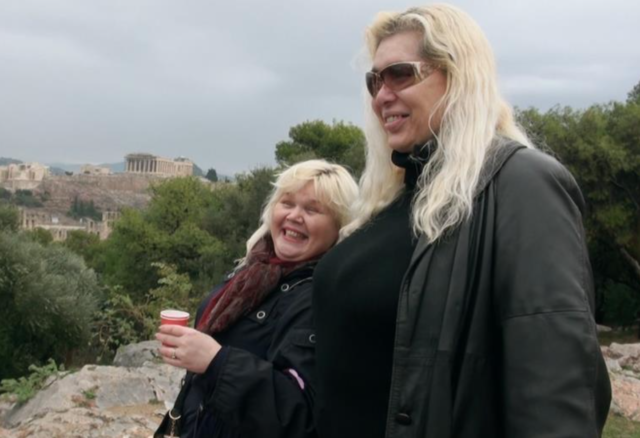
The eponymous Demetra K has a beautiful house in a friendly Athenian neighbourhood, and she loves her job. She is a workers rights campaigner, an animal lover and somewhat of a philosopher. As significantly she is also the flamboyant owner of an art deco brothel in Athens with one employee – herself.
Greek director Eva Stefani has been following Demetra K for the past twelve years, continually fascinated by this larger than life grande dame, in the process developing a very close kinship with her subject.
That said, Demetra showed little inclination to be part of Stefani’s documentary project at first, wary of potential “peeping toms” and people who had nothing other than a “passing interest in the brothel business.”
“As soon as she realized that I was not just curious, but I wanted to know her, I think things were much easier,” says Stefani. “I also talked to her a lot about myself and that I honestly didn’t know what I was doing there. I was there because of things I couldn’t really explain. I didn’t want to do a socio-ecological film about, you know, prostitution in Athens, but I really was fascinated about her. I just wanted to know her better.”
In the film we are told that Demetra’s is the oldest operating brothel in Athens, with a licence originally granted by royal assent. The place is plush and decorated with pictures of the Greek royal family acquired by a father who had served in the king’s army. Originally, there were other sex workers sharing the house, but times became hard and she couldn’t afford to keep them. “But she never had a pimp,” says director Stefani, “because of the way she was.”
Eventually, Demetra decides to move out of her brothel/home to a less salubrious part of town, but into a place that can accommodate her army of dogs, and where she can continue to feed the neighbourhood cats, to the consternation of some of the residents.
And she keeps working, but rendez-vous are arranged via mobile and clients no longer come to the house.
Little by little the film exudes a deepening melancholy. Demetra doesn’t change so much over the 12-year period, and she continually displays her in-your-face attitude and flamboyancy, but one by one her favourite shops close down, such as her favourite bakery, and people get older and die, and a sense of decay seems to permeate the neighbourhood.
“I suppose I was aware of it but I wasn’t so much aware that dying and loss would be so much part of the film,” says Stefani. “But I should have been, because time brings death.”
Furthermore, Days and Nights of Demetra K is set against the backdrop of the chaotic Greek politics of the past decade, and the short-term (and, from Demetra’s perspective, welcome) rise of the left during the country’s financial crisis. But even this leads to disappointment as left-wing legislation is introduced to outlaw ‘prostitution,’ bitterly opposed by Demetra who is also head of the sex workers’ union.
That said, we are told of atrocious acts of violence perpetrated against sex workers, and at one point we hear off camera an aggrieved client angrily, potentially violently, voicing his dissatisfaction.
But the film is never without humour, such as when Demetra describes a young “stud” whom she eventually allows to leave at three in the morning. “I love this kind of guy – you get it,” she proclaims. Also when her friend Ira muses on the power and significance of female genitalia. “A woman begins and ends at the vulva,” she philosophises. “That’s where men take their power from and where they lose their power…and where new life begins.”
At the film’s heart is the relationship between the filmmaker and subject, one which is expressed through the honesty and humanity of their exchanges and the observational incisiveness of Stefani’s camera.
Yet the filmmaker struggles to assess how the project indeed evolved over the past years (noting however that she still doesn’t think that the film is complete but she had to apply a “full stop” at some point.)
“To be honest I can’t even remember because she has gone through so many changes,” the director admits. “At the beginning I was so timid towards Demetra. But our relationship has evolved so much. I was scared at first to question anything. So now in a way I think it has happened, as in all documentaries, that it is now that the documentary should start, because now the relationship is so free. But of course now there’s no more brothel. There is nothing but the two of us, so free with each other, but all the rest is gone. But still it’s a document of a relationship.”





