

The population of Giromeri in the Epirus region of Greece has, like many villages across numerous parts of Europe, plummeted over past decades, its young succumbing to the lure of the big cities. Nevertheless, every year at Easter time, village numbers swell once more, in great part due to a unique custom practised every year, that of a lament for the dead.
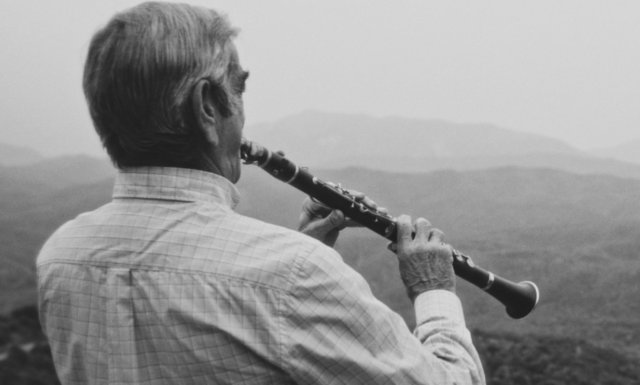
Accompanied by clarinet players, the favoured songs of the dead are sung above their graves, the players systematically moving from plot to plot, responding to the requests of the living relatives.
Memento director Nikos Ziogas, himself from the region of Epirus (although he wasn’t initially aware of tiny Giromeri’s existence), saw a YouTube video of the custom seven years ago and was mesmerised. He was determined to make his own film about the event but his fear of death stood in the way. “The day I decided to make the film was the day that my grandfather, who came from the region, passed away,” says Ziogas.
At first, the director was satisfied merely to record the laments which come to a head on Easter Monday, “but when I visited the village for the first time to meet the people I felt that this should be a wider discussion around life, about the way these people are going close to death through life, through celebrating the memory [of their departed relatives].”
Many villagers are therefore asked to reflect on mortality, one noting how, in the overall scheme of things “we are all passers-by,” another that “life is short.” An orthodox priest offers a more optimistic appraisal, that “we’re here, we’re alive”, while a happy-go-lucky drunk joyously asks, “we live, we have fun, hooray.”
But thoughts nevertheless turn among many to death at this time of year, with one contributor believing the reason to be the wholesale massacre of every male in the village over the age of 14 by occupying Turks one Easter Monday in the early part of the 19th century. “The villagers don’t know exactly the year, it’s something that just exists for them,” says Ziogas, who reveals that his own personal default setting is one of melancholia and nostalgia.
The first time we meet one of the legendary clarinettists is in a café, playing his instrument and singing a lament. “Snakes hear them and stay still, sheep hear them and relax,” we hear of the musical form, before the musicians muster on Easter Monday to play out the annual custom of playing to (and for) the dead.
For one woman the yearly event is very stressful. It is something that must be endured, and so she welcomes its passing, although she tearfully acknowledges, “it’s like we’re telling them (the dead) we are here, we remember you, our roots are here.”
The priest sees it differently. “From the moment they die they don’t belong to society anymore. They belong to our thoughts, to our cycle of imagination, to our own life. The dead take from our blood, from our wine, and live again.”
The contemporary footage in the film is presented in rich black and white, whereas much of the archive is in colour, which marks a neat twist.
“My family had black and white photos since the 1950s, and Epirus in my mind, in my imagination, it was always black and white. It is still black and white,” says Ziogas of his choice of monochrome. “The other reason is that I feel black and white gives you a better connection with something that you are watching. You don’t have so much information from the colour, so somehow you can focus better on the feeling of the image.”
A lovely aside is that three months ago Ziogas’ friends bought him a clarinet in recognition of his work on, and love for, the Giromeri project. They told me, “Nikos, you have to start playing the clarinet. And I’m trying, it needs time because it’s a very difficult instrument. But in September, I’m going to start some lessons because now I’m just playing by myself, making noise.”





