

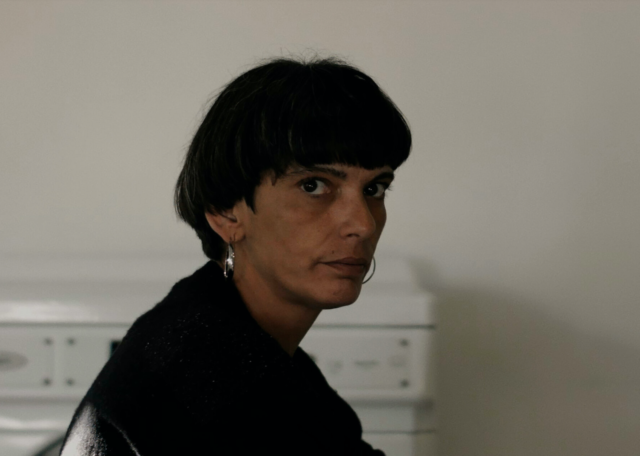
Spanish director Miguel Eek’s feature doc The First Woman (screening this week in Docaviv Panorama) was a project which took extreme resilience and sensitivity to complete. Its protagonist Eva is a schizophrenic who has been in a psychiatric hospital in Mallorca for several years and about to leave and move into an assisted living residence.
The director intended the film (sold by Dogwoof) to be a companion piece to his earlier documentary City Of The Dead, about the everyday lives of workers in a cemetery. When he started work on the project, his first step was to offer a workshop on documentary to the patients in the hospital. That was a way both of building trust and of him getting to know the environment. His first idea had been to make a film about all the patients but, as soon as he met Eva, he decided to focus on her.
“She was someone very special in the middle of this place,” Eek notes of his charismatic and sympathetic subject. Whereas other inmates were condemned to stay there for year after year, she still had a dream of rebuilding her life outside the institution. She wanted to “start again” and yearned for a reunion with her son. She had lost touch with him long ago.
Some of the patients simply didn’t understand what the filmmakers were doing. Others were more receptive to having a camera crew in their presence. “I didn’t know so much about the huge diversity of disease in terms of mental health you can find in a psychiatric hospital,” the director acknowledges.
The shooting style is intimate but unobtrusive. By spending time with the patients, the director was able to reassure them that the “camera is not a weapon” but a way of capturing and sharing experiences. Early on during shooting, the patients always looked at the lens. However, after the filmmakers had spent month after month filming, the cameras (as Eek puts it) “became invisible.” The patients stopped noticing them.
Eek developed a close but sometimes tense relationship with Eva. She is yet to see the film.
“Dealing with Eva has been very hard…schizophrenia is an illness that creates a lot of fragility in terms of trust,” the director acknowledges. There were times when Eva vested her full trust in him. Then, she would get nervous and suspicious again. “Maybe five times, she told me ‘I don’t want to continue with this movie’ and we started again.”
“This has been a long journey of trust,” Eek continues. He and Eva are now friends and he thinks she has a clear idea of what he was trying to achieve with the documentary.
There is a happy end note too. Eva called Eek when he was in post-production to tell him that she has finally been in touch with her long estranged son. “They met twice. It was very difficult because of the pandemic. One of the reasons I wanted to show the movie to her was also to show it to him.”
The First Woman premiered at IDFA and has gone on to show at around a dozen festivals, but almost all of them online. It will have its premiere in Mallorca (where Eva can finally see it) at the Atlàntida Festival later this month. Eek will also give a Q&A.
Through his production outfit Mosaic Producciones, the director is currently developing a new project, a feature doc about Amílcar Cabral whom he describes as an “African Che Guevara.” This is called Amilcar.
Alongside his own filmmaking, Eek is also artistic director of his own festival, Majordocs Creative Documentary Film Fest. The next edition is due to run Oct 5-9. Ask how he combines filmmaking with overseeing such an event and he suggests it is a natural continuation of his work. Thanks to the success of his own docs, he has visited many international festivals, seen films and made contacts.
“Basically I decided to create a film festival in Mallorca because after the experience with City Of The Dead, I realised that the creative documentary is a general language which is not very well understood here. There are not many movies which arrive in Mallorca with this kind of language.”
Eek wanted the event (created three years ago) to replicate the intimacy and mood of the festivals he as a director most enjoyed – events where the directors feel “really embraced.”
“Of course, it is something very rich for me. This is another way for me to be in contact with more filmmakers, with more films,” he says. “We are very happy because in just three editions, we have achieved very important support from the institutions and especially from the audience.”
Only eight films are selected. That way, each one is made to feel special.





