

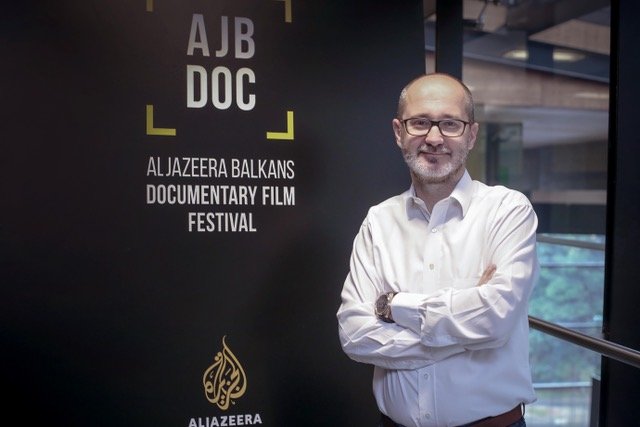
Edhem Fočo. Photo by Dzenat Drekovic
The AJB DOC Film Festival kicks off September 10 and will present 23 films from the Balkans (and beyond) over five days and within four distinct sections: Competition (TV format), Last Minute Cinema, AJB Screening and the newly established SMART DOC section, in which the festival will show films made by participants within the 2020 Mobile Phone Documentary Filmmaking training programme.
In explaining both the festival’s establishing ethos and its uniqueness/necessity, albeit within an already crowded festival calendar, Director Edhem Fočo goes back to first principles.
“Prior to launching AJB DOC Film Festival, Al Jazeera Balkans had already established itself as the largest producer and broadcaster of documentary films in the region. We also realized that, unlike the rest of the region, Sarajevo was lacking a major festival of documentary films,” he responds. “It seemed natural for us to start AJB DOC Film Festival in Sarajevo, a city that has certain dynamics and reputation as far as films and culture in general are concerned. And it is also where our TV channel has its headquarters.”
So what makes the festival unique? “Well, for one thing, our main competition selection is limited to TV format documentaries. No festival has done it before. But, the result turned out to be very interesting and, in many ways, beneficial. Secondly, we choose only the best of the best, and only a limited number of films get to be screened. But this allows each of the films to get proper attention and a well-deserved media coverage and audience, which is difficult to achieve when you have huge selections and packed screening schedules.”
“All films selected for the AJB DOC are also offered acquisition contracts by Al Jazeera Balkans, and many of them end up signing deals with our sister companies from Doha,” Fočo adds. “Our unique advantage is that we have a major TV channel to back us up. No other festival in the region and beyond has that privilege. Our festival can reach wider audiences, which is important to authors who come to the AJB DOC. Lastly, I agree that festival calendar is getting ever more crowded, but I feel that we have already found our place and our niche, and we are happy about it.”
Fočo explains how he and his team started out with moderate expectations for the festival, but were very surprised with how it has been received, with steadily growing audience numbers. Last year’s 20 selections generating 120,000 views, in addition to the festival’s open air screenings.
“As for the social media reach, we recorded over 10 million interactions, which is amazing. We feel that we have additionally stirred up the interest in documentary films, especially in our region, and we feel good about it,” he adds.
As we all know, the world has changed into something tantamount to unrecognizable over the past 18 months both on micro and macro levels, as assessed either in personal or global terms. Does this make the role of the documentary filmmaker even more essential, more poignant? And if so, how?
“I’d like to think that docmakers are now more needed than ever,” Fočo underlines. “At the same time, they have more time and technological means to tell their stories to the audience and to offer us more content. The world is getting very edgy, nervous and polarized in the face of these new, unprecedented challenges. Documentary filmmakers can try to reawaken empathy in people, by presenting different realities of different people. And, hopefully, we can try to be more objective, sympathetic and tolerant. I was encouraged by some amazing films that were made or completed in the past two years.”
And how does he believe the doc industry has responded to the plethora of crises – the pandemic, climate change, the current situation in Afghanistan et al – which are all playing out in parallel?
“I think the industry was very effective and films about pandemic are yet to get their proper place, once the whole world grasps what has actually happened to us,” Fočo answers. “Some very brave films have already been made, such as 76 Days (Hao Wu, Weixi Chen) or Al Jazeera’s Three Days That Stopped the World. The fight for the environment has found its best friend in documentary films. Unbelievable stuff is out there.”
“As for the crises that occur all around the world, such as the one in Afghanistan, I believe that the availability of smart phones and other technological gadgets makes it easier to record every aspect of such events, even if they occur very suddenly,” he adds. “We will screen a fantastic documentary on Afghanistan, My Childhood, My Country (Phil Grabsky and Shoaib Sharifi). We always have a lot of films that deal with current issues such as political oppression, migration, war crises, etc. This year, we have films such as Oeconomia (Carmen Losmann), The House Prison (Mohamed Jameel), Writing With Fire (Rintu Thomas, Sushmit Ghosh), Marriage (Kateřina Hager, Asad Faruqi), or Softie (Sam Soko), all of them tackling serious, heavy topics of our times.”
Fočo further underlines audience need for personal storytelling, played out in tandem with other forms of docmaking. “I love auteur films. For Sama, the winner of the second edition of AJB DOC, was one of the most powerful films I have ever seen. Auteur films can deepen our empathy and help us understand the context of protagonists’ lives, by offering us their personal accounts,” he says.
“However, I would not put them above observational films. Auteur films have their advantage in emotions and intimate approach, but objectivity and bigger picture are a clear advantage of observational films. We will continue to support both forms.”
The AJB Doc director turns to this year’s event, articulating what makes the blood course faster through his veins. “I am excited about returning to cinemas,” he answers. “Unfortunately, due to pandemic restrictions, cinema halls are not allowed to be filled to their full capacity. Our festival always had packed halls. Full cinema halls are a great thing for authors, who always have very lively and engaging Q&A sessions with our audiences. But we will make the best of the one-third of capacity rule. I am happy that authors and distributors will be physically here and I hope they will have a great time.”
“I am also very excited about a big announcement that will be made during the festival. It has to do with the launch of an industry event, which, hopefully, will further push the boundaries of documentary filmmaking in the region,” he adds.
Fočo tells Business Doc Europe that he will always be moved by inspirational films – such as the 2020 festival opener Džemo (Lejla Kajić and Davorin Sekulić) which “made a superstar out of a farmer who is winning races. The film has changed his life, for the better, I’d like to be believe. Drastically better.”
For the 2021 selection he similarly flags up Writing With Fire, I Am Not Alone (Garin Hovannisian), and My Childhood, My Country as personal favourites. “I would love if our viewers would watch all the regionally and locally produced films, as they have a lesser chance of reaching audience, as compared to big international productions. All of these stories are deep, funny and inspirational. We are really grateful to be in a position to support and promote local and regional films,” he stresses.
What, then, of the future in terms of priorities and growth? “Our first priority is to continue to be a festival that people and audiences love. Don’t get me wrong, we really appreciate people from the industry, but authors and audience come first,” Fočo answers. “Our second priority is to grow in quality, and not quantity. This is why we are planning on starting a very significant industry event. We will also continue to improve the work, trainings and workshops with young authors. We have made a significant impact in that area and we intend to increase it. Hopefully, with some hard work and a bit of luck, AJB DOC Film Festival will become the most important festival of documentary films in our region within next 5-6 years.”





