

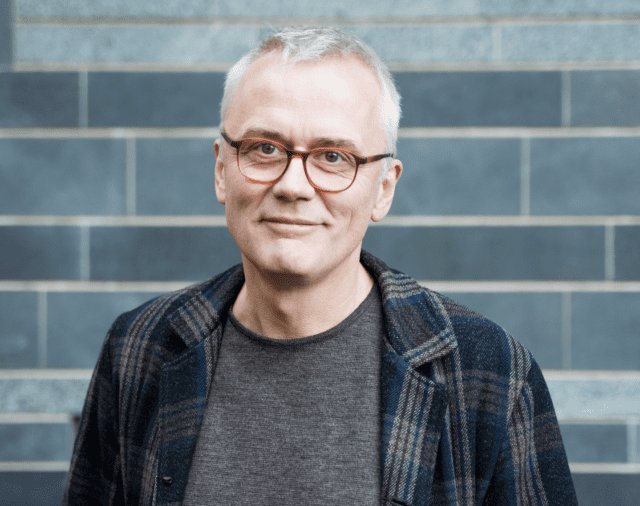
DOK Leipzig director Christoph Terhechte is pretty much delighted that docs are back in cinemas and on the big screen where they belong, away from all the distractions of the living room, such as texts that have to be read, coffee that has to be made, knocks on the front door that have to be answered. “I don’t think cinema and multitasking are compatible,” he confides to Business Doc Europe.
During the two-pronged docfest a total of some 170 films and XR works from 55 countries (doc and animation), including 37 world and 13 international premieres, will be screened to audiences at nine different venues across Leipzig November 25-31. Then the event goes online as 70 works are made available for streaming Nov 1-14.
Films such as Diana El-Jeiroudi’s Republic of Silence (International Competition) will be reserved for exclusively for big screen presentation (a restriction that also includes industry and press online). “I don’t think you can focus on a film like that in front of your computer screen or TV as well as you can in the cinema,” says Terhechte. “You just have to forget everything else, sit down with other people and let it float.” Likewise the majority of the films in the Camera Lucida section, notable for an expansive aesthetic “that challenges the conventions of cinema,” will only be shown in theatres.
But whatever the artistic considerations, the new ‘normal’ of festival and market life means that online is a total necessity, Terhechte underlines, and that a separate online public component is likely to be a permanent fixture of Leipzig in the future.
“And we will probably stay hybrid for the industry program, even after the pandemic, because that way we can broaden our horizon and invite speakers that would not normally not be able to attend,” Terhechte adds of the festival’s professional offer. “[So] people have a choice to say, well, it’s worth traveling to that place because we love DOK Leipzig…or to say no, we have a purpose and we don’t want to have to burn kerosene on a long distance flight, so we’ll just attend online. The [hybrid model] is something I think we’ll keep.”
He adds that Industry meeting locations are set up in 2021 to allow professionals to “seamlessly integrate from a physical meeting to an online meeting, back to a physical meeting.” All of which indicates that Terhechte is as much industry facing as he is public facing during the week-long event, pointing out how he is as interested in meeting the producers of the films in the fest programme as those who directed them.
But Terhechte also commends the festival audience, the majority of whom, he says, are “very cinephile and literate.” There are, of course, the full-on doc devotees, and there are those who will buy one or two tickets to see documentaries on subjects of interest to them. And then there are members of public who would very rarely pay to see a documentary, but who are nevertheless catered for in a free programme of more popular docs screened for free in the Hauptbahnhof Osthalle (East Hall of the main railway station).
Terhechte cites as an example Georgi Bogdanov and Boris Missirkov’s The Cars We Drove Into Capitalism an “ostalgic” trip into the past, detailing the Eastern Bloc love for the Trabant and the Moskvitch.
The film also serves to remind us that the festival is situated in former East Germany and that many people born under Communism constitute its core audience. “We are still a country where the aspect of East and West is very importantand…it’s also very important to reflect on the sensibility of our East German audience. Films in our program tend to have that as a subject,” says Terhechte. He offers up another specific example, the “incredible” 47-minute Kopf Faust Fahne by Betina Kuntzsch, that comprises en cinematic perspectives on a historical site: Ernst Thälmann Park in East Berlin where, in 1986, an old gasworks made way for a housing estate – and a very controversial monument.
The wider festival programme is smaller than in the years before Terhechte took over in 2019 because he found “it was offering too much and had too many films and too many events.”
“I found too few people who were actually able to talk about the same thing because everyone had attended or seen something different,” he stresses. “And I think one of the most important things in a festival is for people to actually get together at night over a beer or over dinner, talk about what they experienced and then exchange… Since much of the festival was sold out, it’s actually better to have another repeat screening instead of having just another film.”
Ironically Covid helped in the process of limiting the programme size. “It turned out that we were able to be even more radical in streamlining the festival and still have too much to offer,” Terhechte continues.
“And the hybrid format of the industry program is something that we would probably not have come up with if Corona hadn’t forced us to, but it’s a good thing,” he adds. “In that sense, the changes that Corona made us do were actually helpful. And we are rethinking the ways that festivals should be. It’s not always about bigger and more. If you have a thousand people traveling to your festival, that’s enough, you don’t need 2000 people here. And if you can enable people to participate in the festival from abroad online and they don’t have to fly, it’s good for the environment. That’s another challenge – the carbon footprint of festivals is not great.”
Terhechte is also determined to lift the veil on industry practice to further the cause of audience media literacy and understanding, as via the public panel discussion named ‘The Elephant on the Wall’. “It’s almost impossible to shoot a documentary without turning your protagonists into performers of their own self,” he says. “We have to make people understand that the notion of direct cinema basically is an idea that was around for a couple of years and produced some interesting films. But there are other options, there are so many hybrid forms.”
Another fascinating talk involves editor Mary Stephen whose Nude at Heart world-premieres at Leipzig. The film is cut from the same raw material as Yoichiro Okutani Odoriko which world-premiered at IDFA 2020. In her presentation Stephen will juxtapose her own cut against the version cut by the director, asking where does she see her role, as editor for hire or as creative co-author?
“This is something that I want to continue to do, to look behind the scenes of documentary,” stresses Terhechte of this public service to open up the trade and its mysteries to the wider festival audience.





