

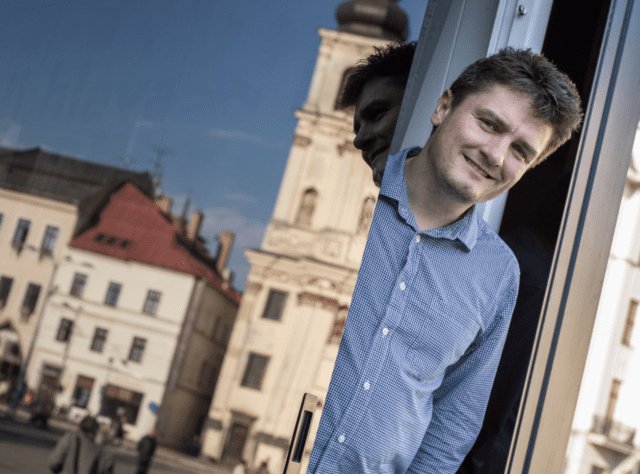
“Business will come to those that are brave,” explains Ji.hlava IDFF’s Marek Hovorka on the extra emphasis placed this year on experimentation, heightened artistic approach and new talent, as evidenced both by the festival’s New Visions programme of 21 highly diverse European and US projects, and the fact that half the main competition selections are by debut filmmakers.
Hovorka also emphasises that the online component of Ji.hlava, which celebrated is 25th anniversary in 2021, is a very much an essential one. “We want to create a hybrid identity of the festival and to develop the digital presentation,” he says. It’s a new space…and definitely it is a real space and all of us are using it. It’s a different type of space because it’s global. And [the festival] is going to have a global identity.”
“In this way, we want to continue supporting experimental cinema, political films and also debut films and young filmmakers,” he adds. “Because they are the future. And we are focusing on working with them and finding films from these circles within this new global digital space.”
Hence the importance for the festival of its the New Visions programme which comprises feature doc, hybrid and experimental, cinema expanded, VR/AR and live doc projects in (post) production. Yes, business is an important consideration, but the projects’ aesthetic offer is the core driver. “In our selection process, we focused on the artistic vision of the project, its originality and author-driven character, visual style and fresh spirit, international potential in terms of financing and development of collaboration, openness for sharing the project with other partners, as well as diverse modes of distribution,” say the New Visions programmers.
Hovorka further underlines how the doc sector was well set up to respond to the new online demands after the pandemic hit in Spring 2020, given how successfully the online portal DA Films has been operated by Doc Alliance (the group of leading European festivals) since its launch by Ji.hlava IDFF in 2006. “This is yet another way in which the documentary festivals within Europe are really innovative,” he stresses.
The Ji.hlava boss stays on the topic of Europe in looking to eliminate the geo-disparity that has seen low numbers of CEE films and projects selected for the Western European festivals. Yes, of course he understands there is a natural tendency to programme local product (and CEE festivals themselves fall into the same trap), but the overall effect is one of continent-wide under-representation which could be neutralised by more judicious selection processes within festivals across all European regions, he argues.
“It’s important to say that there is one Europe,” Hovorka stresses. “There are no borders in Europe yet, it’s one continent. There is so much we can gain from being closer. It’s definitely something that is our mission to say stop dividing, stop creating mental barriers and really think about the balance of the whole continent: east west, north and south.” The European projects in New Vision are pan-European and touch all points on the European compass.
This year, the festival’s main competition section Opus Bonum comprises 15 feature films receiving world, international and European premieres.
“Over the twenty-five years of its existence, the Ji.hlava IDFF has confirmed its position as one of Europe’s leading documentary festivals, known for its trailblazing approach and innovative programme. Therefore, we have upgraded the competitions as well as the structure of the awards in order to highlight the complexity of documentary cinema,” Hovorka explains.
Aside from the main award, therefore, the jurors of Opus Bonum are this year also handing out awards for the best cinematography, editing, and sound design. At the same time, outstanding formats, such as the best film essay, will be highlighted. The jury awards a prize to the most significant debut film as well as to the best film from the region of Central and Eastern Europe.
In addition to the main competition section, Ji.hlava offers five other competitive sections: Fascinations for the best experimental films, Testimonies for the best films with political, ecological or scientific themes, Short Joy for the best short docs, the traditional Czech Joy national competition and Exprmntl.cz, a special competition of that will for the 11th time present the latest works of contemporary avant-garde Czech filmmakers.
There may be a strong online dimension to the hybrid Czech fest, but Hovorka (like most us) can’t wait to get up close and professional with local and international guests. “Last year, we hoped to get together in person in Ji.hlava, but that wasn’t possible in the end [so] this year we will meet. And I’m convinced that this anniversary year will be an unforgettable experience, full of friendly encounters and surprising film experiences,” he says.
“This year’s visual identity of the festival taps into the spirit of dreaming because we all need peace and rest after the hectic times. And that is how we are approaching this year’s edition of Ji.hlava: we want to create a little wellness for the mind and soul for the visitors of the festival events,” he adds.
A distinct focus of Ji.hlava IDFF is on the environment and the relationship between humans and nature, as illustrated by films such as Cow by British Oscar-winning director Andrea Arnold, in which we follow a dairy cow’s the laborious cycle of calf rearing and milk production, and Czech Juliana Moska’s Animot which takes viewers to rescue stations for injured animals and observes the world through their eyes.
“Across continents, filmmakers deal with these issues more and more often, following protests, court cases and even observing the lives of animals. But the previous alarmist tone is now replaced by motivation for action and positive activism,” Hovorka concludes.





