

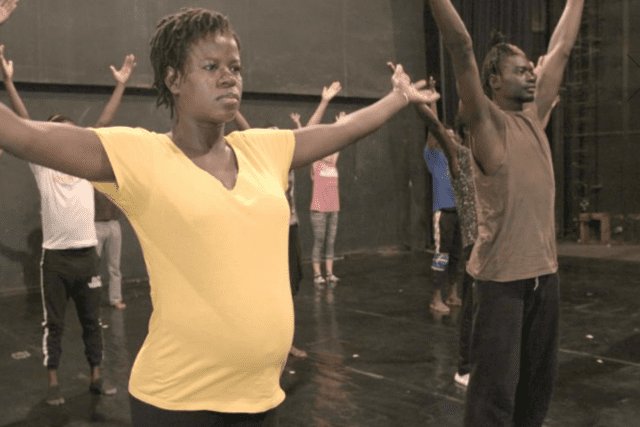
In the Generation Africa short doc Stay Up, which receives its world premiere both in Lisbon and Leipzig, Mariam, a woman who suffered shocking abuse as a child in Mali, deals with her trauma through the medium of dance within a troupe in the neighbouring Burkina Faso. Director Aïssata Ouarma explains to Business Doc Europe her inspiring film about hope and resilience.
Mariam was raped at the age of five, thirteen and sixteen by men she knew well, two of them relatives. The crimes were committed in her home country of Mali. Within an inspirational dance troupe which places as much emphasis on verbal expression as on bodily movement, the gentle but tough, and pregnant, Mariam is able to deal with her inner trauma. “With dance and movement everything is open,” the film says.
Director Aïssata Ouarma says she got to know Mariam via her friend, Jean Robert, also Mariam’s coach, in the Petit Bazar bar in the centre of Ouagadougou, which is frequented by artists. “There, she is admired for the energy she gives off when dancing,” says the director.
“I spent almost two years getting to know Mariam, and slowly but surely Mariam found trust in me, and opened up to me,” Ouarma explains of the period of preparation for the documentary.
But another major concern for Mariam in the film is that she is also the breadwinner for her family back in Mali, and must send back regular payments.
“I could see the fear in Mariam’s eyes when her phone rang. Her family was asking for money again and again, so I decided to include Mariam’s family in the film. It was during the preparation of the shoot that Mariam became pregnant, so I had to integrate this new situation as well.”
Likewise the dance school where Ouarma’s camera lingers, and where she records not only dance but the intimate psychological counsel that is given to Mariam. “[It was] a year of preparation,” she says. “The administration of the school introduced me to them [the dancers] and I was immediately accepted. I often went to their rehearsals, I spoke to them about my film project with Mariam. Sometimes the director of photography and the sound engineer also came without their equipment, we had to come back to film a few times. They were used to it, so during the shoot we had no difficulty.”
There is a fascinating word association sequence in the film which illustrates the power of therapy through verbalisation and gesture. When asked to choose two words Mariam automatically says ‘abuse’ and ‘manipulation,’ which become the subsequent focus of her dance therapy.
Director Ouarma applies her own word association to her subject. “Strength. That’s the word that spontaneously comes to my mind when meeting Mariam. Whether on stage or in life, Mariam exudes an extraordinary energy. This is surely the reason why I chose her.”
That said, for Mariam crying has become a given, a natural state, and no matter how much she tries to force a laugh, it is in vain. But little by little she is encouraged to fight, to resist, and eventually enter “another dimension,” to get to the put where she can “dance with a smile, dance with a laugh.”
“The documentary process was a therapy for Mariam,” Ouarma explains. “During the shoot, every time I asked Mariam to talk about her rapes, she cried, although this was not what I wanted. Off camera, I often asked Mariam to laugh about her rapists, and that’s when Mariam was able to talk about her rapes without crying. I treated this serious subject with a little lightness. I called on laughter, which prevents us from being overwhelmed by emotion. Laughter is a weapon of protest. To laugh at the oppressor is to diminish him, to stand up to him. After the filming, I discovered another Mariam, and not the one I met two years ago.”
As with many recent documentary productions, the pandemic was an unwanted guest at the table that had to be factored in. “We had to take draconian precautions to protect ourselves from the virus, and since Mariam was pregnant I was much more afraid for her,” explains Ouarma. “We were two days away from the end of the shoot when the Burkinabé government announced the closure of the borders. We had to finish quickly so that Mariam could return to her family to give birth. It was a huge stress for the whole team, but we were able to finish before the scheduled date.”
The director reserves praise for the professionalism of her colleagues within the team at Generation Africa initiative, responsible for a collection of 25 short, medium and feature length documentary films from 16 countries in Africa, which aim to shine a light on the future of youth in Africa through the topic of migration and give voice to African storytellers in an initiative that has built a strong documentary community across Anglophone and Francophone Africa.
“Filmmaking is a team effort and it wouldn’t have happened if it wasn’t for this group of incredible people (Don Edkins, Tiny Mungwe, and Bérénice Hahn) who believed in me, and in this story based on the resilience of this young female choreographer trying to rebuild herself after three rapes. I am thankful for the opportunity they gave me to direct this film into which we’ve put our heart and soul.”





