Narodnaya by Vadim Kostrov
Vadim Kostrov is the wunderkind of contemporary Russian cinema. Still in his early 20s, he has already directed nine films and his work has been shown at international festivals from FID Marseille to Sheffield. This week, his Narodnya trilogy has been showing at Doclisboa as has another of his films, Winter.
In the trilogy, the director ventures into the underground art scene in his home town Nizhny Tagil, in the Urals, mixing with the young musicians and artists, working in their own self-enclosed world, operating out of a makeshift garage gallery. “The idea of the film was to save all the presence and energy of this gallery into the form of the film,” Kostrov says.
Narodnaya itself may no longer exist but the film preserves the magic of this period. “It was really important to make it now, to capture this energy, these voices, these people.”
The trilogy ends with Comet, in which the Nizhny Tagil rock group Lazy Comet come to perform in Moscow. Kostrov met the band members when he was making his earlier film Orpheus, an autobiographical documentary in which he returned to his home town to say a symbolic farewell his young sweetheart.
“We became friends really fast,” the director says of the rock band. “I decided to organise a tour for Comet and to bring them to Moscow because I really love their music.”
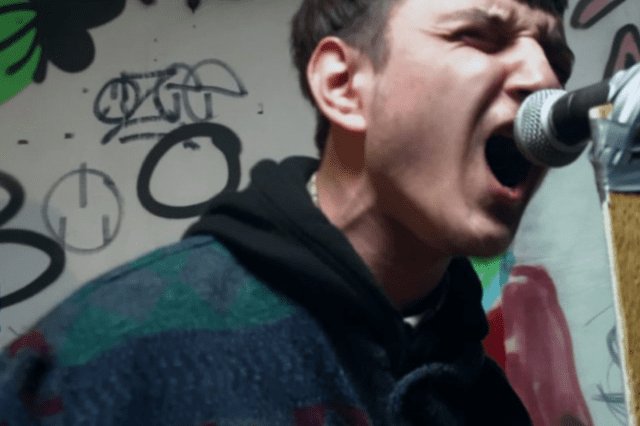
Kostrov may be a filmmaker but as a kid he dreamed of becoming a musician. Working alongside Comet gave him chance to fulfil that dream. In Lazy Comet, he sings with the band. “We did actually a great performance,” he boasts.
Comet was shot over two concerts in separate venues: an avant garde theatre and an underground nightclub. Kostrov also uses footage taken from the audience who were using their iPhones to record the event.
Kostrov is a one man orchestra. That’s to say, he does almost everything on his films, editing them as well as shooting them and appearing on camera.
Born in 1998 in Nizhny Tagil, the young prodigy began his filmmaking career in earnest in 2017 when he came to Moscow to study at the Russian State Institute of Cinematography (VGIK). This is a hugely prestigious school but he didn’t stay there long.
“Actually, I felt some pressure. The masters have their own opinions and they’re old,” is how the director explains his decision to quit VGIK after only six months in 2018. By then, he had shot and edited his first short, Silent Night (2017), on iPhone. Not long afterwards, he was working on his debut documentary feature Cherdak-Underground (2019), looking at Russian underground culture in the 1980s, the era of VHS and illegal art squats.
Kostrov realised that he didn’t need ”to go to any institution.” His way of learning was to make films in the “here and now.” He was a filmmaker in a hurry and “didn’t want to wait for anyone.”
His key collaborators include Gleb Piryatinskiy and Anton Lukin, who are part of Moscow-based film company Mal De Mer Films. “They met me before I met them because they came to the first screening of Cherdak-Underground,” Kostrov remembers. He later bumped into Lukin at a public lecture. Lukin invited him to come to Piryatinskiy’s “place” to watch and talk about films. They decided immediately that they should become friends. “In a few months, we became very close.”
Kostrov asked for help in making Orpheus (2020). “I need a camera. I have nothing,” he told Piryatinskiy who immediately agreed to let him use his Sony Alpha 6400. “These guys just believed in me. Gleb just said ‘let’s do it.’”
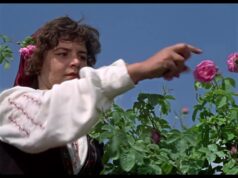
Kostrov is currently planning a new project, Spring, which will continue the cycle he began with Summer and Winter. These films straddle the lines between documentary and dramatic feature.
Ask about the directors who inspire him and he cites figures like the Lithuanian director, Sharunas Bartas, and the experimental US directors, Jon Jost and the late Jonas Mekas (a hero of New York avant garde cinema even if he was born in Lithuania). He also acknowledges the influence of Japanese director Naomi Kawase and even Takeshi Kitano’s Kikujiro.
Kostrov’s four-film cycle organised around the seasons owes at least some debt to Andrei Tarkovsky’s poetic and autobiographical Mirror. The Hungarian master Bela Tarr is another director he admires.
“I am watching a lot of films, every day in Moscow, on the big screen.”
Kostrov will talk about anything to do with cinema but one word never to mention in the young director’s presence is ”storytelling.” The very phrase annoys him. “I don’t like the word storytelling. I’m making cinema. It’s not stories. I want to show things and not talk about them,” he declares as the interview comes to an end.