Layers of Reality is the slogan of the 18th VERZIÓ Human Rights Documentary FF which kicks off across Hungary November 9, running to Nov 14 and presenting 64 films from 35 countries before going online 15–21 November. “We feel our mission is to bring films that show the world in all of its complexity and diversity,” says Festival Director Oksana Sarkisova.
“Documentary filmmakers are curious and attentive people who dive deep into the problems they’re exploring. We as a festival bring together these different versions of reality and degrees of depth into one program. By exposing these layers we allow the viewers to experience the world in its incredible complexity. You can always go deeper if you’re interested,” she adds.
“The festival has grown over the years and the program has become more and more complex,” Sarkisova continues. “But the core of that mission, seeing the world through creative documentary works and showing different perspectives on the world, remains at the centre.”
In 2021 the festival will screen live within Budapest, Debrecen, Kecskemét, Pécs, Szeged and Szombathely. “Our partners beyond Budapest had the chance to curate their own selections from the full program and organize discussions with local experts who can join the screenings. I think this is a very important development that increases festival outreach and audience engagement,” Sarkisova underlines.
The full festival programme comprises three competition sections (International, Hungarian and Student & Debut Competition) as well as four themed sections.
One of these is Anthropocene which presents new documentaries about the human impact on the environment, focusing on “dilemmas and changes that are happening to the world, and also the entanglement of environmental and human rights,” explains Sarkisova.
“But it’s not just about climate change because Anthropocene really encompasses a variety of changes in the world,” she adds, pointing to Shannon Walsh’s The Gig is Up which illustrates how gig economy workers pay the price for flexible working hours and find themselves in vulnerable positions. It’s a film “that exposes the transformation of the global economy, which inevitably has an impact on the urban environment as much as on social relations,” she says.
The festival’s Dive into the Mind section draws our attention to physical and mental health, “which is something that I think COVID made very obvious to us, how important mental health is and how fragile we are, in a way, as humans,” says Sarkisova. That said, the films in the section cover a much broader range of concerns. “There’s a whole spectrum of different issues that will remain with us even after the pandemic is over, from living with autism (He’s My Brother by Cille Hannibal and Christine Hanberg) or coming to terms with the trauma of sexual abuse (Night Shot by Carolina Moscoso Briceño), for example. We are presenting this broad spectrum in co-operation with professionals and experts in mental health.”
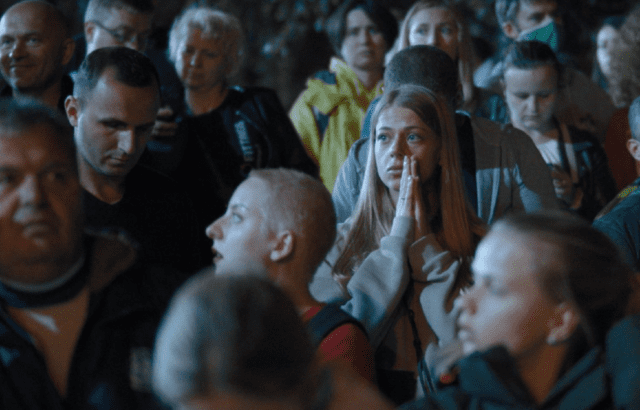
The Parrhesia: The Moment of Truth section takes its concept from French philosopher Michel Foucault’s lecture series at Berkeley, and focuses on fearless speech (the meaning of parrhesia). This is expressed within films that present mass protests in Belarus (Courage, Aliaksei Paluyan) and Hong Kong (When A City Rises, multiple directors*), the work of dedicated women journalists in India (Writing With Fire, Rintu Thomas, Sushmit Ghosh) and also in more personal works such as Hey! Teachers! (Yulia Vishnevets, Russia) which shows a year in the lives of two new graduates who attempt to introduce new teaching methods within a school in the Russian countryside.
The fourth thematic section, Viewfinder, “is the most experimental, with films that are challenging the boundaries of documentary, experimenting with new ways of expression, both visually and conceptually, but also films that go beyond the expectations of the viewer,” explains Sarkisova. “This selection shows films that surprise and provoke with the form as well as with the content and make the audience think about the very nature of seeing.” Selections include Firouzeh Khosrovani’s Radiograph of a Family and Mark Cousins’ The Story of Looking, among others.
Sarkisova points to the robust stature of the documentary sector which remained both active and vital over the past 18 months of the pandemic. “The major lesson learned is to be flexible and ready to adapt. This is what festivals can learn from documentary filmmakers who always have to respond to a situation which is beyond their full control and yet they have to find a way to be in sync somehow, to act fast and to make the most in the given conditions.”
This maxim is as applicable to her festival, she points out, given how she and her colleagues are long used to operating within tight budget limits. “The fact that we’re a festival without state funding has its limitations but also makes us a bit more resilient than festivals that are dependent on central approval. So in that sense, being independent really makes a difference for us. Even though our resources are limited, we think that it’s very important to keep our independence in programming.”
She points out that the festival has received municipal support for the first time for the award of best Hungarian film from the city of Budapest which is now in opposition to Viktor Orbán’s Fidesz party. “This co-operation comes with no attempts to influence the festival’s content… It’s important to be able to work without censorship,” Sarkisova signs off.
*Cathy Chu, Iris Kwong, Ip Kar Man, Huang Yuk-kwok, Evie Cheung, Han Yan Yuen, Jen Lee