

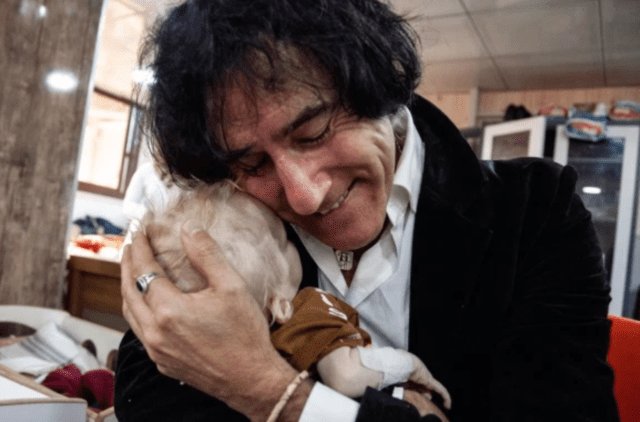
Filmmaker Gorki Glaser-Müller and his subject and collaborator Patricio Galvez are in London this week for the Raindance Festival screening of Children Of The Enemy (sold by Cinephil). They’ll be giving a Q&A after the UK premiere at the Genesis Theatre tonight (Wed 3 Nov) and their documentary will also be available to watch this week on Curzon Home Cinema.
Thanks to travel restrictions during Covid lockdowns, this is the very first time that both Glaser-Müller and Galvez have been able to accompany their film abroad. It has shown widely since its premiere at CPH:DOX earlier in the year and has already created a considerable impact, helping change attitudes toward the plight of western children stuck in refugee camps in conflict zones in the Middle East
In the film, Glaser-Müller follows Galvez on his journey to Syria in search of his seven missing grandchildren. Their mother, his daughter Amanda Gonzales, had moved there from Sweden in 2014 to join Isis but both she and her husband, Isis firebrand Michael Skråmo, had been killed in 2019.
Glaser-Müller and Galvez, a well-known musician, are both Chileans living in Gothenburg.
“We actually were not close friends. Now we are very good friends! But we were more of acquaintances,” Glaser-Müller remembers of the period just before he started work on the film. The director hadn’t then realised that Patricio’s daughter was in Syria. Nor did he know that she had been killed. “That was for me a shock, a devastating shock.”
The director speaks of “the terrible grief” that Patricio felt about the loss his daughter. However, once Patricio drew up his plan to go to Syria in search of the grandkids, he found a new resolve that lifted him out of his despair.
“I saw in you something that was amazing,” Glaser-Müller says to his subject. “You were not crazy. I understood you.”
In the immediate aftermath of his daughter’s death. Patricio recalls going for five days without eating. He was deeply traumatised. But then he took the decision to rescue his grandkids.
“For me, I didn’t have another alternative,” he says of his mission.
Syria was still a war zone but Patricio didn’t even think about the danger. He had grown increasingly frustrated with the lack of assistance from the Swedish government and realised that he would have to plan the rescue alone.
“Of course, first of all, I wanted to find them and later I wanted to show the world the state they were in,” he says of the grandchildren who were growing up in terrible conditions and had already gone close to three years with school or medication.
Patricio expresses his frustration that two years after he brought his grandchildren to Sweden, other western kids remain stuck in Syrian camps without passports.
“Other families were expecting that I could represent them in some way,” he says of the hope that once his grandchildren had come back to Europe, more kids would follow in their wake. Unfortunately, that hasn’t really happened in Sweden or elsewhere.
“[But] I am sure that our film has been part of changing people’s minds,” he says.
In Denmark, for example, after the film was shown, the Government revoked its decision to strip citizenship away from the refugees.
Patricio’s grandchildren are now living with foster families in Sweden. He gets to see them regularly and is happy to see how they are developing. “They have changed so much,” he says.
The Chilean has stepped aside from his music career for now and is instead campaigning and writing. “I think my life has changed forever. Now, I work for children’s rights,” he says.
Would Patricio and Glaser-Müller consider going back to Syria?
“To answer your question, we have been talking about this because Patricio wanted to find Amanda’s grave,” Glaser-Müller says. He adds, though, that he is wary about travelling to the Middle East in the same circumstances as last time. “I was a one-man team over there,” he notes. “It is still a conflict zone with at least one terrorist attack a day by Isis in that area.”
Filming in Syria is a daunting human and logistical challenge. “If it going to happen again, I would like to have different conditions,” he says, but adds that there are still raw and painful stories to be told about the hundreds of western men, women and children abandoned in the region. “This is a European problem. There are so many European kids [stranded]. So people don’t understand this. The scope of this is bigger than people imagine.”





