Four Journeys, which opens this year’s IDFA, is a stylishly personal and involving film from Dutch-based filmmaker Louis Hothothot (Louis Yi Liu) who examines the impact on both himself and his family of China’s one-child policy, which was introduced in 1979, and how trauma has haunted the lives of other families.
An IDFA world premiere and selected for the festival’s new Envision competition, the film is open, illuminating, sad and powerful, painfully honest and confrontational, and details the challenges to families which resulted from the desperate brutality of a policy that had a terrible impact on so many. But it is also a far more complex film than it first appears, with the meaning of the ”four journeys of the title gradually revealed.
As his grandmother says with a sad smile “it was harsh back then,” admitting that she was happy to have another grandson when Louis was born, but also desperately sad that her daughter and family had to escape their country town to find refuge.
As the film opens with shots of gently billowing clouds, Louis details numbers (7800km from Amsterdam to Beijing; a six hour time difference and a 12 hour flight) before his plane lands, only to receive a message that his parents can’t meet him at the airport. Numbers are important to him. He further recounts the weeks his parents travelled, trying to find a safe space to raise their two-child family, and the miles they journeyed to return to their hometown when other family members were too frightened to help.
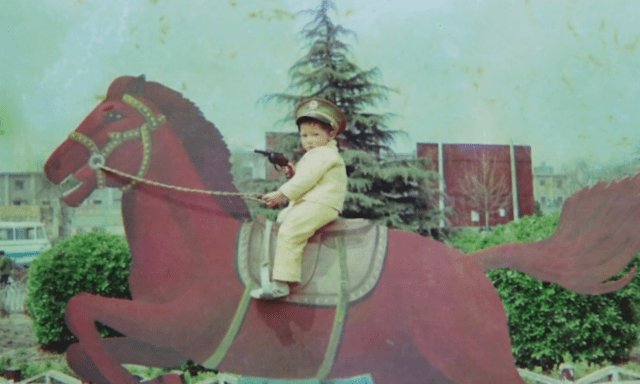
Just as important is when he finds two special black-and-white photographs. Pictures of his parents in Tiananmen Square as they posed holding their two-year old daughter, his mother pregnant, the family en route to a new life.
Photographs and memories sit alongside regret and angst as Louis pushes his parents to explain their decisions (his mother admits having him was a “stupid idea” as they were so poor) and challenges them on his childhood memories – one chapter heading is “forgotten child” which very much reflects how he sees himself now, still the “illegal” second child.
The authorities punished his parents with a fine equal to three times the annual salary of his father, whose career was also destroyed. The devastating consequences of his birth have left Louis with a knowing sense of guilt, and in his twenties he left for Amsterdam. The film goes on to examine his fractured relationship with his parents and sister as it unravels a complex and challenging family history, with the ‘four journeys’ of the title reflecting a series of trips taken by both son and his family.
Details are gradually revealed about an older son who drowned aged two, and the fact that his mother ripped up photographs of her first child. They come to visit Louis in The Netherlands when he has an injury, which exposes the fractured relationship between his sister and their father. They mull over the fact they want Louis to marry, but perhaps not to his girlfriend Artemise. The film also reveals the troubled and strained relationship he has with his own sister, and dwells on his father’s unstated sense of loss about the route his life might have taken.
Louis at times can be brutally confrontational as he forces his family to look at their past as well as muse about what the future might be. As the family – minus his sister – visit Artemise’s parents in France there is much discussion about the nature of family and how the past defines the present. He even confronts his girlfriend about whether they will have children, perhaps exposing a degree of selfishness and lack of empathy.
While the film is compelling in its analysis of family relationships the director initially comes across as cold and lacking in compassion, as if using the control that filming offers to distance himself. But he is equally very self-aware, and adds footage of himself chatting warmly to his sister and discussing family matters with his father as the film draws towards its conclusion. We also observe him embark on a final trip to see his dying grandmother.
In the end, despite the angst and conflicts, this is a film about the complexities of familial relations, with Louis using his camera to push family members to confront trauma from their past. But as a big family party is held in China he reveals a sense of generosity as he admits to missing the warmth that family offers. There is real emotion towards the end when his mother finally deals with past guilt and trauma, when eventually the film determines to look forward rather than to the past.
Netherlands, 2021, 112mins
Dir/scr Louis Hothothot
Production Moserfilm, Pieter van Huystee Film, CNEX, EOStudios
Producer Pieter van Huystee
Cinematography Louis Hothothot, Ming Xue
Editors Chris van Oers, Louis Hothothot, Albert Elings
Music Harry de Wit
With Yisong Liu, Ahenying Zhang, Jingjing Liu, Louis Yi Liu