For two decades the highly talented populist Norwegian politician Trond Giske turned down filmmaker Håvard Bustnes’ entreaties to be the subject of a fly on the wall documentary. Until 2017, that is, when allegations of sexual harassment were levelled at him, at which point he went on a tour around Norway to resurrect his political career.
And this time, as the director tells BDE, the politician could see the benefits of answering Bustnes’ emails…
Bustnes’ first contact with Giske was by letter (which was never answered) back in 1998. The director, fresh out of film school, could see, like everybody else, that Giske really had something. “The idea was to make an observational documentary and to follow him until maybe he became prime minister of course, because he was one of the most talented, most popular Labour politicians.”
But after #MeToo, the world turned 180-degrees and women began to cry foul of the casual or overt (and certainly unwelcome) sexual advances, propositions or abuse that they were, or had been, subjected to. Politician Giske was one of the accused as long-standing rumours of inappropriate behaviour towards young Labour party members were substantiated by a series of hard accusations.
He didn’t deny it, but neither did he show any contrition. In fact, he went to the polar extreme to claim that he himself was the victim both of malicious politicking by rivals in the Labour party and/or unscrupulous journalism by what he perceived to be a hostile press.
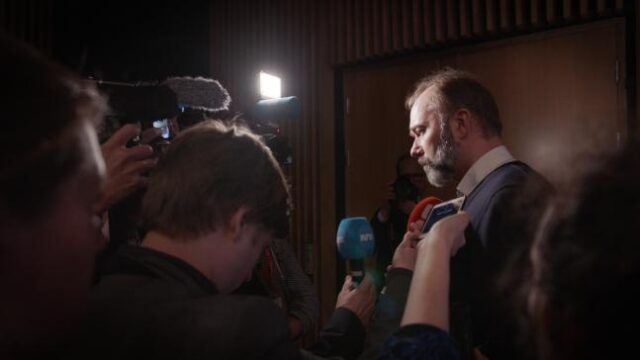
So Giske went on the road across Norway, towing a caravan, to apply political CPR to a career that was suffering major cardiac arrest. He discovered en route that his support base was a strong as ever, especially in the North and in the provinces, away from the liberal capital. But the allegations didn’t go away, the sleaze quotient increased and more and more women were prepared to go public…
When we first see filmmaker Bustnes he is lying on floor of Giske’s car, adopting his shooting position, just as the politician is embarking upon his whistle stop tour of the country. It would be a journey during which they got to know one another pretty well.
“As a filmmaker, you always try to be open and try to see the subject from many different sides and you have a professional view on things, but at the same time you are a human being,” says the filmmaker. “And when you stay a lot with a person, as you do in this kind of documentary, you develop some kind of sympathy. I think we, as human beings, are very likely to believe people that we have a sympathy with.”
Yes, Giske was charming and persuasive and good fun to be with, and of course Bustnes was quite aware that he was a pawn in the politician’s game of self-promotion, but on a human level he still liked him.
But as a dad, Bustnes felt that Giske had to be called out, alongside those who stood to gain from his being in power.
“There’s no doubt that he had been harassing women. And I think that the message of the film is very clear, which is: people in power, why didn’t anybody stop him and people like him? How can they stay in power so for so long without being stopped?… A lot of people had heard rumours about him and his behavior against women, but still people protected him in the Labour party,” says Bustnes.
“And I find that really scary, because for me as a father the most important thing of course is that women should be safe everywhere at work, in the party or in politics. It’s a really big democratic problem that they [female objects of unwanted sexual attention] are forced out of politics because of people like him.”
Director Bustnes has more than a touch of the Nick Broomfield about him, which adds a welcome levity at times to proceedings. In a scene reminiscent of Broomfield’s 1994 Tracking Down Maggie, we see Bustnes standing helplessly, surrounded by equipment, waiting for events to happen at one venue just as things are kicking off at another, and of course when he is lying supine on the floor of Giske’s car he looks very funny. As a matter of interest, Broomfield was executive producer on Bustnes’ Golden Dawn Girls (2017).
“I am not afraid of humour,” says Bustnes. “It’s also important in serious films like this if you can have a laugh for 10 seconds, but it’s not a comedy of course. I think people understand when something is funny and when something is serious… I didn’t do it to be funny, but I can see that it is funny.”
The footage of Giske is balanced by interviews with political commentators and women who have accused Giske of inappropriate sexual behaviour. Balance was essential, given how one-sided the opinions are of the pro-Giske folk we meet on the political tour. “We needed to talk to all sides, not just to Giske’s supporters,” says the director.
So has Giske seen the film (and what did he think of it?) Yes, is the answer to the first question. “The agreement between us was that I have the freedom to decide how to make the film, but he was not so happy about the ending as I think he hoped that the film would tell more of his personal narrative.”
“His hope was that I could film him for a longer time, for two or three more years, because for him, this story is not over,” Bustnes ends.
First Hand Films is handling world sales for Name of the Game.