Still: Courtesy of Searchlight/Hulu
Ahmir ‘Questlove’ Thompson takes a moment. No-one has asked him this question before. Which of the many brilliant performances from among Mahalia Jackson, the Staples Singers, Stevie Wonder, Gladys Knight and the Pips, Nina Simone, and all those others featured in his documentary Summer Of Soul …(Or, When the Revolution Could Not Be Televised) meant the most to him?
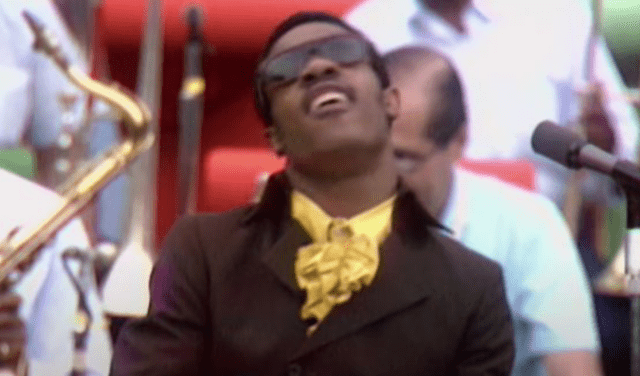
Summer Of Soul, which tells the story behind the 1969 Harlem Cultural Festival, the so-called ‘Black Woodstock,’ features remarkable footage which, quite astonishingly, had been left to fester in the vaults for 50 years. (The film, distributed by Searchlight and Hulu, premiered in Sundance and had a market screening in IDFA last week).
Questlove, who is now being talked up as a major awards contender, made his feature directorial debut with the project. He is a polymath – a musician, DJ, journalist and author.
“It is sort of like being asked what is my favourite child,” the director chuckles at having to choose a favourite among the acts. “You know what, I’ll probably say that all those performances give me goose bumps, but to watch the full 45-minute performance of Sly and the Family Stone is a revelation to me.”
The funk band wasn’t originally on the bill. The audience wasn’t expecting to see them. “At that point, Sly is still a cult artist and his reach is for the younger generation. The whole point of the film is the dividing line between the Civil Rights era and the Black Panther era – and the generational divide between the ideology of Martin Luther King and the ideology of the Black Panthers.”
Younger members of the audience in Harlem were thrilled beyond belief to see Sly and the Family Stone make their appearance. Older spectators, though, looked at the band members as if they were aliens from space.
“At that point, most black artists had been told that in order to get success, you had to be as safe as possible, like Motown. You’ve got to wear tuxedos.”
The event was taking place in high summer but David Ruffin, who had recently left the Temptations, still came on stage in a wool tuxedo. The women performers, meanwhile, wore ball gowns which “belong at the Met Gala.”
Sly and his band members completely ignored such formalities. This was a mixed band in street clothes with a white drummer and a Black female trumpeter. “They had that audience in stunned silence for the first three songs, like kids[were] losing their minds, adults are looking like ‘is this allowed to happen?’”
“To watch them convert that audience in 45 minutes…it’s nothing short of a miracle.”
Questlove’s curiosity about taking on the project was caused partly by embarrassment. He’s a well-informed man when it comes to music – and yet he had never heard about this huge musical celebration that happened in Harlem at around the time the Americans were putting the first men on the moon.
“I would like to think that I am a well versed guy in modern events, especially in the world of music,” Questlove states. Friends who know him as a fountain of knowledge sometimes try to trip him up by asking about, say, obscure Prince concerts in Japan. Most times, though, he knows far more than they do. This was one of the few times in which he was, at least briefly, non-plussed.
Once he discovered this brilliant half century-old material, he began to work out why. It wasn’t just racism on behalf of white American broadcasters and distributors. Timing played a part too. All those performers, from Stevie Wonder to Gladys Knight, were, in 1969, “on the precipice of a cliff of greatness. It was in 1970 that Stevie Wonder, the Staples singers, BB King and Gladys Knights would blossom…they weren’t household names yet. In a year, they would be.”
Nonetheless, there was obvious prejudice behind the decision to bury the material. “There were powers that be that had a problem with the intersectionality of what America was about to become.”
Alongside the music in the doc are contemporary interviews with festival attendees, musicians who played in Harlem and leading political figures like Al Sharpton and Jesse Jackson.
“There are probably two factors that made it easy for the producers to choose me as a director. I am certain that they wanted a fresh pair of eyes and a fresh mind, a non-traditional person to create a film,” Questlove reflects on why he was chosen to direct. “And I also believe that my social reach was a factor.”
After all, Questlove has an extraordinary range of contacts. There aren’t many other filmmakers who could call up the likes of Chris Rock and Jesse Jackson and get them to agree to interviews just like that.
“But what, you know, is so weird about this festival is that it was such a mystery. There were people who weren’t believed when they said that they were there,” the director notes. He used social media to reach out to young followers whose parents and grandparents may have told them that they once saw Stevie Wonder and Sly together in Harlem at a festival no-one else had ever heard about. That way, he was able to track down some of the old-timers who had been in the crowd.
Having made one film, Questlove’s appetite has been whetted. He would like to continue working in the medium.
A much travelled figure, the filmmaker/musician has some strong UK connections. One of his closest English friends was the ill-starred singer, Amy Winehouse.
“Amy, man!” He sighs. They first met at a festival in Norway and struck up an immediate rapport. After she released ‘Back To Black’, he re-established his connection with her. Whenever he was in London, she would take him to an all-night bagel shop. “I just miss all the small things we used to do, hanging out. I miss her terribly. The night before she passed, we FaceTimed each other.” He was then en route to the UK for a festival.
“The second I landed, I didn’t even see the news, I started texting her. Are you there, are you there? I didn’t realise until I got off stage and looked on Twitter,” he remembers how he learned of her death. “She was just one of my favourite people ever. I miss her terribly.”