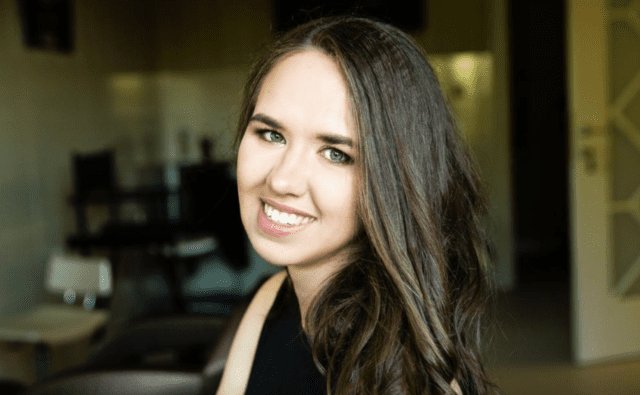
Director Julia Bobkova
When filmmaker Julia Bobkova was first approached by the St Petersburg Documentary Film Studio about making a documentary on Russian theatre guru Konstantin Sergeyevich Stanislavski (1863-1938), she wasn’t sure how to approach the task. Her brief was to look at how Stanislavski influences modern stage and screening acting.
Her film Stanislavski. Lust For Life has been screening this month on the BFI Player as part of a Russian Film Festival in the UK organised by Russian film promotional body, Roskino. (MagicFair Films is handling international sales.)
“At the beginning of the story, the producers wanted to make a film about how Russian theatre schools changed the American film industry and Hollywood,” remembers Bobkova, who works at Ostrov Studio in Moscow as a director and scriptwriter.
Stanislavski’s legacy to contemporary filming theatre is enormous. Movie stars from Marlon Brando to Meryl Streep have acknowledged the great Russian theatre theorist’s influence on their approach.
Even so, Bobkova acknowledges that it was a struggle to make Stanislavski’s story “come alive to a modern audience.” Big Hollywood stars weren’t interested in talking to her. Instead, the director decided to track down “personalities in modern theatre in different countries; I tried to find some people who really know Stanislavski; who had read his books and really use his technique in theatre.”
The documentary, which is backed by the Russian Ministry of Culture, includes an extraordinary range of interviews.
One of the most prominent of the talking heads is Kirill Serebrennikov, the maverick young Russian film and theatre director whose movies, such as like Petrov’s Flu and Leto screen regularly in Cannes and Venice. Serebrennikov, though, is also often in trouble with the authorities.
Also sharing his thoughts on Stanislavksi is Nikita Mikhalkov, the Oscar-winning director of Burnt By The Sun. Unlike Serebrennikov, he is regarded as very much a Russian establishment figure, and is close to President Putin.
“I really wanted to show that, in great art, it doesn’t [matter] if you love Putin or you don’t. And for me, it was interesting to make some connections between people who are not so close – and who are so different,” the director explains her eclectic mix of subjects. “Each of these characters can find a piece of himself or herself in Stanislavski.”
Alongside the Russian admirers of Stanislavski Bobkova also features prominently two leading theatre directors from the UK, Declan Donnellan, artistic director of Cheek by Jowl, and Katie Mitchell, best known for her work with The Royal Shakespeare Company and The National Theatre. Donnellan and Mitchell have both visited Russia and seem to know more about the country’s theatrical tradition than the locals themselves.
“Sometimes, I thought Declan Donnellan may be closer to Stanislavski than some Russian directors like Serebrennikov,” Bobkova says of the English stage guru whose book ‘The Actor And The Target’ was originally published in Russian. “He [Donnellan] really loves Stanislavski.”
Counterpointing the contemporary footage is black and white archive footage of Stanislavski in Soviet Russia late in his life.
The documentary also shows students rehearsing today at the Moscow Arts Theatre, the company set up by Stanislavski in 1898.
At first, the School wasn’t interested in participating in the documentary. “For them, it was as if we were just journalists. They didn’t understand that we wanted to make a big film,” the director remembers. However, the director of the theatre was keen to have a record of his rehearsals and therefore allowed Bobkova to film in the theatre.
Bobkova agrees with one of her interviewees, theatre director Yuriy Butusov, that “Russian theatre today is really like a prison. It is all rules, rules, rules and regulations.” One reason so many look back toward Stanislavski for inspiration is that he represents a world of artistic freedom and daring.
The documentary recently won a Best Script award at the RusDocFilmFest 2021 in New York. The film has also screened at various Russian festivals.
What does Stanislavski mean to the director herself? Bobkova (who is now making a TV series about Russian prisons) admits that when she was a film student, the great theatre teacher was just a distant and academic figure. He was simply the author of a book that all the students had to read. “We really didn’t understand the…soul of Stanislavski.”
But making the film has humanised the great guru in the director’s eyes while also making her regard him with far more affection and respect. “He really inspires me now,” she concludes.
Russian Film Festival, Nov 12-Dec 10, https://rff.online/uk