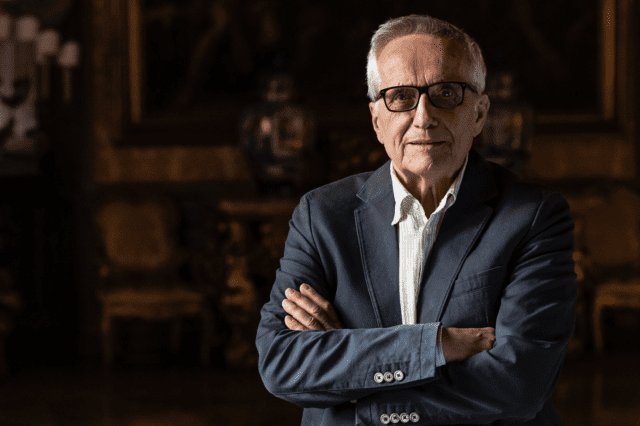
Swiss docfest Visions du Réel will this year celebrate the legendary Italian director, screenwriter and producer Marco Bellocchio with the presentation of its Honorary Award. The homage will include a Masterclass and a retrospective of selected works of ‘one the most significant oeuvres in contemporary filmmaking.’
The prize will be awarded during the 53rd edition of the festival, which will take place from 7 to 17 April 2022, and during which Bellocchio’s new documentary Marx Can Wait, as yet unreleased in Switzerland, will be screened.
“Visions du Réel is extremely happy and delighted to pay tribute to an indisputable master of contemporary filmmaking, as well as to a body of work which, from the very first films, has demonstrated dazzling modernity, and is brooding, subversive and audacious, formidably eclectic,” write festival organisers. “Marco Bellocchio exercises impressive liberty to combine registers of images and genres, moving between fiction and documentary, between the intimate and the collective.”
As in previous years, the Cinémathèque suisse and ECAL (Lausanne University of Art and Design) partner Visions du Réel on this invitation.
The festival published January 17 the following biography of the revered director.
Born in Bobbio in northern Italy on the eve of the Second World War, Marco Bellocchio studied at the Academy of Dramatic Art in Milan and at Rome’s renown Experimental Cinematography Centre. In 1965, he directed his first feature-length film, Fists in the Pocket (I pugni in tasca). It was a manifesto of a young generation in rebellion, shot in his family home and played by school friends, which began a raging and lyrical body of work that was to be immediately noticed by critics – who saw it as an Italian response to the French New Wave.
A political, committed and anti-fascist filmmaker, Bellocchio has constantly questioned the violence of institutions, particularly the Family within his first film China Is Near (La Cina è vicina, 1967); the Church with In the Name of the Father (Nel nome del padre, 1971) and My Mother’s Smile (L’ora di religione: il sorriso di mia madre, 2002), the Army within Victory March (Marcia trionfale, 1976) and Health with his documentary Fit to Be Untied (Matti da slegare, 1974, co-directed with Silvano Agosti, Sandro Petraglia and Stefano Rulli), shot in a psychiatric hospital in Colorno (Parma), and influenced by the anti-asylum approach advocated by the psychiatrist Franco Basaglia.
Exploring Italian history – for example, with Buongiorno, note (2003), about the kidnapping of politician Aldo Moro by militants of the Red Brigades, or Vincere (2009), which tells the story of Mussolini’s hidden mistress – Bellocchio successfully interweaves televisual and cinematographical archives with fiction in an unprecedented and remarkable manner.
Throughout his career, the filmmaker has over 50 films to his credit as director, constantly alternating between fiction and non-fiction, from his first documentary Il popolo calabrese ha rialzato la testa (1969) to Marx Can Wait (2021) via La macchina cinema (1978), shaping the codes of non-fiction and further widening his creative spectrum with each project.
He has presented his films at the most important festivals, and particularly at Cannes, for instance A Leap in the Dark(Salto nel vuoto, 1980), for which both Michel Piccoli and Anouk Aimée won acting prizes, or Devil in the Flesh (Diavolo in corpo, 1986), whose powerfully erotic dimension caused a scandal. He was also awarded an Honorary Palme d’Or in Cannes in 2021 for his essential body of work in contemporary filmmaking while, at the same time, his latest film was screened: a documentary dealing with the painful subject of his twin brother’s suicide in 1967, Marx Can Wait. Eminently intimate and heartrending, this latest opus highlights the profound and spectral influence of this insurmountable event and, more generally, that of his family, over fifty years of a singular and impressive career, with its endlessly renewed aesthetic ambition, writes the festival.