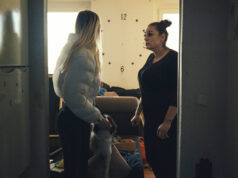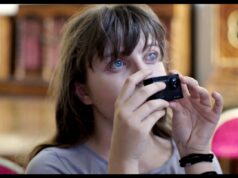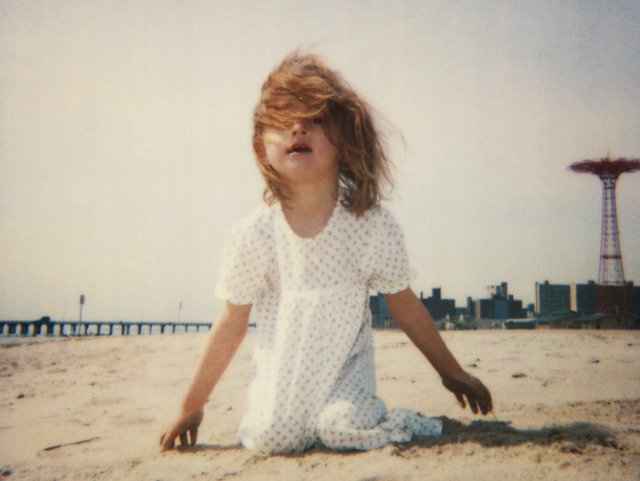
There was an inevitability to Claire Doyon’s decision to make a feature documentary about life with Pénélope (Pélo), her daughter with autism. Not that she was always planning to do so. The process of chronicling the lives of her daughter, herself and her family, itself worked as a form of therapy. “I never stopped filming because it was like a survival thing for me. It was my way of dealing with the situation,” she says.
But one day Doyon opened the wardrobe that contained somewhere near 300 hours of footage of Pélo, recorded onto DV tapes and Super 8 reels and shot over 18 years, and the enormity of the personal archive finally hit her. “My eyes almost popped out. These images had to be brought together,” says Doyon.
In the film, which won the Georges de Beauregard National and Renaud Victor Prizes at FIDMarseille 2021, we see Pénélope more or less from birth, but at the age of two and a half she shows signs of being different. “She regressed, she stopped relating,” the director narrates. “Spinning like a top, rubbing her eyes endlessly.”
A psychiatrist gives short shrift to Doyon who cannot understand her young child’s behaviour, eventually claiming that she had worked out immediately that Pélo had autism but she didn’t think that Doyon would be able to bear the news, thereby delaying by a year the parents’ progress.
When Pénélope was three and a half, her mother vowed to “save” her within three years, signing up for ABA (Adverse Behavioural Therapy) which promised a return to normal life for the child via a programme of rewards.
When this doesn’t work Doyon and husband Nicolas take their daughter to a centre that practises the Tomatis immersive method of replenishing myelin, a fat that protects neurons in the brain.
Pénélope is eventually diagnosed with Retts Syndrome, a condition which affects the central nervous system, entailing the severe loss of cognitive and motor skills and thereby explaining the child’s severe autism. But the parents are not to be deterred. Doyon decides to give up filmmaking to become her child’s “second body” and husband Nicolas gets a higher paid job to plug financial gaps.
But a trip to New York for more ABA treatment ends in disappointment, as does a later visit to a Mongolian shaman.
A visit to a shoe shop, we are told, resulted in the shopkeeper telling Doyon, ‘I don’t sell shoes to retards,’ after which Pénélope collapsed in the street. Which leads Doyon to remark in the film: “We have to accept the monsters [such as people with autism], venerate them. These remarkable, wild beings who frighten us, who tell us each instant that humanity is this, too.”
After the birth of another daughter, this time healthy, Doyon further expresses how “a miracle is when there is nothing wrong.”
And all the time we are led to the sad but necessary familial separation that opens the film, after Doyon’s realization that her life has “slipped through the cracks of this war,” and that she wanted to reclaim back her body.
“It’s really the story of separation,” Doyon underlines. “It’s a way to say that I have to live my life. And living with Pélo – it’s so engaging, it’s like your body doesn’t exist because she needs so much attention and so much care…she’s like a very big baby. And that’s it, it can drive one crazy, really…So all this dilemma, this tension of wanting the best and still being there for her, at the same time I realized that I really have to live my own life.”
Was Doyon reticent about making a documentary feature that was so intensely personal and revelatory? Yes, is her immediate answer.
“I was very frightened, not with my family or my husband, but very frightened with me,” she responds. “To go into this intimacy…I didn’t want to go there.”
She explains how earlier versions of the film had autistic people who would talk on behalf of Penelope (who herself doesn’t talk). But a change of tack was needed, especially after friends of Doyon observed how these versions didn’t reflect the severity of the experiences she suffered living with and treating Pénélope.
“When we watched the film and did the different steps of editing, it is like the film wanted me to go in this intimate place. And so I started to go there and it was not pleasant at all. I couldn’t find the right words [to] evoke the very difficult time of regression, and the anger I could feel at this time, because I was not in this state anymore. So I had to go back in some diaries and to find the words I had written.”
“You have to express what it is really like, otherwise the balance between the path I have to go through to find some kind of freedom doesn’t have weight or meaning if I don’t express also the terrible part of the history.”
Doyon is the founder of MAIA, a Paris-based experimental institute created in 2007, which currently hosts 24 children and adolescents with autism. The school promotes an experimental form of pedagogy, and she is responsible for innovative projects and initiatives for adults.
In her notes for the film Doyon articulates a key perception which informs her life and work. “Why do we ‘normopaths’ seek at all costs to make autistic people look like us?” she asks. “And what paths do we take to reach them? Despite the years, despite the road traveled and the reversals of the signs of affect, all this remains complicated. A small voice in the back of the mind stands alert: what if the miracle happened one day? That shows the persistence of the fantasy of normality.”
International sales for Pénélope My Love are handled by Lightdox.