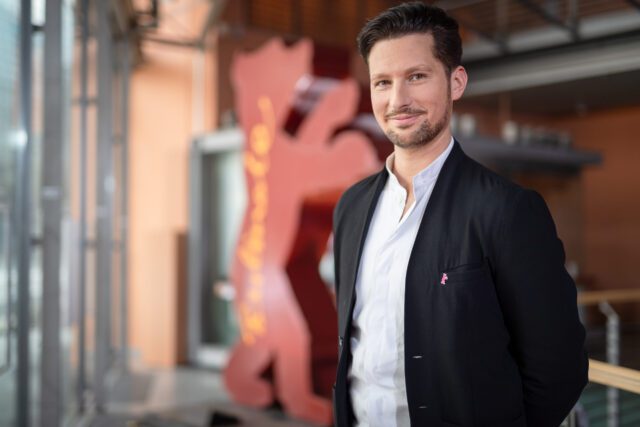
Dennis Ruh, Director of the European Film Market (c) EFM/Angela Regenbrecht
With no Doc Salon in 2022, Dennis Ruh, Director of the European Film Market, and Martina Valentina Baumgartner, EFM Documentary Coordinator, answer questions posed by Business Doc Europe about how they plan to tackle documentaries, the needs of doccers and all issues pertaining to the doc sector during the upcoming edition, running 10-17 February.
Business Doc Europe: The most obvious change (from a documentary perspective) is that there is no Doc Salon in 2022. Why is this, and what are the doc components that will replace it? Can you elaborate on these and the appeal of each? How will the mechanics of doc business be tackled? Will docfests be given a forum?
Dennis Ruh: I do understand that this change comes into focus from a documentary perspective, but it’s part of a general change of the EFM conference programme. We already introduced our joined conference programme, the EFM Industry Sessions, last year. This is a comprehensive programme and of course, we keep our offers for the large groups of participants with our programme strands: ‘Documentary’, ‘Series’, ‘Producers’ and ‘Distribution’. Under the main title “Shaping Change” we want to discuss the challenges facing the industry in times of digital transformation. In terms of topics, we set the core themes of ‘Future’, ‘Diversity & Inclusion’ and ‘Sustainable Development’, providing an editorial line. Nevertheless, our four programme strands each have their special fields regarding their characters which you will find represented in the EFM Industry Sessions programme. One attempt is also to give documentary topics a wider visibility amongst all groups of market participants.
Martina Baumgartner: Talking about Documentary components, we’ll find them in the established and remaining networking formats like Meet-the-Festivals and Doc Roundtables and in Panel Slots we have dedicated to Documentary themes. Furthermore, we plan to have the third edition of the Archive Day, due to the pandemic situation, to go online. It will be organised in an adapted version having one-on-ones with archives and experts. A brand-new offer the EFM has in store and we are excited having it for the first time: we are partnering with institutions from around the world and we will be hosting a series of Rough Cut Presentations, bringing to the market the latest documentary projects awaiting for festival premieres in the spring season.
Dennis Ruh: In addition, we continue with our EFM Doc Toolbox programme, which is supported by Creative Europe – Media and the Canada Media Fund for the first time and continuously supported by Goethe Institut, Téléfilm Canada, SODEC, HessenFilm and imagineNATIVE. It provides around 30 participants with a kit of transferable business know-how and connections under the guidance of a consultant and a coordinator. It is designed specifically to endow documentary creatives from marginalised and underrepresented groups with market intelligence, business tools and connections. Initiatives like this one reflect the EFM’s commitment to reach out to and welcome film professionals from the widest spectrum of backgrounds possible and to be a space where not only business is conducted but also community is formed.
Business Doc Europe: Is Doc Salon’s omission permanent or can we expect its return in 2023?
Dennis Ruh: It might reappear under a different name, but our aim for 2023 is, besides continuing with a joint conference programme, to provide a dedicated meeting space for the documentary community at the European Film Market. So I wouldn’t call it an omission, but a transformation, that continues to include most elements the community appreciated in the old form.
Martina Baumgartner: In the combined Industry Session Programme, as Dennis already mentioned, this transformation of course includes documentary dedicated components and will keep up the most important one – the networking – as well as providing communication platforms for the doc community. Unfortunately in this year’s EFM online format it is a less wide range than we would like to offer. For the next edition, with a physical component, we plan to integrate these offers.
Business Doc Europe: Berlinale/EFM is a cross-genre festival/market. Nevertheless, it is very important to the international doc community, even coming just a short while after IDFA and just before CPH and Visions du Reel. How do you describe the festival and market’s appeal to docmakers and doc producers?
Martina Baumgartner: Like every year the Berlinale Festival has a rich selection of documentary films in most of the sections, with increasing numbers, bringing the latest documentary gems to the big screens. We have been very much hoping for a physical market event and a reunion in Berlin where the doc community would have been able to meet again during documentary specials in our programme like the Doc Lunch, happy hours and in our dedicated doc working space. Under the given circumstances, we had to decide to move market activities and programmes online. For now we give our best to offer an effective and exciting online programme, and are very happy to welcome many experts from the documentary field to enrich the EFM and our networking formats this year. Within the 25 open talk formats of the new EFM Industry Sessions we will offer documentary dedicated sessions and the very essential networking formats like the already mentioned ones.
Business Doc Europe: Documentary is in the ascendant at the moment. How is this reflected in terms of numbers of docs selected for EFM? Are all festival docs selected for EFM?
Martina Baumgartner: Yes, the ascendance of documentary is very visible in the numbers of docs registered for the EFM. As of today – and there is still movement – a quarter of all films (shorts excluded) submitted for market screenings at the EFM are documentaries! This is an impressive number! Yet in the last five years the market for documentary films has never been bigger with renewed box office interest and surging streaming demand which finally reflects the importance of documentary films in the industry.
Business Doc Europe: Berlin is also a great time to catch up on German documentaries. How do you assess the German documentary scene at the moment in terms of its strengths and offer to local and international audiences? Conversely, what difficulties does the German doc sector face?
Dennis Ruh: Based on my previous experience stemming from my work at German Films, I always like to keep an eye on German documentaries.The German documentary scene reflects a trend seen globally – documentary is constantly on the rise, but also Germany looks at a long documentary tradition. Right now, it’s great to see that besides theatrical projects Germany is also producing a lot of TV documentaries and also doc series for streamers, and, additionally, that German documentaries and co-productions have a high level of theatrical releases on a national and international level.
When it comes to difficulties, financing comes to mind. There tend to be fewer TV slots for feature length documentaries, and many projects are underfinanced. There were also problems with theatrical releases during and after Covid – marketing and promotion of documentaries in the cinemas lack funds. Further, audience numbers are not yet back to their pre-Covid shape, and we have too many documentaries aiming for a screen in the cinema, so for the future we should ask if the funding system for documentaries needs some reconsideration.
Business Doc Europe: Personally, I am very disappointed not to be attending Berlin and EFM, but my disappointment must be as nothing compared to yours, and your accompanying sense of frustration. How do you manage to convince professionals of the appeal of an online EFM as they look to conduct their business (whether doc or otherwise).
Dennis Ruh: Moving the market online this year was a very difficult decision we had to make. I understand your disappointment, but there was no way of creating a satisfying trade fair with thousands of market participants gathering in a high frequency of face-to-face encounters. This differs a lot from cinema screenings. So, we will make the best of the situation and focus on the online offers. We are confident to offer most of the festival-selected films in the form of online market screenings and will create a high-profile conference program, online networking, one-on-ones etc.
As you know, the EFM was held entirely online last year, when it welcomed up to 12,000 daily participants. Numerous sales announcements of current films and projects reaffirmed the key significance as the first film market of the year, even in the enforced digital form. We saw that the online offer we made was highly appreciated. But of course, we look forward to holding the EFM in 2023 again together with the festival as an in-person event.
Business Doc Europe: Please add any other doc-related comments which you feel may be pertinent.
Martina Baumgartner: I would like to point out one of our Doc-talks which is embedded in the 25 open talk formats within the EFM Industry Sessions. Under the title “The Truth Will Out: Potential + Problems for Documentary Films” it will be discussing among others that Documentary films are more popular than ever at the box office, and streaming services increase their programme of non-fiction storytelling. Also new models of distribution offer new opportunities for documentary producers and directors to bring their true stories to audience worldwide. Besides that there is an increasing discussion about objective and subjective “truth”, about what should and shouldn’t be allowed in non-fiction, which I think is an important debate to follow.