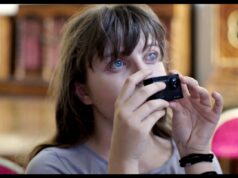
Jessica Beshir (whose Harar-set documentary Faya Dayi is on the shortlist for the year’s Best Documentary Oscar) may have been born in Mexico but her father is Ethiopian. When she was around two years old, he decided to go back to Ethiopia which had just been invaded. “There was a call for anyone in the diaspora to come back to help. My father was a surgeon at the time…he decided to go back and we joined him.” She therefore grew up in Harar, she underlines.
Faya Dayi premiered in Sundance last year and has gone on to be picked up for distribution by Janus in the US and MUBI has the UK, Latin America and several other territories. (Cinetic is handling world sales).
Shot in black and white, the documentary explores the role that the addictive plant khat plays in Ethiopian society.
“In the beginning, when I decided to make this film, I was shooting mostly anyone that could talk to me about how they felt about khat. I was mostly interested in how this had become a cash crop.”
Khat had played a huge role in Ethiopian history and culture but now (Beshir discovered) it was being commodified. “The meaning this plant had, which had existed for centuries, it was completely morphing in front of our eyes. It was being separated from its spiritual roots,” she explains. “[Consuming] it had become a pastime, completely devoid of those anchoring ideas, those anchoring emotions.”
At first, the filmmaker spent much of her time interviewing farmers, gathering information. She began to think more precisely about the effect that khat has on every level within Ethiopian society, from the personal to the political. The drug, she realised, offers an immediate sense of relief and escape for a beleaguered people. “It calms your soul. If you’re going through persecution, if you’re going through frustration due to the fact that there are not a lot of opportunities, especially for young people…when they are chewing, they are being relieved of all of those incredibly stressful concerns.”
The director talks of the “explosion of colour” in day to day life in Harar in the way people dress and in the walls of the city. However, she eventually decided to present the film in black and white. Her reasons for doing so were not aesthetic, although the documentary is exquisitely shot. She was trying to convey the monochrome heaviness and “the incredible sense of disappointment” felt by young Ethiopians about their lack of opportunity and to hint at the political darkness in the country.
“Also, I am talking about how addiction is affecting the social fabric, creating separation and how it is affecting the children.”
Whenever Beshir was shooting, she would be surrounded by kids who were curious about what she was doing. Over the years, she saw them grow up and she heard their stories. One of those kids was Mohammed Arif, who becomes a key protagonist in the documentary. He yearns to escape and is increasingly perturbed by his father’s addiction to khat.
When she began work on the documentary, Beshir was completely on her own, she says. She didn’t have financing or backers. At first, she thought she would shoot some material, drum up interest and then bring on board collaborators she needed. That, though, wasn’t how it happened. “The years were going by. I was researching a lot, shooting in the meantime and the producers were not coming. The very few that I met, they really had their own ideas…for me, this film is a whole prayer. Slowly, I began to realise the producer I was hoping for was not going to come and money to hire a DOP was not going to come.”
In the end, the director took on both roles herself. She shot the movie and pulled together the financing. This was ultimately “liberating.” It meant she could concentrate on making the documentary on her own terms rather than trying to attract backers.
“I say it was ‘liberating’ even though it was very difficult to finance this for pretty much eight years,”
she reflects ruefully on her struggles to complete the project. She would return to Ethiopia every year with the tiny amount of money she had managed to pull together, keeping the project on the rails that way. Late on, she received backing from, among others, The Jerome Foundation, Sundance, the Doha Film Institute and The Flies Collective.
As an artist, Beshir straddles three different cultures. She is based in New York but was born in Mexico and has roots in Ethiopia.
“I am Ethiopian and my childhood belongs there. Also, I am Mexican because that is the country that gave us refuge when we needed it and that my mother is from. That is where I finished high school. I’m very rooted in both cultures.”
No, Beshir hasn’t been back to Ethiopia since March 2020, and so hasn’t been able to show the film there in person. Covid and a civil war have made it almost impossible to travel. “I would love to go back as soon as possible,” she sighs. “I’m not sure where this predicament is going to end.”