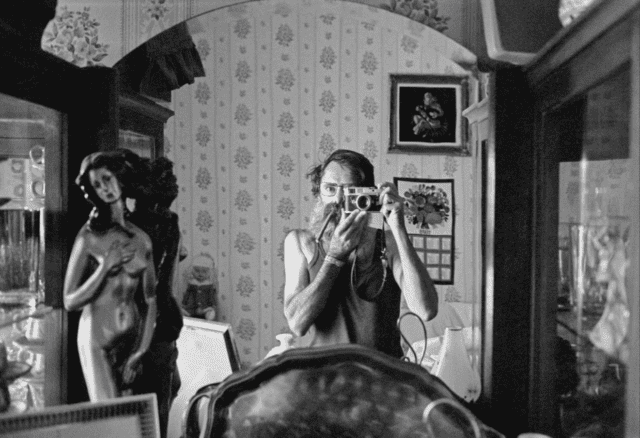
Israeli photographer Micha Bar-Am is now in his early 90s. Thanks to his advanced age and the difficulty of travelling in the pandemic era in the middle of winter, he wasn’t able make it to Berlin (the city in which he was born in 1930) for the festival premiere of Ran Tal’s new film about him, 1341 Frames Of Love And War [which world premieres February 13 as a Berlinale Special].
Nonetheless, director Tal feels the Berlinale is the perfect setting in which to launch the film. Bar-Am’s family lived in Germany for many generations. He saw himself as a German boy. His son lives there today.
“Micha actually grew up a few miles from the place where the film will be shown [in Berlin]. It is very exciting to close the circle for him and for me. I really want to open it in Berlin. It is natural for the film,” the director explains to BDE.
A few years ago, Tal went to see Bar-Am’s huge, decades-spanning archive which the photographer keeps in his basement in his home a 25-minute drive from Tel Aviv. The filmmaker was astounded by the richness of the images he encountered. Not only were they outstanding photographs in their own right but, together, they provided a pathway through Israeli history.
Bar-Am had been everywhere with his camera: in the front line at the Six Day War and Yom Kippur War, in the crowd at the Adolf Eichmann trial, at the massacre of Sabra and Chatila. He had taken photographs of everyone from the humblest soldiers to the most revered political leaders of the day.
“This was a great opportunity for me to deal with this question of the role of the witness,” Tal suggests of his portrait of one of the great chroniclers of 20th Century Israeli history.
There is an obvious tension in the film. The eye and drive which make Bar-Am such an exceptional photographer continually get in the way of his role as husband and father. He always puts the work first. Capturing the most vital images becomes a compulsion for him.
“I think Orna his wife describes it very well. It’s a kind of phenomenon for many artists who devoted their lives to their work. They’re totally in the work of the art, not the family,” Tal reflects. An added complication was the nature of much of Bar-Am’s work. He was witnessing, close-up, extreme violence and suffering. That can’t have helped but take a severe psychological toll on him. When they look over their memories, Micha and Orna therefore sometimes have to peer back into the abyss.
Tal is at pains to explain that 1341 Frames is “not just a film about Micha; it’s a film about archive.” The director had many other potential images at his disposal. He says he could easily “have picked another 1000 frames.” The options were endless. He knew from the outset, though, that he would use Micha’s images to tell his story. He was never going to make a talking heads film. The photographs needed to be at the heart of the work.
“I felt that this was the right way to create some unique experience for the viewer. I wanted you as a viewer to stick to Micha’s mind when he was there, when he framed the reality and freezed it for one second. Then, if we stick to the frame, maybe we will be able to listen, understand and experience what he went through much, much better.”
Viewers, the director continues, have their freedom to make their own “connections between the sound and the image” and to marvel at the “genius” with which the photographer could create a story with a single image, “in less than a second.”
Bar-Am and his family welcomed the idea of the documentary. “They opened the archive completely for me. I spent two years of constant conversation with them – with Micha, Orna and the sons. I was very welcome. They were very, very happy to see me.” The director also talks of the “endless amount of effort” he put into the film.
There’s a famous quote from Robert Capa: “if your photographs aren’t good enough, you weren’t close enough.” Bar-Am was almost always very close indeed. In war situations, he was brave and intuitive in ensuring he was in the best position to get the picture he wanted. He also knew just how to charm and cajole his subjects so they would open up to him. As he realised early on, access was crucial.
“You need to make people trust you. This was a gift you had to have,” Tal says. “He was so great because he had such an enormous passion about photography – to catch the best frame even if it is in the front line, even if he can die.”
After 50 years, that passion subsided. These days, Bar-Am takes very few photographs and will only use his camera for family occasions.
Yes, Tal suggests, as a documentary maker, he has learned lessons from his subject’s example. The main one is to take risks. “Micha took extraordinary risks in his career. This is one of the keys to his success. He went there alone, by himself, and took physical risks in many areas – and enjoyed that! I think the sense of adventure…this is why he takes a picture,” Tal observes. “He is a great inspiration for me definitely.”
In June, there will be an exhibition in Tel-Aviv to accompany the documentary. Tal hopes this will later travel around the world. “The film will have a life in the theatre, on the television and in the museum,” he says of the likely journey of 1341 Frames Of Love And War.
Reservoir Docs is handling world sales for the film.