Like so many documentaries made over the past few years, the spectre of Covid hangs over Constantin Wulff’s For the Many: The Vienna Chamber of Labour. But in this instance it actually helps to reinforce the good works and compassionate intent of the Chamber of Labour (AK), as this official legal representative for employees acts as the daily point of contact for people who are fighting for their rights within the workplace.
Shot using the Direct Cinema method of filmmaking, the film originally set out to show how the Austrian Chamber of Labour (Arbeiterkammer – AK) functions, how it interacts with the people using its services but also how it operates as an employer itself. All this was to be set against the backdrop of the AK preparing for its centenary in 2020 – but as Covid started to have an impact around the world, the film also became a process of self-reflection.
Established 1920, the Chamber of Labour is a unique institution. In Austria, as soon as you enter an employment relationship you become, by law, a member of the AK. As an independent organisation, the AK offers consulting services and represents working people’s interest. There is an AK for each of Austria’s nine federal states, the largest of which is situated in the capital, Vienna, where some 700 people are employed.
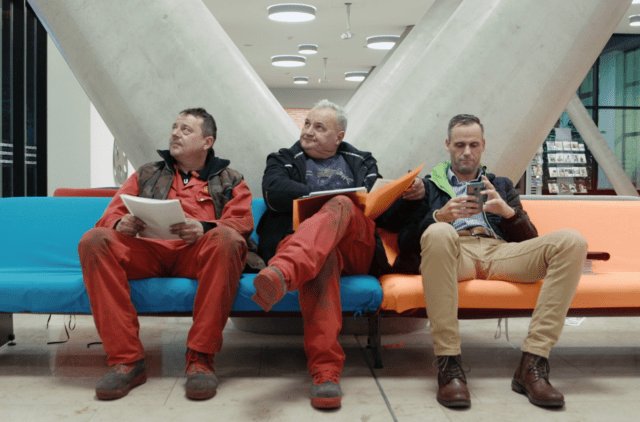
In classic observational style, the film opens with footage of people queuing up to get an appointment with an advisor to discuss their various issues. The Vienna waiting rooms are clean and ordered – more like an airport departure lounge than an employment rights institution – and both workers seeking advice and the AK staff are polite and good natured.
The AK provides a wide range of services to its members, such as providing information about diverse issues (labour law, social insurance, tax law, women’s and family policy, worker protection etc), participating in the legislative process by drafting laws or amendments (and accompanying their implementation), and conducting research on the myriad issues facing workers.
The film observes all kinds of interactions – from a group of men who have not been paid for five months and a delivery driver who has never received a pay slip, through to a young woman worried she might be sacked from a job as a bike mechanic, and a man on a €100,000 contract who has been asked to sign a termination contract.
At an event to help celebrate 100 years of AK, the waiting room seats are given new covers and staff gather to share an anniversary drink. In another scene, senior staff look at the trailer for a short film designed to commemorate the event. Part of the footage sees a young woman put upon by bosses, and eventually joining with others to help stop autocratic superiors.
As Covid arrives, the Chamber of Labour has to respond quickly and efficiently in the interests both of those who need desperately to make use of its services and also in terms of how best to create an environment for its staff to work in safety. As one senior staff member says: “We need to position the AK as a counselling institution in times of crisis – if we perform well now then people will trust us even more in times of peace.”
Though Covid had an immediate impact on the intended structure of the film, writer/director Constantin Wulff noted how this also reflected the core tenet of Direct Cinema. He says: “The concept changed as a result (of Covid): the plan to portray an institution with several weeks filming turned into a much longer process of observation. In hindsight, I’m still ambivalent about the whole thing, because everyday life in the Chamber of Labour was transformed at a stroke, and a lot of what I wanted to film simply wasn’t happening any longer. On the other hand, of course, it was also fascinating to see how the institution behaved during the crisis.”
Despite this change of direction in the AK story, what shines through is just how lucky Austrians are to have such compassionate and dedicated institution. Every day, scores of people seek help with issues of concern to them and the Chamber of Labour is there as a point of contact for people who need to have their rights protected within the workplace.
Austria, 2022, 120mins
Dir/scr Constantin Wulff
Production Navigator Film Production
International sales Cercamon
Producers Johannes Holzhausen, Johannes Rosenberger, Constantin Wulff
Cinematography Johannes Hammel, Michael Schindegger
Editor Dieter Pichler