(Pic courtesy of GFF)
“I guess I have had a kind of meandering life. I haven’t really been able to follow the ABCD route through things,” Scottish filmmaker Lizzie MacKenzie tries to make sense to BDE of the somewhat random circumstances which eventually led to her making her feature documentary The Hermit of Treig, a world premiere at the Glasgow Film Festival 2022.
MacKenzie grew up on the Island of Seil, near Oban, off Scotland’s west coast, but has travelled very widely.
“I have worked with horses quite a lot, in different countries – training horses and taking people on horse trips in wild places,” she says, listing the many different places to which she has travelled, Wales, Italy, Nepal and the US among them. She briefly attended Edinburgh University, studying environmental science, but left after six months. “I think I was too restless…maybe it would be different now, but, at the time, I was far too restless. I couldn’t sit still for very long. I was always following one curiosity after another. The academic structure of education doesn’t suit my brain, I would say,” she explains why she left her course.
Nor did she stay long in Edinburgh. “Growing up on Seil, I didn’t really enjoy city life. I enjoyed it momentarily but I was always trying to think of ways of being able to go and live somewhere more rurally.”
One of MacKenzie’s next ventures was running the Corrour Station House Restaurant – famous as the UK’s most remote restaurant. She and her boyfriend at the time (to chef Ollie Bennett) had seen an advertisement placed in a newspaper by the owners of the property (located in the Highlands, miles from anywhere), looking for someone to turn it into a viable business.
“We came up with the idea of a destination restaurant and just went for it.”
The restaurant was a roaring success – but that was the problem. She and her boyfriend were overseeing the business on their own. “We were run ragged,” MacKenzie says. “For me, moving up there, I had imagined I’d have lots of time to go out and explore, climb all the hills and so on.” Instead, the work was relentless.
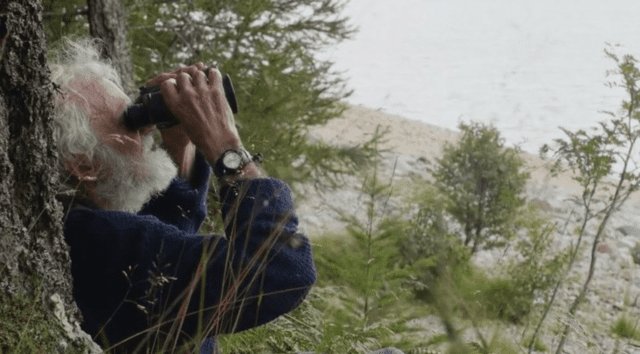
Nonetheless, this was the period when MacKenzie first met Ken Smith, the celebrated hermit who is the subject of her documentary. From Derbyshire originally, Smith has spent four decades living on his own in a log cabin in the Highlands.
“Deer stalkers from the area would come and sit in the bar in the evening and just tell stories about this old man.” She was immediately fascinated. ”You hear about people like that in Alaska or Canada but I just didn’t imagine anybody in Scotland doing that.”
Ken’s cabin was a two hour hike from the restaurant. One day, MacKenzie made the journey to meet him, turning up on his doorstep with a fishing rod in hand.
That was around a decade ago. Her first impression of him? “I was so amazed by his sparkly eyes. He was living a life most people would consider poverty and yet he had this complete youthful energy, joie de vivre – just a spring in his step and a sparkle in his eye that you so rarely see in older people. You see it in children, that wonder and awe. I feel like people lose that so easily when they grow up.”
Smith may have lived for 40 years in the same spot but he was still very curious about the outside world. He was an excellent fisherman and wildlife photographer. A keen diarist with a strong work ethic, he wasn’t a misanthrope, hiding in the woods. Years before, he had suffered a brain haemorrhage from which he hadn’t been expected to make a full recovery. He defied the doctors but, from then on, was determined to live on his own terms.
“He was someone who had various difficult things go on in his life and he retreated from the world, retreated into his shell for a long time. Then, (he) re-emerged and was ready to share what he learned with the world…he’s happy on his own but he is also happy with other people, just a really contented soul. Everything, the good and the bad, he just takes it in his stride. He is living the life that is meant for him.”
Over the years, MacKenzie became close friends with her subject whom she sees as a kindred spirit.
The filmmaking was “a very gentle and organic” process. “When I first met him, I thought, god, someone needs to make film about this guy,” the director remembers. At that stage, she wasn’t actually a filmmaker herself. Nonetheless, she digitised Smith’s photographs, read his dairies and started recording his stories. She also later began learning the filmmaking craft, working as an intern with director Amy Hardie.
At first, MacKenzie was aiming for a fly on the wall, verité-style approach for The Hermit in which she would be invisible. “It was so hard because we are friends and because of his vulnerability. There were so many times where I felt I had to come out from behind the camera. So, when we started the editing process, we first of all tried to edit it objectively but I think the editors were just really moved by our moments of interaction,” the director explains why she features prominently in the film herself.
In 2019, MacKenzie received support from ScreenSkills for a three minute short on Smith. She paired up with producer Naomi Spiro of Aruna Productions. (They met when they shared a car together to Sheffield DocFest). BBC Scotland came on board (a shorter version of the film was shown on the channel late last year). MacKenzie later secured support from The Whickers (the organisation set up with the legacy of legendary broadcaster, Alan Whicker). Creative Scotland and BFI Doc Society were also backers of the feature.
Ken Smith may have seemed too frail to attend the Glasgow premiere but he delighted audiences with a surprise appearance. “He loved it. He would have been a filmmaker in another life if he had had the chance,”
Cosmic Cat will be handling the UK distribution of The Hermit of Treig. The film has been chosen for The Camera Is Ours, a prestigious BFI Southbank season in London in March celebrating Britain’s women documentary makers from the 1930s to then present day.
An international sales agent is yet to be appointed.