

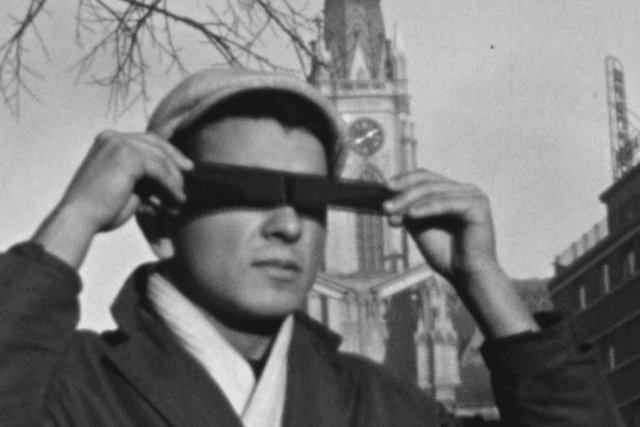
For just about everybody in the ‘zone of totality’ on August 11 1999, the eclipse was strange, joyous and magical. But not in Serbia, tells Nataša Urban, where an official warning was put out claiming that solar radiation during the event was even more deadly than normal, and so the shutters came down and the streets were emptied. Therefore the eclipse went largely unobserved.
For Urban this response was telling. “I use this surreal event as a metaphor for Serbia’s avoidance of its wartime past and responsibilities. People, locked in their apartments, hid from the lunar shadow behind thick curtains, cowering before their involvement in the horrors of the ‘90s in the former Yugoslavia. It represents the unclean conscience of a nation about the consequences of its political choices,” she says in her notes for the film.
It was thinking about the 1999 eclipse which triggered Urban’s memories of the war and its associated atrocities, and which determined her to make her documentary. In the films she returns to Serbia, having settled in Norway in 2010, to revisit her past, and in the process interview her immediate family, including parents, grandparents, aunt and brother, and close friends with whom she grew up. The interviews and recollections span the wars in Croatia, Bosnia and Kosovo, all of which were prosecuted by Serb president Milosevic and his paramilitary forces.
As we see, the process isn’t always comfortable, especially for her parents. “We’re all trying to forget, but you’re now reviving the memory,” says her mother at the beginning of the film. Her father, meanwhile, claims to have no idea of the number of Bosnian Muslims murdered at Srebrenica, which, at 8,000, is a number very much in the public domain. There are no accusations of blame by the filmmaker, as her father is an urbane and good man, rather his response seems a psychological need to compartmentalize the past.
“That’s his way of dealing with it,” Urban tells BDE. “We all have a tendency to shut out things. He just doesn’t want to go into that. He’s protecting himself…He can’t change what happened and what would he gain by going into that and suffering when nothing will be gained? But I think those processes within us are very important.”
Even the smaller acts of localised violence recalled in the film have a powerful resonance. Urban tells of the “big man with messy hair” and a rifle, who “guns down” street dogs while children play on the pavement. Her favourite aunt (Branislava) tells how, when she was a child of five, she was beaten on the head, propelling her face into a bowl of hot soup, after she played ‘horses’ with her friends.
Urban’s grandmothers go even further back in time, remembering how the partisans assassinated Germans in their yard during the Second World War, and how a human head was used as a football.
But the bulk of the film, produced by Norwegian Ingvil Giske for Medieoperatørene and competing in DOX:Award Competition, is comprised of recollections from the 1990s, in which Serb paramilitary forces ran roughshod over its neighbours. Even the Serbian Orthodox Church were culpable, Urban’s film argues, in the establishment’s advocating how ‘wherever there are Serbian graves, there should be Serbian land.’
The recollections are recreated using new and old Super 8 film stock (scratchy and grainy, and some of which is half a century old) to give an impression of the past and to mimic the process of remembering, Urban points out. Faded images represent half-forgotten episodes while a total black-out echoes the suppression of memory.
After having turned to filmmaking in 2005, Urban left for a new life in Norway 11 years ago. She admits that the process of revisiting her past for this film took its toll. “I knew the whole process of making this film was going to be very difficult, but I couldn’t imagine that it was gonna be this difficult,” she admits. “I totally fell apart. Absolutely, like I’ve never done in my life. I was clinically depressed and developed anxiety disorder and PTSD. So my whole sense of safety was totally off for about a year out of the two and a half that I’ve been actively making the film. I’m out of it since May last year, but it’s something that I’ve never experienced before.”
“My close family and friends are the driving force of the film,” Urban adds in her film notes. “We dig into our memories, confronting the demons of our wartime past, exposing the evil that our country perpetrated on our behalf. Together we provide a picture of our wartime reality in the ‘90s. How did a modern society slip into a society governed by nationalism? How can you fight for truth and what is right when the whole society is turned upside down? What can you do and did we do enough?”
The Eclipse is therefore very much an anti-war document, she underlines of its poignancy and contemporary relevance. “The recurring solar eclipse, and the break-up of Yugoslavia, warn us that the post-war European peace is an illusion, that our violent history can be used to sow the seeds for new carnage and war. But how do we stop this vicious cycle? One of the ways is to look to compassion, shame, guilt, and responsibility. Hope lives in an open and honest communication. I hope this film will contribute towards that.”
Sales for The Eclipse are handled by Taskovski Films.





